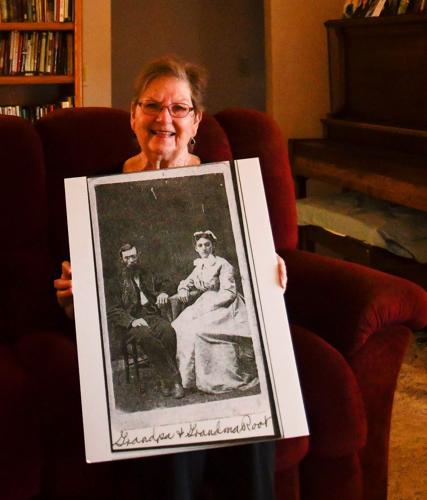
Local author Doris Smith holds a portrait of her grandparents, Amos and Hannah Root, the subject of her book "Rooted." The two were pioneers of Mosier and the book includes photos, clippings and family memoirs.
Amos and Hannah Root are the subject of local author Doris Smith's book "Rooted." The two were pioneers of Mosier and the book includes photos, clippings and family memoirs.
Local author Doris Smith holds a portrait of her grandparents, Amos and Hannah Root, the subject of her book "Rooted." The two were pioneers of Mosier and the book includes photos, clippings and family memoirs.
MOSIER — After a decade of staring at microfilm, Doris Smith’s pride and interest in her pioneer ancestors resulted in a family chronicle set in Mosier’s early years.
“She was a mover and a shaker,” Smith said of her great-grandmother Hannah Root, the book’s protagonist. Root was the first Mosier woman to cast a ballot when Oregon removed the word “male” from its voting legislation in 1912, allowing many women, depending on their race and citizenship status, to vote.
The story opens with the Roots’ deaths on a Sunday in 1923, at the hands of Amos — who suffered from dementia and, Smith theorizes, unwilling to leave his wife to live alone — before recounting their eventful lives. “Rooted: The Lives of Amos and Hannah Root, Pioneers of Mosier, Oregon,” is a story in the form of news clippings, photos and family memoirs. All in one flow of text; Smith dislikes the complications of footnotes.
“I’m very tied to Mosier, because I have ancestors that have been there since 1878,” she said. “I’ve got five generations buried in the Mosier cemetery.”
After spending the later part of her childhood in Mosier, Smith lived with her husband in eastern Oregon, including 30 years on a ranch in Ontario, Ore. After selling the ranch, they lived in Yakima for seven years to be closer to grandkids before following the lure of home to The Dalles in 2015.
Amos and Hannah Root are the subject of local author Doris Smith's book "Rooted." The two were pioneers of Mosier and the book includes photos, clippings and family memoirs.
Contributed photo
“Over the years, I’ve written little short stories about things that happened in my life and done a little poetry and stuff. And so I thought, when I retire, I’m gonna focus on this a little bit,” Smith said.
Her first project: A chronicle of the Evans’ side of Smith’s ancestry, “I Am All A Lone.” A lonely quote from the journal of Mary Evans made the title. “[Mary] was a homebody and sort of shy, I think, and her husband was a social butterfly,” Smith explained. Based Evans’s journal, it was published by Columbia Gorge Discovery Center in 2010.
That done, Smith switched to researching the Root side of the family — which took a decade.
“I had some family information, not a lot,” she admitted. “I got many of the old family pictures ... Then I started spending days at the library, looking at microfilm for the historic newspapers.” Microfilm, handling delicate ancient newsprint, the trials of photocopy machines — “That’s the only way I know, on a weekly or monthly basis, what this family was doing,” Smith said. “Although this started out being a family book, it ended up having a lot of Mosier history in it.”
It was hard work. “I mean, my eyeballs were sucked out on the [microfilm] machine,” she chuckled. “But I was so glad to find that information.”
Other Root family contributed, passing on information and old photos and genealogy facts. “I have many, many questions to ask people who are no longer here,” Smith said. “I wish all of my ancestors had written some stuff down!”
COVID-19 interrupted the search for a publisher, just as Smith completed her work, and “Rooted” was published in 2022 with little fanfare.
Smith knows Hannah’s stories by heart and is proud of her “hardy pioneer” heritage, itemizing the trouble and persecution she believes they encountered as they settled, providing for their families and “honoring God in their time and possessions.”
Eloping with Amos Root, who was 17 years older, Hannah Root came west with her husband on the Intercontinental railroad in 1871. Finding San Francisco not to their taste, the couple took a steamer to Portland, following rumors of good farmland to Willamette Valley. The rain proved too much. They crossed the Cascades to clearer skies, settling in Madras County.
“They had 1,000 head of sheep and took care of them out in the boonies,” Smith marveled. Then “a neighbor came and said, ‘The Indians are having an uprising, you need to run for your life.’” The Roots and their three kids headed for Mosier, sold their sheep for a dollar a head, founded a farm, and settled for good, enlivening the social columns of the local papers for Smith.
“I wanted the family in later years to be able to go, ‘Oh, here’s where we came from,’” Smith said. “... Even if nobody else read this, I just fascinated with ... what I found out.” Smith’s still studying Mosier history, planning her next work — perhaps untold stories from the local cemetery.
“Rooted” is available at Klindt’s, Waucoma, or online.



Commented