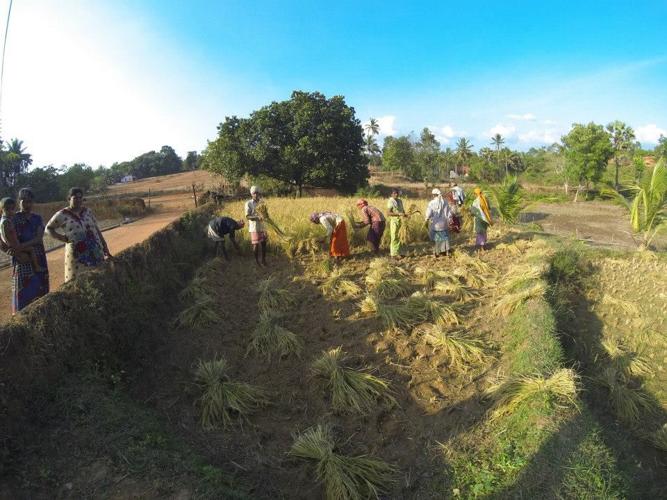
Villagers harvest wheat while Donohue and others in the team observe “to get an idea of the process before attempting to find a less energy- and time-intensive solution.”
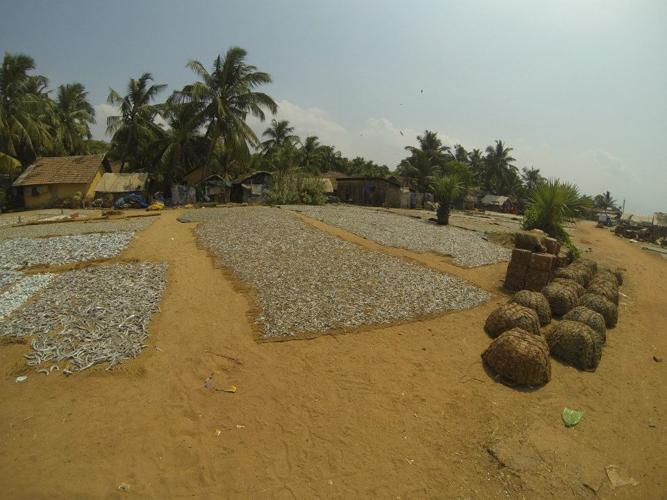
Villagers use large mats to dry fish, which led the Selco team to build a solar food dryer for the fishing union to make the process more sanitary and effective.
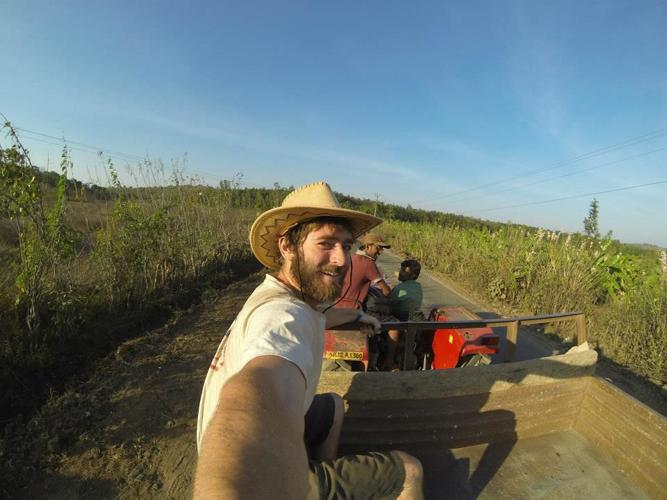
Kyle Donohue and a coworker hitchhiking to a farm the Selco team needed to visit.
Photos by Kyle Donohue
Villagers harvest wheat while Donohue and others in the team observe “to get an idea of the process before attempting to find a less energy- and time-intensive solution.”
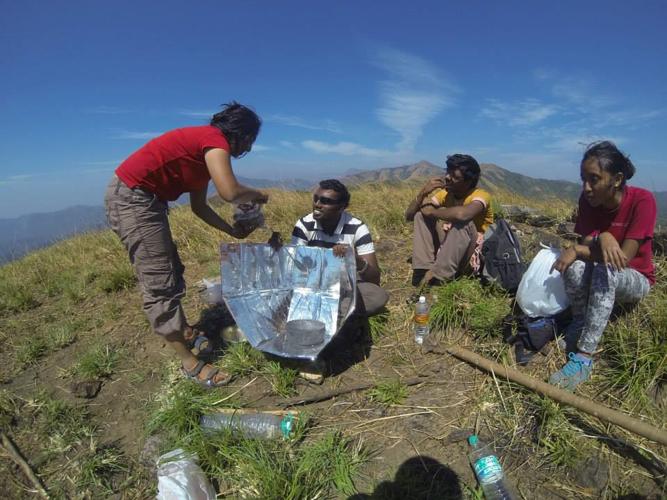
A team-member demonstrates a solar cooker the team designed.
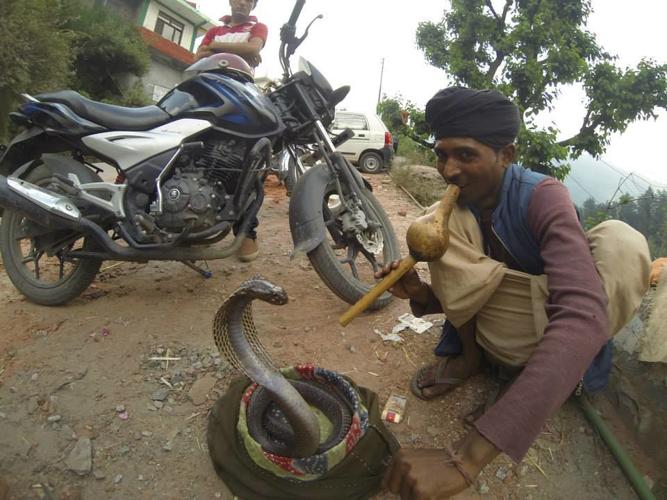
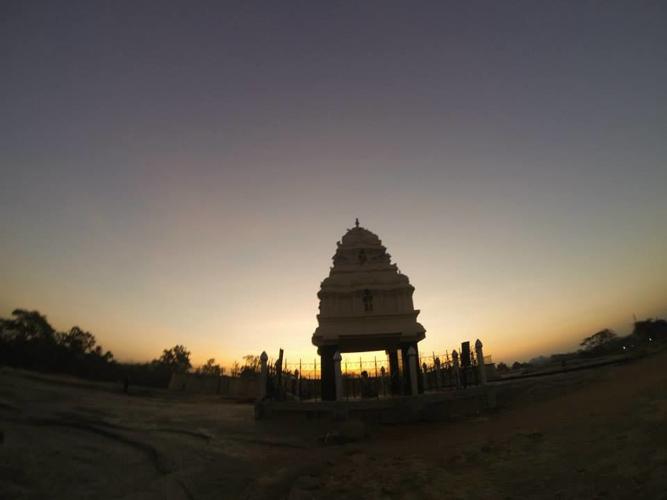
One of many Hindu temples around Ujire, and local snake charmer with cobra Donohue often saw on the side of the road.
Temple
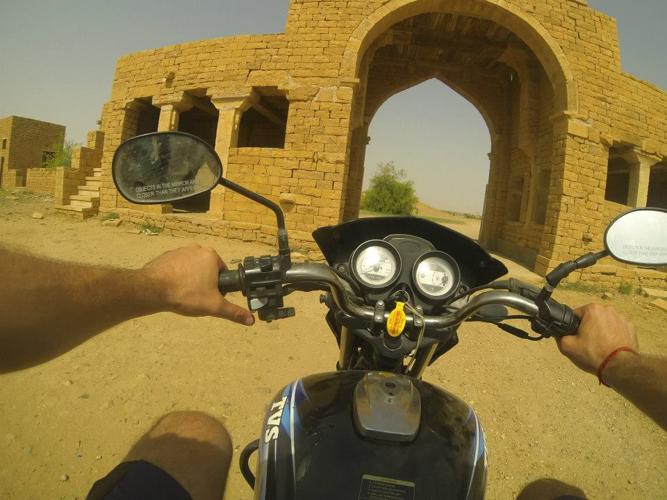
TYPICAL view over handlebars of a motorbike, a common mode of transport.
Villagers use large mats to dry fish, which led the Selco team to build a solar food dryer for the fishing union to make the process more sanitary and effective.
“Ujire?” I asked the bus driver for the 15th time, butchering the name of the village I would be calling home for the foreseeable future. He shook his head and I turned sideways to allow an old woman to squeeze past, the chicken she cradled announced her presence before she had a chance to shoo me aside. The woman managed to find space next to two boys on their way to cricket practice, three of them crammed into a seat that would barely fit one person here. She gripped her precious chicken while it squawked and squirmed to her neighbor’s ambivalence. Now that it was halfway down the bus, the racket it created was hardly noticeable over the cacophony of the mid-afternoon journey. After 10 more minutes of hairpin turns, cow dodging, and motorbikes flying by, the driver slammed on the brakes. With a horrendous squeal the bus stopped and I wearily asked again if I had reached my home. To my surprise the driver nodded and gestured to the door with a smile.
Two hours and about 20 miles after we had departed from Mangalore, I stepped onto the dirt street and let my senses make sense of themselves. My nose was overwhelmed by a combination of curry, diesel, burning garbage, and livestock with just a hint of rotting animal tossed in. My ears were greeted with the ceaseless honking of the minimal traffic: an old compact car, a beat-up motorbike, no matter the vehicle or the speed the horn was constantly blaring at animals and people alike. “I’M HEEEEERRRREEE” they all shouted, doing their best to make themselves feel significant in a country of over a billion people. Once the locals started to realize I was in fact not a gigantic albino Indian, the many tuk-tuk drivers ran up to me asking in varying degrees of broken English where I wanted to go. I rejected them all politely, telling them I could walk and proceeded to ask the rapidly growing crowd if anyone knew where Selco was. There were only two streets, the one the bus had come and left on and another running perpendicular, yet none of the hundreds of people watching me wander aimlessly saying “Selco?” seemed to be expecting me or knew what to do with me.
•
My communication with my new employers had been minimal. Once I had accepted the job and secured my visa, they told me to go the the Selco Foundation in the village of Ujire (located between the coastal city of Mangalore and south central city of Bangalore, near the southern end of the subcontinent). My reply: “Great! See you there!” It didn’t take long to find a bus to the station from the Mangalore airport and after a quick samosa snack, I only had to ask four or five people, get funny looks, and write the town name down on a piece of paper before I was directed to the correct bus. My plan upon arrival was to do the same thing, either keep asking people until someone knew where Selco was, or wander around until someone thought, “Oh look, a confused foreigner, there’s only one place he’d be going.” In reality, no one seemed to have a clue what I was doing but they were happy to pause their lazy afternoon activities to watch me get progressively sweatier in the stifling South Indian summer.
On my fourth lap of the main street, the locals were losing interest now that I seemed to be too preoccupied to pose for pictures or make faces at babies. I sought shelter in a building that referred to itself as a travel agency and heaved my horribly sweaty carcass through the door. My frame blocking the fan was the only thing that woke the shopkeeper from his nap on the floor behind the desk. He took his time rubbing the sleep out of his eyes and dragged himself to his office chair.
“Do you think I could use the Internet?” I asked enunciating every word and punctuating the question with an exaggerated gesture towards the computer.
“Internet doesn’t work in Ujire today,” he responded, finally giving me the correct pronunciation of my home (oo-je-re).
“Do you know Selco Engineering?” I asked hopefully.
He bobbled his head back and forth, “SDMIT? The engineering college?”
“Hmmm, I don’t think so but they might know where Selco is. Can I walk there?”
“Maybe 20 minutes by walking, better I take you by bike,” with that he stood up and led me out the door before I could politely reject his offer. He jumped on his 140cc Pulsar followed by me and my backpack.
“Don’t worry, one of my friends is very fat, I drive him no problem,” he reassured me with a smile, showing me the few teeth he still possessed. I grabbed the bike just in time as he gave the horn a furious honk, pulling onto the empty road.
Once at SDMIT it was only another 10 minutes of aimlessly wandering the odd campus, one beautiful brand new building up on the hill and a handful of dilapidated living quarters below, before someone finally knew what to do with me.
“Kyle?” a man about my age yelled from down the hill.
“Yes!” I tossed out a highly unprofessional fist pump.
One of my coworkers had found me! He introduced himself as Yashwin and showed me to my apartment. After I dropped my bag off in the spacious unit and introduced myself to the cockroaches I’d be bunking with, we headed to the cafeteria to have spiced chai and talk about Selco.
Selco is a nonprofit that uses engineering solutions to improve the lives of the impoverished throughout India. Myself, Yashwin, and another coworker, Sudarshan, were specifically working in Selco Labs. It was our job to visit farmers, see how they manage day to day tasks, and design low cost solutions to improve their processes. Throughout my time there, we worked on low wattage lights, rice threshers, and solar food dryers. Our other coworkers worked on policy and education and while we all hung out in the office together, the three of us would spend a phenomenal amount of time together.
•
Work days were long and relaxed. It didn’t take me more than a week to realize that while we were expected to work six days a week and often spent 10 or more hours a day in the office; tea breaks, sharing jokes, and taking walks around the campus were highly encouraged. Yashwin, Sudarshan, and I worked independently with a decent budget to use as we saw fit. Occasionally a manager from Selco’s main office in Bangalore would visit to check in on us and escape the big city. Once a month, the wewould take the nine-hour night bus to Bangalore to get some fresh eyes on a particular problem and to provide the same for our urban coworkers.
The farm visits were my favorite aspect of the job. We’d hop on Yashwin or Sudarshan’s motorcycle, often the three of us on one bike and head into the surrounding hills over bumpy unpaved roads past cows, temples, and farms. We’d show up to unbelievably friendly greetings from families who were more than happy to show us their outdated means of surviving as a small farmer while we took a few photos. After a cup of tea and some chit-chat between Yashwin and the locals (the farmers all spoke a local dialect with no written language that myself and Sudarshan couldn’t speak a word of), we would go back to the lab and get to work. Once we had a design and a prototype, we’d have to figure out how to get it back to the farm and let the locals test it out, showing their new toy off to their friends. They would give us some feedback and we would either modify it or look for a place to manufacture it. It was a process that kept me engaged and excited, and I doubt would ever get old.
•
Outside of work, I played basketball and occasionally cricket with a group of boys from the college. They never kept score and didn’t play much defense, but I managed to drop my American need to know who was winning and just join in everyone’s urge to watch each other shoot three-pointers and fadeaways. Holi festival also happened while I was in town. I had no idea it was happening until I left the office to see groups of students wearing white shirts throwing paint at each other. I snuck past to keep my only work shirt intact, changed into an old white one and had a wild afternoon chanting things that meant nothing to me, playing the drums, and dancing. I worked much of the time while I was in Ujire but managed to have some fun and make a ton of friends when I had a bit of time off.
The slow pace of Indian lifestyle took a little while to get used to, but by the end I was loving the speed at which the Indian world operated. Dinner often took three or four hours to cook, shopping was done daily and people had no problem being told they would have to wait a few hours for the next bus. When you are in a world suffocating with heat and humidity, there is no option but to sit back and relax while the five-hour line to buy a bus ticket crawls along.
I am happy that I was able to call such a wild and unique place home for a little while and despite what I had heard from friends who had traveled to India, I wasn’t even close to getting sick of curry after having it three times a day for six months straight. It is still the most exciting place I have ever been, and having the opportunity to fully immerse myself in the culture and lifestyle taught me lessons that will stick with me for life.
•
ABOUT THE WRITER
Kyle Donohue graduated from Hood River Valley High School in 2008, earned his environmental engineering degree from Tufts University in 2012, and is currently at home in Parkdle “gearing up for the next adventure and spending my winter playing in the snow.”



Commented
Sorry, there are no recent results for popular commented articles.