
Readers’ memories, on the 50th anniversary of an historic event, part one of two
This spring, Hood River News asked readers to help us remember the biggest news event of 1969 and one of the biggest of the 20th century.
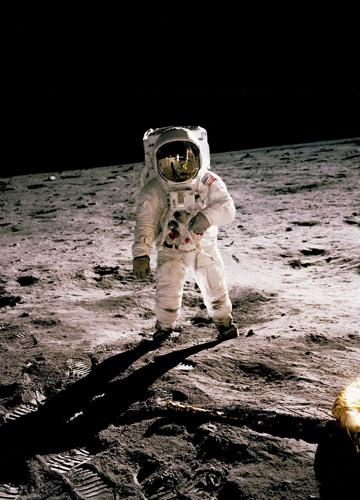
On July 20, 1969, Apollo 11 landed, and human beings set foot on the Moon, the only celestial object visited by humans. “This is one small step for (a) man, a giant step for mankind,” astronaut Neil Armstrong said.
We asked people to recall one of mankind’s most extraordinary accomplishments, as well as their thoughts on the era of Chang’e, Ultima Thule, and Viking, Voyager, Challenger, international space stations, and more.
I will briefly add my own:
I was 11, at YMCA Camp Orkila on Orcas Island, Wash., when it happened.
The camp staff set up a single black-and-white TV in the Orkila lodge, and dozens of us gathered to watch. I remember being alternately fascinated and bored by Jules Bergman’s analysis.
Then the event: Neil Armstrong hopping backwards down the ladder, uttering his famous words, followed by broadcast static from the cold of space. We all sat in silence for 5-10 seconds, and then erupted in applause.
Then it was back to rowing and swimming in the cold Strait of Juan de Fuca, named for a Spanish explorer who in the 15th century might as well have been traveling to the moon.
There have been no moon walks since 1972, yet a range of scientific and photographic explorations such as Voyager and the Hubble telescope have taught us much about the Solar System and our galaxy.
President Trump has called for an armed Space Force, and even added it to the list of American armed services during his July 4 address.
Unmanned explorations of Mars have given the world new insights about apparent organic life on the Red Planet, and raised speculation from Elon Musk and others about planetary travel and even colonization.
The return to the moon is news again in 2019. According to The Guardian online, “everyone is going to the moon”: India, Israel and Europe are sending unmanned vehicles to the moon, and the U.S. is staged to start “Gateway,” an unmanned lunar orbit project, in conjunction with other countries.
This follows last year’s historic voyage by the unmanned Chinese craft Change’e — the first craft to land on the dark side of the moon.
— Kirby Neumann-Rea
Guardian online reported on July 6: “The success of China’s Chang’e-4 probe provides an example of what can be achieved without human involvement.
“It is the first vehicle ever to alight on the moon’s far side, and has continued to operate without problems, despite having to survive prolonged periods when temperatures have plummeted to below minus 180C during lunar nights.
“(These last for 14 Earth days. Apollo schedules were planned to make sure astronauts landed only during daytime on the moon.)
“Exploiting these advances in robotics to aid human activity on the moon will form the backbone of the forthcoming U.S. Lunar Gateway project. Nasa plans to use America’s giant Space Launch System rockets and Orion crew-carrying capsules — both in the final stages of development — to build a smaller version of the International Space Station that would orbit the moon. Partners from Europe, Canada, Japan and other countries have been invited to take part in Gateway, which would be constructed over the next decade.
“Gateway would be used by astronauts to operate robots working on the lunar surface a few dozen kilometres below them. These automated machines would be used to set up radio telescopes, to harvest minerals, to search for ice and water and to study how lunar rocks could be used as building materials for a lunar colony. Ultimately a craft would one day carry humans down to work on the moon in colonies prepared for them by robots.”
... ‘And one small step for a young woman’
By Sandy Kirkland
By Sandy Kirkland
If I were to write an autobiography, my early life would be defined by a single word: “Flight.” My father lived to fly; he flew a crop duster as a kid, anything he could in the RAF, fighters in the young Army Air Corp and newly-formed USAF. Our lives in the Air Force revolved around training flights, test flights, breaking the sound barrier … and space flight.
As soon as newspaper articles related to astronauts and space began appearing, I cut them out of the paper, poured over every word, and pasted them into a homemade book. I dreamed of becoming a scientist, or better yet, an astronaut. Dad encouraged me.
In January 1969, when I turned 16, he began “ground-schooling” me himself. Flying was a natural for me, and a given to my Dad. When he thought I was ready, he turned me over to a flight instructor.
That following July, I monitored the space program, Apollo 11 and all things related with intense interest while I studied and logged flight time with my instructor. Unbeknownst to me, my instructor had decided to mark the day of the projected moon landing with a personal first.
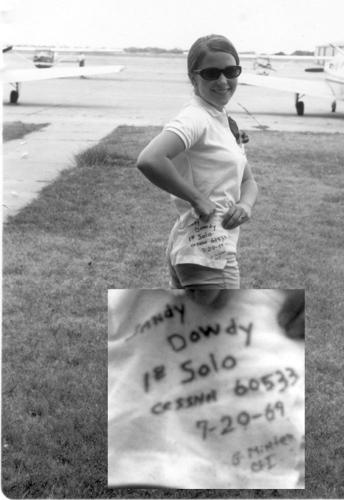
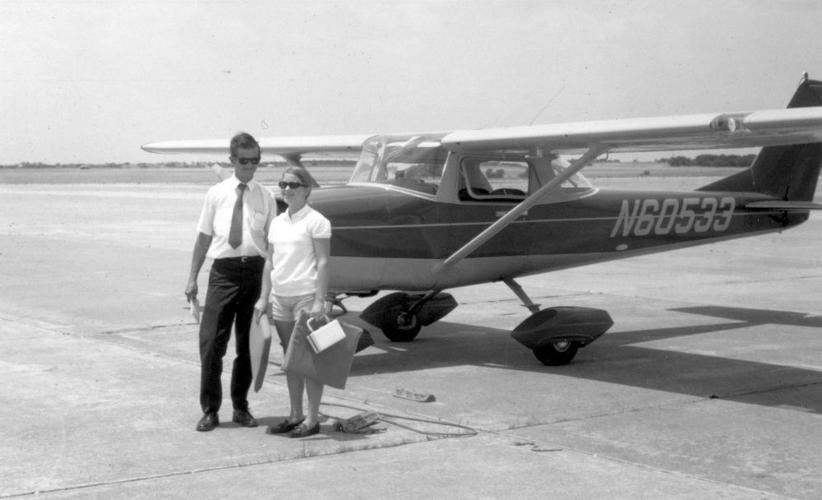
So on July 20, 1969, I solo piloted my small Cessna for the first time. Later, as family and friends celebrated my achievement at a local restaurant, a TV set was located, retrieved, and tuned to the NASA broadcast. (This was long before screens would become ubiquitous.)
The restaurant patrons gathered around and peered at the scratchy black and white images. It was thrilling, and I felt part of that history making day … one small step for man, and one small step for a young woman.
Sally Ride, America’s first female astronaut, was born only two years before me. I was definitely born at the right time to act on my goals, but life sent me another direction.
Every year when July 20 rolls around, I linger a few moments immersed in the emotion of that day and my first brush with the true kinship of “mankind,” the optimism, the excitement for the future, and the palpable sense of unity that I felt.
Sandy Kirkland lives in Hood River.
Earth is our only home
By Richard Iverson
By Richard Iverson
On July 20, 1969, I watched the fuzzy live broadcast of the first moon walk on a small black and white television in our basement family room in Sioux City, Iowa.
I was 14-years-old and suitably impressed — but only in a “Wow, that’s cool” sort of way. Some combination of youthful callowness and ‘60s callousness kept me from appreciating the deep significance of what I saw. (A thick coat of protective callous was common among Americans in 1969. Our country had just been torn by the assassinations of some of its most important leaders, by bloody riots in Chicago, Baltimore, Detroit and other cities, and by the Mÿ Lai Massacre and terrifying escalation of the Vietnam War.)
Only later, after NASA’s Apollo Program ended and I became a professional scientist, did I begin to appreciate the staggering combination of audacity, commitment, courage, hard work, good luck, and shear scientific and technological competence that enabled humankind to set foot on the moon in 1969.
If our civilization persists into future millennia — if it learns to tame the technological tiger it has unleashed with commercialization of the internet and learns to care for our planet rather than abuse it — then it will look back at the July 20, 1969, moon walk as one of the signature events in all of human history.
Space exploration inspires the better angels of our nature, but in the foreseeable future, Earth is our only home.
Richard Iverson lives in Hood River.
‘We all finally took that breath we’d been holding’
By Judy Hanson
By Judy Hanson
July 20, 1969 ... a day I remember like it was yesterday.
I was 15 and at home in a suburb of Chicago that night, with my Dad, Mother, sister and brother ... crowding around a tiny, maybe 20-inch TV, since we couldn’t afford to have our big console TV fixed.
It was nighttime and everyone seemed to holding their breath as we watched Neil Armstrong come down the steps of the lunar lander. It was all so unreal ... the hazy, gray, staticy picture. Was he really on the MOON? Was it really possible?
I can hear all the transmission beeps between his raspy, mechanical-sounding breaths. He moved like a robot. Then, he paused dramatically, and as took that last step onto the moon’s surface, he finally spoke those most memorable words: “One small step for man ... One giant leap for mankind!”
I think we all finally took that breath that we had been holding ... so worried that something would go wrong... but it didn’t. It was historic!
Judy Hanson lives in Parkdale.
Buzz Aldrin’s beaming parade smile
By Ellen Wylde
By Ellen Wylde
In five days, I would be 13 years old. It was July 20, 1969, and my parents and sister and I were crowded around the black and white TV in the living room of our house in Upper Montclair, N.J. The night was humid and sticky as east coast nights are, and I remember being tired as it was late.
We were about to watch Neil Armstrong and Buzz Aldrin walk on the moon. The TV was fuzzy, but the sound was good, so we heard Neil Armstrong’s famous statement: “This is one small step for (a) man, a giant step for mankind,” clearly.
I had mixed emotions about what I was watching. One part of me was disdainful. After all, wasn’t the moonwalk just another aspect of the mighty military machine representing the establishment? These were heady times to grow up in. Though I was only 12, I had already participated in anti-Vietnam War marches in our town, and was part of the Peace Club at Mount Hebron Middle School. And yet, here I was about to watch two men walk on the moon, and one of them, Buzz Aldrin, was born in Montclair and went to the same middle school I was currently enrolled in.
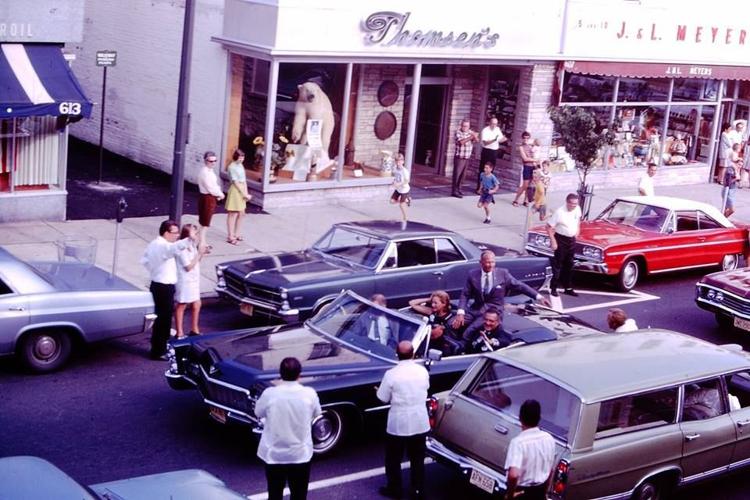
The town threw Buzz a parade, and I went with my Girl Scout troop and leader, Mrs. Edelhoff. As we were waiting for his motorcade to come down the street, Mrs. Edelhoff stunned us by saying, “I dated Buzz Aldrin in high school.”
When his Cadillac passed us 15 feet away, we were yelling and cheering, and then Buzz noticed Mrs. Edelhoff In the crowd. He threw her a special smile and wave, and I will never forget the beaming look on her face when he did that. It all came together for me in that moment. My 12-year-old political self disappeared and I was enamored with the marvel of it all.
A man walked on the moon, the same man who walked down my halls in Mount Hebron Middle School, and the same man who at one time kissed my Girl Scout leader.
Anything was possible in that moment, absolutely anything.
Ellen Wylde lives in Hood River.


Commented