
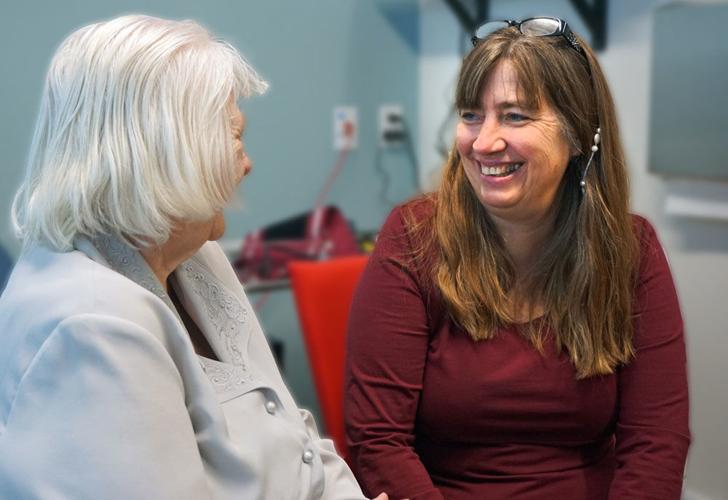
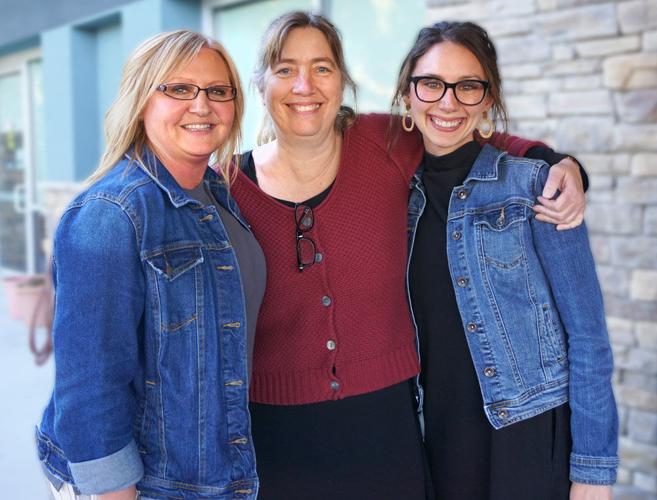
From a small clinic at Columbia Basin Care in The Dalles, Val Hiveley Blatz works as the Gorge’s only provider specializing in the care of older adults.
Want to make an appointment with the most popular health care provider in The Dalles?
She’d like to see you, but there’s just one catch: you may be too young. Valerie Hiveley-Blatz specializes in a demographic many medical professionals avoid—old people.
Val, as her patients call her, is the only provider in the Columbia Gorge caring exclusively for those 55 and older. And she’s busy. From her clinic at Columbia Basin Care, Hiveley-Blatz carries a load of 450 patients.
Columbia Basin Care is the region’s only independent, nonprofit facility for short-term recovery and long-term care. It’s also the only nursing home in the Columbia Gorge providing residents with an on-site geriatric nurse practitioner.
She and her team—Nina VanEs (nurse practitioner and partner), Donna Troxel and Sara Beedie (medical assistants) and Traci Waddington (clinic manager)—assist and support patients and their families through persistent problems, difficult diagnoses, and painful transitions.
“We help them navigate through the complex medical system,” explained Hiveley-Blatz. “We’re guides.”
Hiveley-Blatz spent her undergraduate years at the University of Wisconsin-Madison and earned her masters degree from Oregon Health Sciences University, specializing in geriatrics and psychiatrics.
She has lived in The Dalles for 30 years, and has practiced medicine for over 20. She initially worked as an emergency room nurse at Mid Columbia Medical Center, then as a home healthcare nurse, prior to moving into her current role as a primary care provider.
While she’s in great demand locally, the work she does as a geriatric specialist is also in short supply nationwide.
“We see a shortage in geriatric care. We’ve got an aging population and we don’t have enough specialist nurses in geriatric care,” Cheryl Peterson, vice president of nursing programs at the American Nurses Associatio, told the U.S. News & World Report.
As life expectancy increases, there is a pressing need for specialists to address the specific needs of older adults. One of the challenges of working in geriatrics is that older patients typically have more complicated care needs and are much more likely to suffer from multiple ailments. Geriatric nurse practitioners are typically more involved with their patients than a general practitioner as they adjust medications, prescribe physical therapy, and help them navigate long-term care.
The geriatric nurse practitioner shortage is compounded by the fact that the nursing workforce itself is aging. While last decade’s recession delayed the retirement of many nurses, the improved economy has seen older practitioners retire. This exodus puts pressure on hospitals and health care facilities around the country, and rural locations already facing limited services—such as communities in the Columbia Gorge—are feeling the impact even more.
For those who choose to serve the ill and aging, the rewards can be profound.
“I learn so much from my patients. I love what I do,” said Hiveley-Blatz. “I love to listen to people’s stories. We get to know the families. It’s important to connect with patients and their families and get to know who they are.”
While most physicians see patients on an annual basis, she typically see her patients every 60 to 90 days—and meets them in nursing homes, assisted living facilities, in her clinic at Columbia Basin and even makes house calls.
“We communicate with our patients. We’re one of the last places that calls patients,” she says. “We still operate old school, with phone calls and home visits, because our clients need that.”
But the work doesn’t end with the visit. To understand the full scope of each patient, Hiveley-Blatz consults with other providers—orthopedics, cardiologists, dialysis centers, therapists, pharmacists, surgeons. With this comprehensive approach, patients are more likely to thrive, even in the face of a health care system that can feel overwhelming.
“A good day is when you see that all the hard work you do behind the scenes works,” she said. And the good days often bear handmade gifts, with patients and their families bringing her home-grown tomatoes, crocheted blankets, knitted slippers. “A good day is when we help solve what matters to them.”
Drew Myron is marketing director for Columbia Basin Care, located at 1015 Webber St., The Dalles; 541-296-2156, colbasin.com.


Commented