
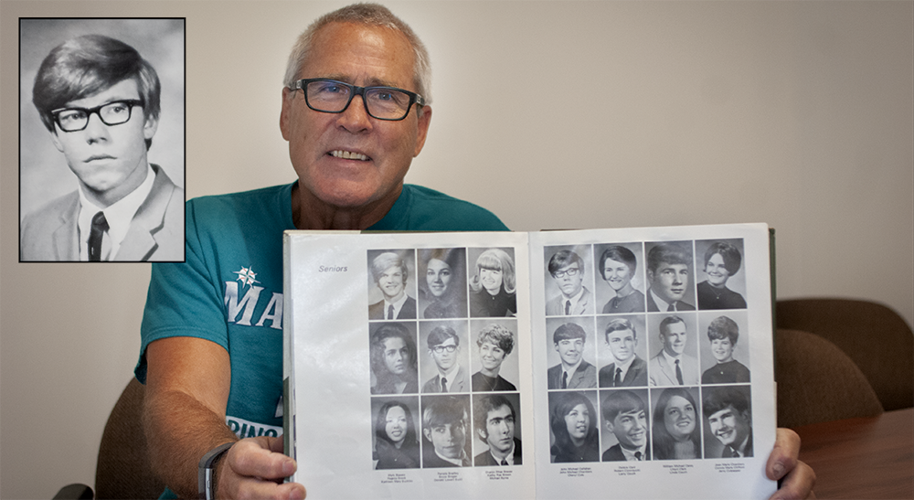
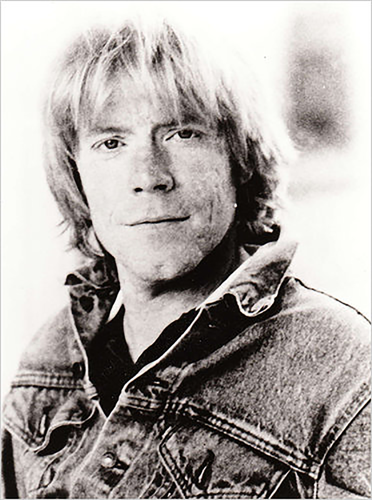
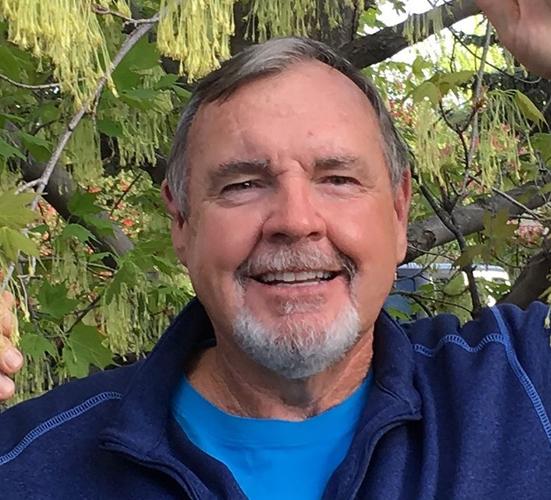
John Chambers was clear at the other end of the hall at The Dalles High School when he heard the bam of someone getting slammed, hard, into a locker.
The slamee was John Callahan, the eventually famous cartoonist whose life story is told in the recently released movie, “Don’t Worry, He Won’t Get Far on Foot,” which opens Friday, Aug. 24, at Columbia Cinemas in The Dalles.
The slammer was Tim Arends, a fellow classmate and good friend of Callahan’s, who had just learned he was the subject, yet again, of one of Callahan’s biting cartoons, which he’d been drawing for years by that point.
At the height of his career, Callahan’s cartoons, simply drawn and often politically incorrect, were syndicated in over 200 publications around the world. Boycotts and subscription cancellations were a regular reaction to his taboo-breaking dark humor.
Years later, Arends could get back at Callahan, noted for his bright red-orange hair, just by pointing out his fame. “I would say, ‘Hey John, you’re my most famous friend.’ He’d turn bright red. And he was already bright red to begin with.”
Callahan began drinking at 12, and, just a few years after graduating from TDHS in 1969, became a quadriplegic at 21. It happened one drunken night when a guy he’d been bar-hopping with drove his car into a utility pole at 90 mph. He sobered up at 27, and poking fun at disabilities was a regular theme in his cartoons.
In fact, the title of the movie — taken from his autobiography — is from the caption on one of his cartoons, which shows an empty wheelchair in the desert, surrounded by a sheriff’s posse on horseback.
Chambers, now 68, still has copies of several of Callahan’s cartoons. When Callahan died at 59 in 2010, of complications from paraplegia, Chambers gave the originals to Callahan’s family.
Callahan was adopted, the first child of David and Rosemary Callahan, who went on to have five more children — Tom, Kevin (Kip), Richard, Mary (Murph) Callahan, and Teri Duffy.
Callahan was godfather to Chambers’ three kids, and his best friend from fifth grade at St. Mary’s Academy in The Dalles.
At St. Mary’s, Chambers recounted hearing stories about how Callahan was the class pet of the nun who taught fourth grade. “From the stories I heard, it was almost unnatural the way she treated him.”
One time, he said, she “made the whole class stay in for recess because he wouldn’t smile.”
He said Callahan drew a nasty cartoon of the broad, ruddy-faced nun “and that was the end of that weird friendship.”
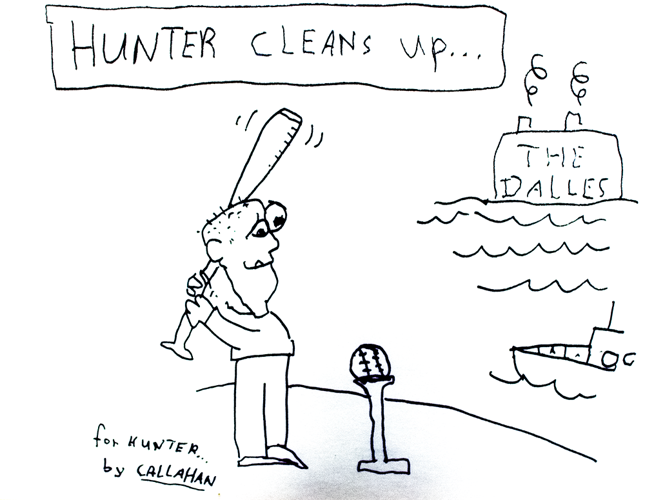
Arends admits he probably slammed Callahan into a few lockers, but “he could be vicious with his cartoons.” He’d threaten to beat him up if he did another one, Callahan would promise not to, and then, as soon as he escaped Arends’ clutches, another cartoon would appear.
Even so, “I loved the guy,” Arends said.
He was gifted at everything: musically, with writing, with art, with sports.
He’d scribble an English assignment in the few minutes before the bell rang, and always get an A, Arends recounted.
Chambers described an active, carefree childhood with a tightknit group of friends who rode bikes to each other’s houses, baseball mitt on the handlebars, to play ball in nearby fields.
They often hung out at Chambers’ house on East 14th Street, and he always wished Callahan had done a cartoon of one memorable event.
Callahan had a habit of disappearing for awhile at Chambers’ house – he would learn later Callahan was sneaking off to get into his dad’s liquor.
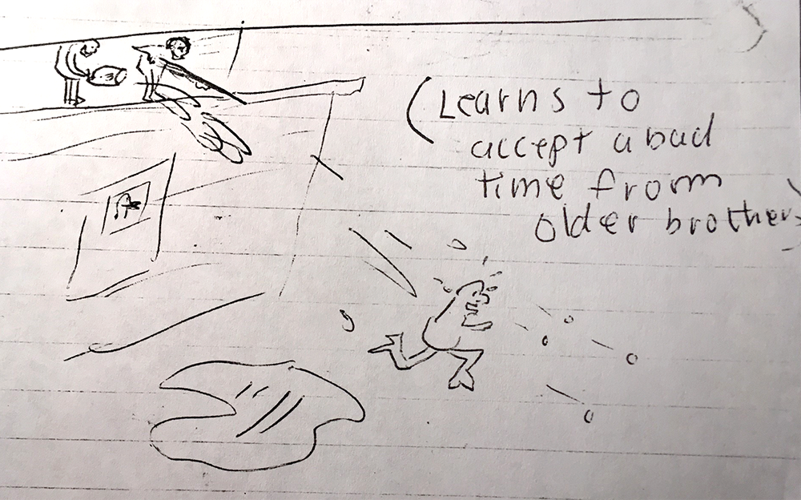
After one such disappearance, Callahan burst out of the house, Chambers’ sister in hot pursuit, screaming at him and hitting him, as Callahan ran off with her cat. He ran to the edge of the property and flung the feline over the steep ledge.
The cat was fine, but that earned Callahan one of his many brief banishments from the Chambers house. (Some of them were for “unfavorable” cartoons of Chambers family members, Chambers said.)
Chambers found the incident hilarious — the blur of Callahan’s bright orange hair, the flailing sister, and the flying cat, and he’d always wished Callahan would’ve drawn a cartoon of it, but he never did.
He did draw a cartoon of the time Chambers’ brothers shot bb guns at him and Callahan from the roof of the projection booth at the Starlight Theater, which Chambers’ dad owned.
Jim Woods of Dufur became fast friends with Callahan in junior high. They played Little League baseball together and Callahan was always a good multi-sport athlete.
Woods and other classmates from their class of ’69 attended a premiere of the movie in Portland recently. “I thought the movie was pretty accurate in a lot of ways,” he said. “Made me cry and I’m not a crier.”
The movie focused on Callahan’s alcoholism and recovery, and one point that choked up Woods was Callahan making amends to those he’d hurt.
He recounted how Callahan had called him during that time, 15 years after high school, to apologize. “He gave me a nickname that stuck to me forever, that was kind of crude and mean, but it wasn’t any big deal. And I said, ‘What are you talking about? You don’t have to apologize.’”
The nickname? Bull Nuts. Woods said, “I’m thankful he didn’t name me something about tiny things.”
Callahan was also a singer/songwriter, and over the closing credits “there was a song John had written and sung himself, so we got to hear John’s voice.”
While Arends was featured in many cartoons, Woods wasn’t spared either. “He skewered everybody.”
Woods grew up lower middle class, in an old semi-falling-down house. Callahan drew his house like an Addams Family house. “It was mean, but we were really good buddies.”
“He was absolutely one of the most compassionate, kind people you would ever want to know — but there’s always a ‘but’ — but he was ruthless,” Woods said. “He could see the humor in everything.”
As a teen, Callahan had severe acne that left his face pock-marked. Treatments for it made his face red, and that, along with the pimples and his flaming orange hair, made him shy, Chambers said.
Even so, Callahan was a nice looking man who always had women flocking around him, Woods said. “Women just loved him, and I think a lot of it was his wit, his charm.”
Woods went off to law school after college, and Callahan, by then a quadriplegic, came to visit him, attendant in tow. “He was just a drunken mess, it was awful.” He drank to get drunk, and it was no fun for his friends to be a part of it, Woods said.
Another time in his drinking years, a friend was hauling him around in Portland when his wheelchair tipped over in the van. He got out to right him, Callahan fell out, and his pants fell down. There were countless similar stories from those years, Woods said.
After sticking around The Dalles for a few years after high school, Callahan headed to LA to get discovered, Arends said. Soon after came the wreck.
Chambers recounted visiting Callahan down in California shortly after his accident. “It was pretty damn traumatic,” he said. “I felt so horrible for John seeing him that way, you don’t ever think your friends are going to be paralyzed.”
He still had limited movement in his upper body, and used both hands to draw his cartoons.
Callahan got his publishing break by submitting crude cartoons to Penthouse Forum. “And he used to call me up and say, ‘You’ve got to see this one Jim,’” Woods recounted.
Woods said he reluctantly bought the “sleazy” magazine to see his friend published.
Arends used to visit Callahan in Portland, and just as the movie portrays, he’d tear around town in his wheelchair, making it impossible for people walking or even jogging alongside him to keep up. The movie also captured his “chug chug” drinking, Arends said.
Because Callahan was an icon in hipster Portland, Woods said a lot of people would be surprised to learn he was actually fairly conservative. Sure, he skewered priests and nuns in his cartoons, but he was no “recovering Catholic,” Woods said. “He thought a lot of the church.”
Callahan complained that it was fair game to skewer Catholics, but “you can’t get away with saying what they say about Catholics about a Jew,” Woods said. “And he was certainly no anti-semite, but you can’t do that, and it used to irritate him.”
He said Callahan “got the biggest kick” out of people getting offended over his dark cartoons about the disabled, “and he’d been in a wheelchair for years.”
He used to do cruel cartoons about lesbians, but quit doing them after lesbian friends said they were hurtful, Woods said.
And his barometer for whether he went too far on poking fun of disabilities was whether the disabled themselves took umbrage.
Among his cartoons focusing on the disabled was a drawing of an aerobics class for quadriplegics, with the instructor saying, “O.K., let’s get those eyeballs moving.”
Callahan told an interviewer in 1992, “Like me, they are fed up with people who presume to speak for the disabled. All the pity and the patronizing. That’s what is truly detestable.”
Chambers always comes to Dufur to help Woods with cherry harvest, and one day in 2010, they were both talking about Callahan. Woods’ wife, Janet Stauffer, told them they should call him.
“We called him and we never got an answer, and that was the day he died,” Woods said.
Arends regrets not keeping all those cartoons he was skewered in. “Who knew he was going to be so darn famous?”
He added, “There’ll never be another one like him, that’s for sure.”


Commented