
Here comes fall!
The autumnal equinox, the first day of fall, is Sept. 22 this year. At that time, the Sun will be directly overhead at the equator, and we’ll have nearly equal amounts of day and night. Nights are still warm, and darkness comes earlier. September can be an excellent month to stargaze.
For viewing the bright planets, the best part of the year is now behind us, but Jupiter, Saturn, and Mars still beckon in the southern evening sky. And our outermost planet, Neptune, makes its closest approach on Sept. 7.
Mars was hard to miss in August, shining a brilliant red in the southern sky. It will remain in our evening sky in September, although it is growing smaller and fainter. It will move almost a half million miles farther from us over the course of the month, and shrink in apparent size by about 25 percent.
Jupiter is also moving away from us. However, through size alone, the solar system’s largest planet will still appear to be almost twice the diameter of Mars when viewed through a telescope.
An interesting event will occur on Saturday, September 15, when Jupiter’s moon Io passes across the front of Jupiter. Io’s shadow will be visible on Jupiter. This is a good time to visit the Goldendale Observatory’s Stonehenge location!
Saturn, along with its impressive rings, will still be visible, although it is also growing fainter. Our second-largest planet is very distant – about 900 million miles from Earth.
As mentioned above, Neptune will reach opposition on November 7. Neptune is over three times more distant than Saturn – about 2.7 billion miles away! It takes Neptune roughly 146 years to circle the Sun.
Those distances may seem huge, but they pale in comparison to the distance to nearby stars. Distances to stars are measured in light-years, the distance light travels in a year. Light travels at about 186,000 miles a second, so a light-year is an enormous distance. Alpha Centauri, the nearest star other than the Sun, is about 4.22 light-years from us; Neptune is only about four light-hours away.
Fall constellations continue their march into the night sky in September. Pegasus is now in the eastern sky after sunset; to find it, look for four equally bright stars forming a large “square.” Cygnus the swan still looms overhead at 9 p.m., right in the middle of the Milky Way. An interesting constellation near the two is Delphinius, the dolphin. This small constellation does appear to be shaped like a fish or dolphin, with four stars forming the body and a fairly bright fifth star as the tail.
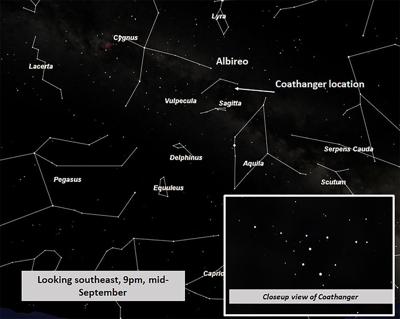
The Moon will be new on September 9, and full on the 24th of the month. You can use it as a guide to the planets – it will be above Jupiter on the 13th, to the left of Saturn on the 17th, and above Mars on the 19th. Face south or southeast, and look below Cygnus and to the left of the bright star Altair. Use the picture included with this article to help.
We also have “asterisms” in the sky; this is the technical term for observable shapes formed by stars that may or may not included in the official list of constellations. A good example is the Big Dipper. The dipper is an asterism located in the constellation Ursa Major, the Great Bear.
Another interesting asterism is the “coat hanger”, located in the dim constellation Vulpecula. You’ll need binoculars to see it. Face south, and locate the head of Cygnus the Swan (Deneb, the brightest star in Cygnus, is the “tail” of the swan; a fainter star, Albireo, is at the swan’s head.)
Look about eight degrees lower than Albireo (the width of your fist, held at arm’s length, is about 10 degrees.)
Scan the area in binoculars and look for an upside-down coat hanger. It fits nicely in the view of binoculars.
See if you can locate Delphinius and the Coathanger!


Commented