Playwright Cassandra Medley is in town and will be present at performances of her drama “Cell,” at Adult Center Theater. The limited-run production is Oct. 4-6 at the Hood River Valley Adult Center, on Sterling Place next to Gorge Athletic Club. The story looks at the experience of people whose job it is to guard immigrants from Central American countries at a border federal detention center. Medley, director Gary Young and the cast will do “talk back” sessions with audiences after each show. The play returns a year after its Hood River debut on the same stage, this time with cast members who are Hispanic . Medley, who lives in New York, has drawn from current events to update the script by adding and changing dialogue, and introducing a new character. Young added the “An Immigration Story” subtitle, along with an NPR interview clip to open the play.
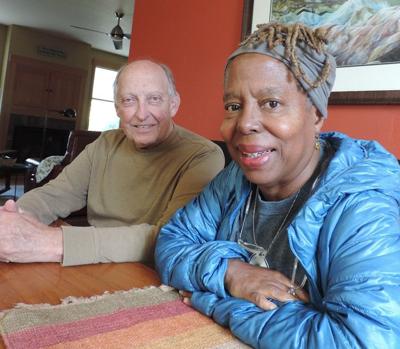
Cassandra Medley interview Here are excerpts of an interview with Medley, joined by Young at his Hood River home. Of the guards she writes about, Medley said, “You literally have people who are very connected to the experience of the people whom they are hired to guard, people who have been imprisoned.”
HRN: How is the production different from the one staged in Hood River in 2018? Cassandra Medley: “The difference is that we have the privilege of working with people who are of Latinx background, and since the guard situation in these centers is one of basically white ethnic, African-American guards and Hispanic, people, this is a great opportunity to have a cast that represents the Hispanic aspect of it. “This script has dialogue that has been transformed in a more authentic sense, and it has a new character. A new character, Luis, referred to in the original, has been added. (A version of updated “Cell” was recently performed in Dallas, Texas.) Medley said, “I hope to have similar audience feedback as in Texas: The audiences were very much Hispanic, and they said, ‘I have an uncle ... that’s my aunt, ... my mother is there’,” Medley said. CM: “It looks at this idea of guarding people — you could be in their place, and how do you deal with that?” Medley said the effect resembles the way Jews were forced to guard fellow Jews in Nazi concentration camps. She acknowledged that the Jews were inmates, forced to do what they did, not people who had filled out a job application and punch a time clock each day. CM: “It’s a matter of signing up for a job and thinking it is going to be one way and it turns out to be something entirely different. Nothing in the description about separating babies, putting them in cages and giving them alumalite blankets. Given what it concerns, and not to stretch the analogy, there is this steady progression similar to ‘the Germans are putting us in a ghetto, we’ll survive that,’ and then, ‘they’re putting us in a work camp, we’ll get through it,’ and it just gets worse and worse. “In the case of the guartds, it’s ‘I need this job. I don’t have a whole range of opportunities.’ And then it gets worse and worse. Articles are now coming out about the depression, the cost that guards are suffering because of their jobs.” HRN: The human cost of this system is great not only for the people who are detained but the people who work there. GARY YOUNG: “That’s when the male character was added. CM: “I was commissioned to extend the play and I knew that the man who was referred to in the original short play would become a character. Then the question was how to create a complex character. Again, someone who was a good guard, a good soldier, and trying to be, and yet faced with worse and worse conditions. “When I did my original research for the play, there would be these guards, male as far as I have researched, who would take advantage sexually of women under their care, and what fascinated me about this is when it would finally came out that there was going on, was the ‘blue wall of silence.’ People knew and wouldn’t say anything. “I’m interested in people who are in moral crisis. It’s one thing to be mentally ill enough to be (Nazi Adolf) Eichmann, and you justify it, but to write someone who knows this is wrong and they are participating in it and I’m looking at myself in the mirror every morning, ‘how am I making this happening?’ So that became the male character. “Plus, I wanted to write someone who was complicated in the sense of the audience not pointing the finger: ‘he’s the one, off with his head,’ but someone who was trying to be good and yet ...” HRN: There are gray areas there. How did you achieve that nuance? Gary Young: “I think the play points out that there’s a pride that comes through at one point: he’s (Luis) very prideful of the way at least his section of the detention center operates, and he says, ‘we’re better people than this, we don’t do that here.’ But then because of the organization, things do happen.” CM: “I try to portray in the male and the female characters the power of being in power, of being in charge, of feeling, historically, ‘My group’ -- be it African, Hispanic, or poor white -- ‘my group doesn’t get these (jobs),’ and then, ‘I’m going to make this better.’ All of this combined in the male character, for me. And then, ‘I am caught up in it, and this is going to expose me, if this comes out. So I have to see what I’m going to do’’.” HRN: You added new layers to an already pretty challenging story. “Yes, I had that opportunity and I’m glad I have been able to do that. But everyone says, ‘99 percent, I’d have been the one to hide slaves ... to hide Jews ... It would have been me standing up.’ And then we have our own crisis. You always have a crisis, in every era you’re in, but now it’s ‘are you one to take in a family?’ I am very encouraged by churches and synaogogues that have become places of refuge, and that involves people who are congregants.” HRN: What are you working on now? CM: “I’ve been working on a play about climate change and black farmers, about fracking, (in her home state of Ohio) and this notion of being made an offer by oil and gas and not having enough money.” HRN: It sounds like a moral choice. “I’m very fascinating with these moral choices. I’m lucky to have had actors who have also challenged me all along my career. They ask, ‘where is my crisis? I can’t be all terrible?.Where is my other emotional range?”
Gary Young noted that the “Cell” playbill includes brief bios by each actor about their own famliy history. “There are some very interesting stories there and who they think of and who they are in their personal immigration stories,” Young said. Most of the actors get into specifics about where they or their family came from, and their immigration experiences. Yet at least one speaks in more general terms. “And we honor that,” Young said.



Commented
Sorry, there are no recent results for popular commented articles.