Local health care and social service organizations are seeking input from community members regarding topics “ranging from local health resources, barriers to care and gaps in service, to trends regarding health and family lifestyles” by through a Community Health Needs Assessment (CHNA), according to a May 25 Skyline Health press release.
Currently live for community participation, the Gorge-wide assessment consists of an anonymous survey that community members can take from their smartphones or computers, either by scanning the provided QR code or going to arcg.is/1rybP, where the survey can be found in both English and Spanish. The link to the survey can also be found at any of the participating organizations social media pages. According to the press release, the goal of this assessment is to “understand the strengths, needs and challenges impacting health in the Columbia River Gorge.”
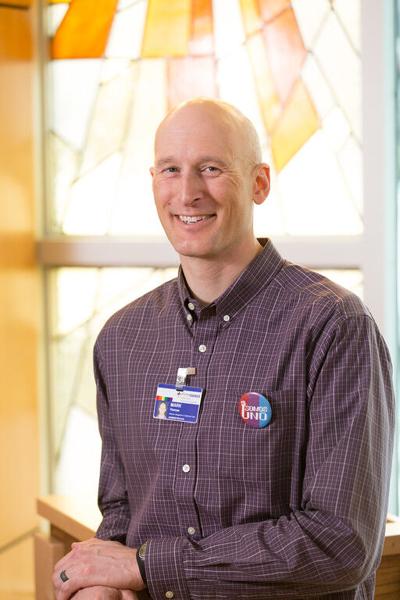
Mark Thomas
Michael Peterson
According to Mark Thomas, chief mission officer for Providence Hood River Memorial Hospital, this CHNA will be the most comprehensive assessment in the Gorge area since the beginning of the pandemic. “We all know our world and our community is changing and being changed by many forces,” said Thomas. “This assessment will help us to understand those forces better, what dynamics are affecting which groups within the community and what specific needs are emerging.
“Ultimately it’s a tool to help ensure that any solutions and visions are really tailored to an understanding of the challenges we aim to address,” said Thomas.
This year’s CHNA partnering organizations include Skyline Health, Providence Health & Services, Mid-Columbia Medical Center, Klickitat Valley Health, One Community Heath, Mid-Columbia Community Action Council and Skamania County Public Health. According to Thomas, 2022 marks the fourth inter-agency, collaborative approach to putting together the CHNA, which non-profit hospitals are required to conduct every three years. “Each organization has specific requirements, and a specific service area. We look for the overlap and figure out how to accommodate requirements outside of that,” said Thomas. “It’s fun to remember back to 2013, when the heads of all the agencies came together in Lyle, which was geographically central, to decide to do this together, and we’ve kept it going ever since.”
According to Thomas, the partnering organizations involved have changed over time, with 2019’s assessment including 18 organizations compared to this year’s seven. “This year we’re actually a smaller group because Oregon’s requirements for Medicaid are a little different in terms of timing,” said Thomas. “We plan to resume with the larger group … in 2025.
“By doing this together, we have more of an opportunity to agree on priorities, and have greater collective impact,” said Thomas. “It works and we’re building on a good thing.”
•••
Through this collaboration, the assessment will generate a list of Gorge-wide health related strengths and needs, from which each partnering organization will create a Community Health Improvement Plan (CHIP), said Thomas. “We’ll look for opportunities to align those efforts, so that collectively we’re addressing as many known needs as possible, in ways that create synergy and don’t unnecessarily duplicate or confuse efforts,” said Thomas. “In Providence the CHIP helps to inform our overall strategic plan. It will shape what health care services we consider adding, but also what things beyond health care we recognize a need to support, so that health can be most improved.”
•••
The goal of the assessment is to hear as many voices in the Gorge community as possible in order to address as many of the community needs as possible. “We really need to hear from everyone. The agencies involved will use it to shape their strategic plans, other nonprofit partners will use it for grant seeking in alignment with these priorities. The findings of this assessment will guide tens of millions of health investment dollars in the Gorge,” said Thomas. “It’s especially important that we hear from people whose voices aren’t as loud. People who don’t have a chance to hear about this in the language they speak, or for whom the time and technology to respond to a survey is more difficult.” According to Thomas, the organizations conducting the survey are making specific efforts to reach those who may experience difficulty participating in, or completing the survey, but encourages everyone who can to support their friends and neighbors who may be less likely to answer the survey to participate and have their voices heard.
“In particular, we want to hear from people who speak Spanish, people who are living with a disability, people who have lower income, people who are Latino, Native or another ethnic or racial minority, people who are older adults, youth and people who are LGBTQ+,” said Thomas.
Everyone who participates before June 30 can be entered into a drawing to receive one of 40 $10 dollar gift cards. According to Thomas, those who desire to be entered must attach their contact information to the survey so they can receive their card. Their contact information will not be otherwise associated with their response.
“We take a Gorge-wide approach because we really are functionally one community,” said Thomas about making the assessment regional. “Many of us live in one area, and work, or shop, or seek care in another. We’ve also found that as a region, there are solutions we can pursue, grants we can apply for that we couldn’t do individually. Some of the challenges we want to address, like hunger or affordable housing, or mental health are massive. We need to understand the nuances of each part of the Gorge and the communities within it, but we also need to act at scale and as a team. We are much better together.”



Commented