
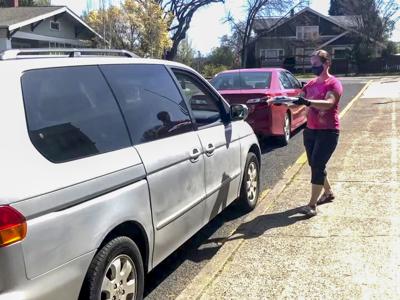
Schools may be closed, but their kitchens certainly aren’t.
The food service staff at North Wasco County School District 21 has proven nimble in its response to the coronavirus pandemic. Mere days after schools closed in mid-March, the food service staff was offering free meals for pickup at some schools.
In the weeks since, the service has expanded significantly. More meals are now being offered for distribution at more places. Plans are to start offering three meals per day for pickup, and enough meals on Fridays to cover the weekend. That will hopefully begin on April 27, said Dottie Ray, director of nutrition for D21.
The last day of school was Thursday, March 12, and by the following Monday, March 16, kitchen staff were offering boxed meals at The Dalles Middle School and Chenowith Elementary that included a lunch and a breakfast for the next day, said Ray.
Now, pick-up is offered from 11 a.m. to noon at the middle school, Chenowith, Dry Hollow Elementary, Mosier Community School, and four bus routes have been added (see sidebar, page 2).
She estimated the kitchens are producing about 30 percent of the meals they normally produce. “Are we doing what we do when the kids are in school? No. Would I love to do more? Absolutely,” Ray said.
With food supplies sorted, and enough bags to put them in, and production and distribution routes developed, the issue now is getting the word out to people that the meals are available, Ray said.
Work on that is happening on a number of fronts. Teachers are telling their students, the Migrant Education Program is getting the word out. Messages are also going out on Facebook, and word of mouth has helped. “We’re even stuffing little flyers in the lunches now when we give them out. Everything helps,” she said.
“Transportation has been a huge asset and I’m really thankful to Lisa (Kaseberg, D21 transportation director) and the bus crew that came on board because they’ve added an average of 300 meals a day since they’ve added the routes. We’re still trying to grow that and add some more routes and we’re looking at logistics of what we can add and how we can make it better.”
She said seeing the bus drivers report to work was gratifying because they were so excited to be able to work for a few hours and get out of the house. Each bus is staffed with two or three people, she said.
She added, “I want to give a huge shout-out to my staff. I couldn’t do it without them, they’re just amazing women. It’s been a really hard time. It’s out of their norm, it’s been a huge challenge because we’ve had issues with supply and we’re changing menus the day of. They’ve just been fantastic.”
The hardest thing has been the change in routine, Ray said. “I don’t think I realized how much of a structure we had.”
Menus are usually developed six to eight weeks in advance. So by now, normally the staff would know what was going to be on the menu in May. “Now, it’s ‘Hey, I don’t know what we’ll be doing tomorrow.’”
The changes have come fast and furious. “We’d develop a plan and they’d release a new waiver and everything changed again. It’s just a continual change.”
One welcome change was getting rid of the rule that in order for parents to get meals for their kids, the students had to be present. Now, the parent just says how many kids they’re picking meals up for.
To expand capacity, starting this week meals will also be prepared at the Wahtonka kitchen, although it won’t be a distribution site. They will prepare food for some of the bus routes, to take pressure off the other school kitchens that are doing more and more meals for on-site distribution, Ray said.
The first day, they served 68 meals, she said. Now, it’s up to about 1,200-1,400 meals distributed per day. On average about 740 kids per day are getting meals. It was around 200 when the meals started. The district has about 3,000 students.
Through April 10, the district had served 12,839 meals, she said. “We have the same regulars every day and they’re very thankful and very gracious and that’s the best part of the job.”
Any leftovers are given to the Columbia Gorge Food Bank, St. Vincent de Paul and Bread and Blessings, Ray said. “I always want to overproduce, I don’t want to under produce,” she said.
She said she’s received “a ton” of community outreach from people offering to volunteer. “That part has been really great. We haven’t needed them thus far but it doesn’t mean that we’re not going to and it’s always very much appreciated.”
Meals have included hot lunches like a hamburger, or a sandwich or a wrap, as well as a fruit, vegetable and milk. “So it’s all the components they get in a normal lunch day, it’s just wrapped up in a bag.”
She’s working to vary meals. “I’m sure kids get tired of ham sandwiches and turkey sandwiches and burgers. Right now we’re re-looking at that and figuring out what we can supply.”
Breakfast is a breakfast round, which is like a big granola bar, and milk.
She’s been grateful to have adequate bags locally. “The toilet paper of the schools is the bag issue. Because now, we’re like, ‘How do we bag things better so we’re not using as many?’”
So far, she’s been lucky. When she puts orders in, she expects to see “Item rejected,” but hasn’t so far.
She’s sourcing food from Sysco and Duck Produce, which delivers local food out of the Portland area. So far, she hasn’t seen price increases.
The schools get commodities from the U.S. Department of Agriculture and the allotment is designed to last through the end of the year. “And now there’s no school and you still have all this food you need to use,” Ray said. “We don’t want to be wasteful.”
When she’s been on the market trying to find other foods, there’s been a few glitches, like finding cereal. “It’s the individual packs and everybody ordered all at once and they couldn’t keep up. They’re finally starting to get back in stock and we’ll be back to normal. I shouldn’t say normal, we’ll be back to not having a supply issue hopefully next week.”


Commented