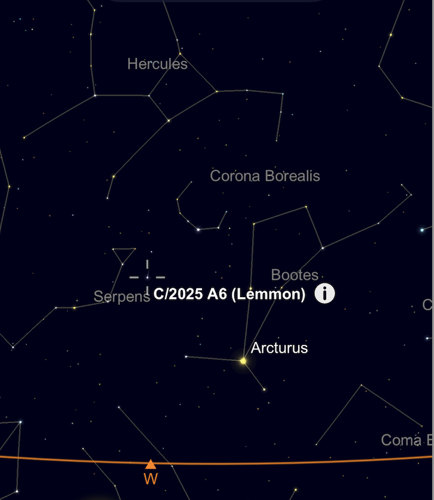
A sky map indicates where Comet Lemmon will be this Saturday. Look west about an hour after sunset. The comet is above the very bright star Arcturus and is moving further south each night. Unfortunately, the rising moon will soon make it more difficult to see.
A sky map indicates where Comet Lemmon will be this Saturday. Look west about an hour after sunset. The comet is above the very bright star Arcturus and is moving further south each night. Unfortunately, the rising moon will soon make it more difficult to see.
THE GORGE — Comet Lemmon visits us about once a millennium, dropping in from far beyond the orbit of Pluto. It hasn’t changed much since it was formed 4.5 billion years ago, so getting a chance to see it is an experience that connects us to the very beginnings of our solar system.
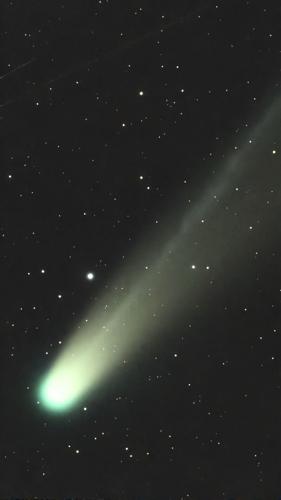
Comet Lemmon on Oct. 20 from south of The Dalles using a Seestar S50 telescope.
Phil Brady photo
Seeing a comet also demonstrates why protecting dark skies is important. Comet Lemmon can easily be spotted with binoculars from our rural areas but is overwhelmed by light pollution from any suburban area in the Willamette Valley.
Comet Lemmon is approaching the Sun and will be closest to the Sun on Nov. 8. The same atomic particles that fly away from the Sun and cause the northern lights also push evaporating gas away from the comet creating the comet’s tail, so the tail is always extending away from the Sun. From our perspective, the tail is currently rising directly up from the horizon while the comet is moving southward above the horizon night after night.
Nature has not been treating us to dramatic bright comets recently. The last great comet was Hale-Bopp back in 1997, which was before many of us were born — so it’s important to look up and appreciate the lesser comets that do swing by.



Commented