
Economic impacts and private property rights.
Housing availability and neighborhood preservation.
Speakers at Hood River City Council Monday pleaded two sets of cases in part two of a continued hearing on proposed regulations on short term rental (STR) housing.
“There’s just too many of them. Most of my neighbors are concerned. There’s got to be some kind of governance,” said Mike Stroud, who said more and more infill condos have added STRs in his neighborhood of East Third Street.
“Decide this on the facts, not on theory or hearsay,” said Robert Wymore, who invested in a house he rents near his West Sherman home, as a future place for his children to live.
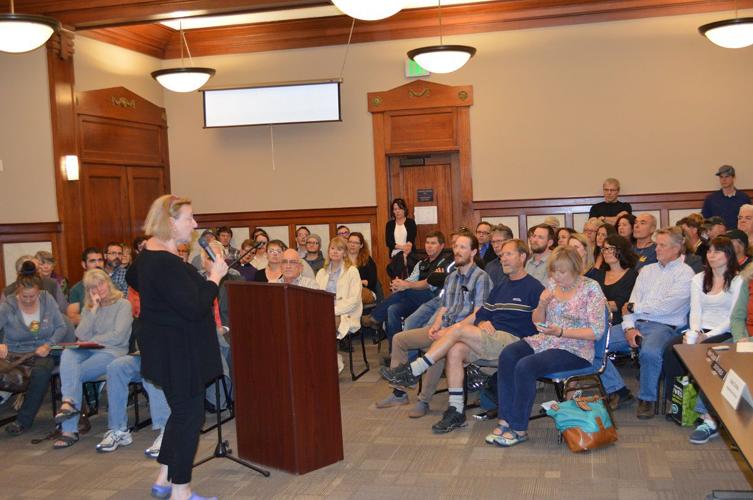
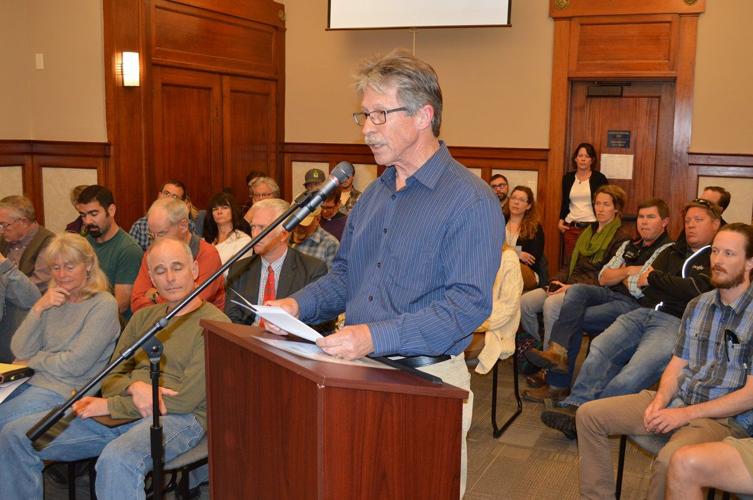
It was a packed house for the second straight council meeting, with about 225 in attendance; every seat in chambers was filled and it was standing room only in the hallway.
Testimony lasted more than two hours Monday, slightly less than when the hearing opened on April 11. In light of the hour, Mayor Paul Blackburn announced Monday that council would delay deliberation on STR regulations until May 9 at City Hall.
At issue is the Planning Commission’s proposal, also referred to as the Portland Plan for its similarity to that city’s new rules, adopted last month by a vote of 6-1, to require STRs to be in owner’s primary residence only (aka hosted home shares), prohibiting STRs in accessory dwelling units, and to phase out non-compliant STRs over a five-year period.
Five council members heard testimony: Becky Brun and Laurent Picard recused themselves April 11 for conflict of interest because both are STR providers. Picard was absent Monday; Brun reiterated her recusal and sat in the audience and testified in support of the regulations.
Monday’s testimony was a near equal split, with 19 speakers calling for little or no STR regulation, 17 in favor of all or most of the Planning Commission recommendations, and two neutral.
In the first hearing date, on April 11, the split was 32 opposing STR rules and 25 in support.
At the April 11 session, testimony was heard from spokesman Jon Gehrig of the group Livable Hood River, which backs regulations.
“Pure and simple, this is a zoning issue,” Gehrig said. “It simply says you cannot run a commercial business with transient rentals in the middle of a residential neighborhood.”
“It is simple, straightforward, and has been done before, it allows hosted home shares and some full house rentals but phases out investor owned (properties) in our residential zones,” Gehrig said.
Asking for “cautious change” Monday was spokesman Paul Thompson of the group Lovable Hood River. Thompson, a 40-year Hood River resident, said, “The idea of bunch of newcomers, myself included, saving Hood River from a crisis is preposterous. There are some issues and we need to address those, but there is no crisis.”
Attorney Bill Kabeiseman of Portland warned the council that adopting the regulations “would put the city directly in the crosshairs of Measure 49,” the 2007 Oregon legislation that requires municipalities to pay property owners for loss of property value or revenue decreases caused by regulated changes of use.
Four local pastors spoke in favor of the Planning Commission proposal, with Rev. Anna Carmichael arguing that the city is faced with “a moral question” of meeting needs of all citizens and not just those of property investors.
“We cannot sacrifice neighborhood stability for the fiscal interests of vacation rental investors,” said Rev. John Boonstra.
“This won’t solve our housing situation but it’s a step in the right direction,” said Rev. Vicky Stifter.
Stifter said she and Cascade Avenue neighbors encountered a practical issue with neighboring STRs during last summer’s drought when sprinklers turned on in the middle of the day and no one was around the turn them off and no one knew who to call to do so.
Solutions from pro-STR speakers included grandfathering current STR owners, relying on renter contracts to reduce livability issues such as noise, parking, and excess garbage, expanding the Urban Growth Boundary, and “working with landowners to address the real issues.”
Another suggested allowing non-compliant STRs to continue operating until there is change of ownership of the property.
•
Livable Hood River and, formed later, Lovable Hood River, are two groups separated by one vowel but far different avowals.
• “Lovable” is comprised of homeowners, property management and other businesses. Its mission is “to cultivate the unique lifestyle of Hood River and its diversity, and believes that vacation rentals are an undeniable asset.
“We are here to work with you, other organizations, homeowners, and other stakeholders, to come up with reasonable, workable regulations to guide the use and placement of vacation rentals and other STRs,” Thompson told the council, urging them to develop clear guidelines, monitor changes in STRs and establish a cap on the number of STRs based on the percentage of current inventory. (The cap idea was one considered, and rejected, by the planning commission.)
“STRs are part of the solution, not the problem,” Thompson said. “STRs encourage tourism, and tourism is a central part of the Hood River economy.”
• “Livable” was formed last year “by a group of local residents looking to preserve the integrity of our neighborhoods,” Gehrig said, “and long-term livability of our community, to recognize a well-documented problem: Hood River has a housing shortage.
“Our motivation was to provide a forum to rally together and develop some zoning regulations and preserve the limited housing supply we already have.”
Gehrig told the council that one of 10 dwellings in Hood River is an STR or vacation home, “and the number grows every year,” a condition exacerbated by the fact that Hood River has limited available land zoned for housing, and is surrounded by rivers and the National Scenic Area, obviating Urban Growth Area expansion without a long and complicated process.
“Overwhelmingly owners are not locals: 68 percent are owned by people who live outside the community,” Gehrig said. “We cannot build our way out of the housing crisis, but we can plug the leak. We have to before we move on to other issues.
“Too many residents can’t find a home to buy or rent, and at the same time we watch more and more of our neighboring homes purchased by non-residents,” Gehrig said. Livable Hood River presented selected comments from a 400-signture petition in favor of STR regulations, presented by Elizabeth Terhaar, while Thompson and Libby Taylor of Lovable Hood River cited a phone survey showing strong support for avoiding regulations.


Commented