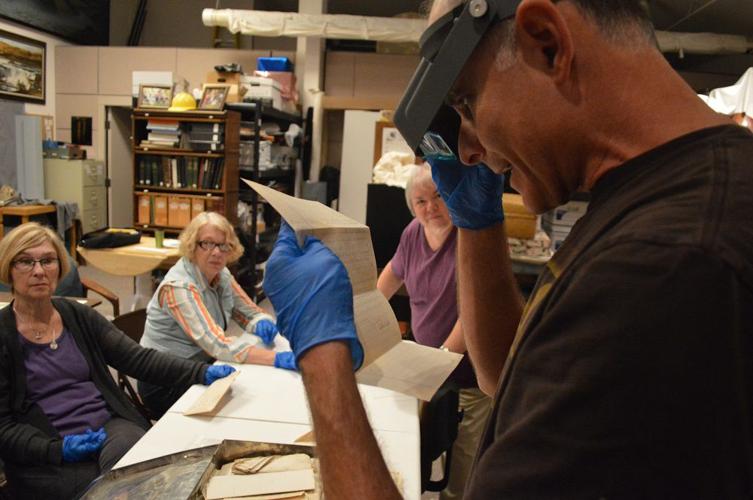
Arthur Babitz studies a historic letter from a box of school district records at the History Museum of Hood River County Wednesday, peering through a magnifying visor. Historic committee volunteers Gail Lyon, Betty Shalhope and Joyce Jennings look on.
Arthur Babitz studies a historic letter from a box of school district records at the History Museum of Hood River County Wednesday, peering through a magnifying visor. Historic committee volunteers Gail Lyon, Betty Shalhope and Joyce Jennings look on.
Patrick Mulvihill
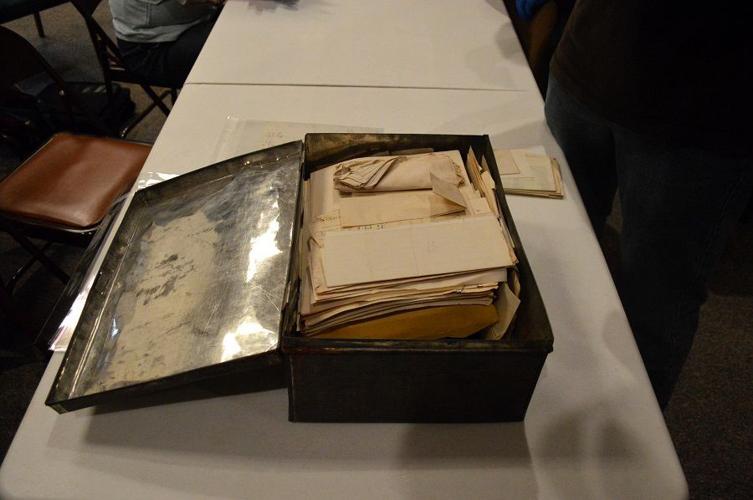
A tin box reveals artifacts – letters, bonds and school board records -- from the late 1800s through the mid-1900s.
Patrick Mulvihill
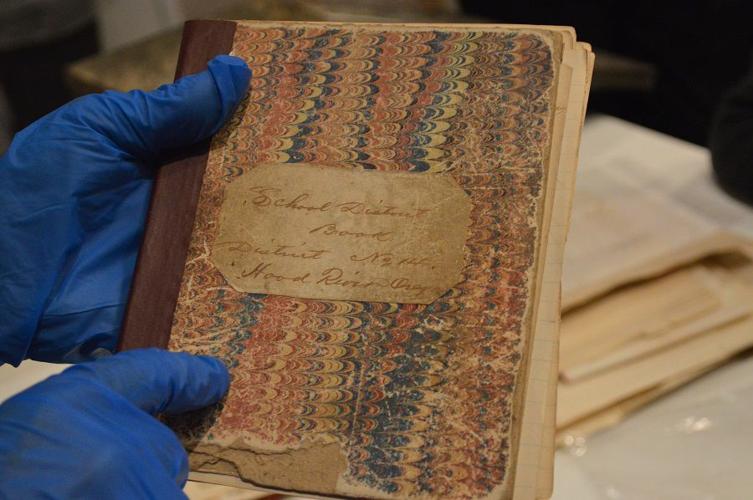
Above, a school board ledger discovered last December alerted the museum that HRCSD is nearing its 150th anniversary.
A metal box of school district history posed an exciting challenge for volunteers at the History Museum of Hood River County.
The box, which volunteer historians Arthur Babitz and Dottie Gilbertson uncovered in the museum’s archives last December, turned out to be full of documents marking the 1865 creation and early years of Hood River’s school district — a timely discovery considering the school is hitting its 150th anniversary in November.
Babitz said he was “surprised” when he discovered the tin box while working on another research project.
“I think it’s fair to say it was unknown we (were) coming up on the 150th anniversary until we rediscovered this,” said Babitz of records in the box.
Babitz said he called up Hood River County School District Supt. Dan Goldman and former Supt. Pat Evenson-Brady and neither was aware the anniversary was approaching.
Ever since the box was discovered, the museum has been piecing together a new exhibit to celebrate the school district’s sesquicentennial, with a grand opening slated for next year.
On Wednesday, a committee of volunteers gathered at the museum for a closer look. They donned rubber gloves and popped open the old tin box, which read “Old old records … SAVE!!!”
Documents included letters sent to school officials, bonds, tax and insurance records, school board minutes and — possibly the most detailed find in the box — a bound ledger chronicling school board actions from the district’s creation in 1865 through 1882.
According to the ledger, the notice of establishment for “School District of Hood River, District No. 14” in Wasco County was dated Oct. 28, 1865 — just months after John Wilkes Booth shot Abraham Lincoln.
The first board meeting was held on Nov. 11, 1865, in Hood River founder Nathaniel Coe’s house. In the school district’s kickoff term, 17 students attended for three months and the first school teacher, William B. Stilwell, was paid $90.
At the time, Hood River was part of Wasco County, the largest county in the United States, which spanned much of Oregon Territory east of the Cascade Mountains. Hood River remained a part of Wasco until it seceded in 1908.
The original Hood River school district was legally bounded on the north by the Columbia River, on the west by “the mountain,” on the southeast by the Hood River … and also “included the farm of J.B. Condon on the east side of Hood River,” according to the ledger.
Other records in the box revealed lighter, amusing moments from bygone decades.
In 1924, Professor A. M. Cannon, Supt. of Hood River schools, sent a letter to a concerned parent about students playing marbles for keeps.
“Boys are not permitted to play for keeps on the school grounds, but many times they do it. They have been warned against it and teachers have broken up games detected. The Park Street principal has confiscated marbles of offenders,” wrote Cannon.
In a 1944-45 meeting entry, the school clerk recalled a gathering where “chicken and ice cream” delighted the children. While sorting the letter into a Ziploc bag Wednesday, museum volunteers commented that sugar was rationed during World War II, and was thus a cause for celebration.
Besides reading documents for the intrigue factor, volunteers were hard at work filing and preserving the documents. Most were pieces of rag paper in “good condition.”
Volunteers estimate the box of records hadn’t been examined for at least 30 years. The only clue pointing to its last perusal was stickie notes attached to several pages, which suggest someone handled the documents in the 1980s or later — Post-It Notes were first mass-circulated by 3M in 1980.
The team of volunteers who banded together Wednesday included former city and school leaders: Babitz, Evenson-Brady, Gail Lyon, Joyce Jennings and Betty Shalhope.
“It’s been really fun,” said Evenson-Brady. “The fact that we could work with documents that had a direct relationship with where we live was way cool.”
The museum plans to build up its exhibit over the next few months. The next steps are laying out historical documents in a rough timeline, and getting interviews with former educators. Volunteers are also seeking donated artifacts to put on display.



Commented