
By SVERRE BAKKE
The Enterprise
A perceived lack of progress on the SR 14/Bingen Point overpass project led the Klickitat County Board of Commissioners to issue a letter of concern near the end of June.
That letter got the attention of the Washington State Department of Transportation’s Columbia Gorge Office, which is in charge of planning and designing the project.
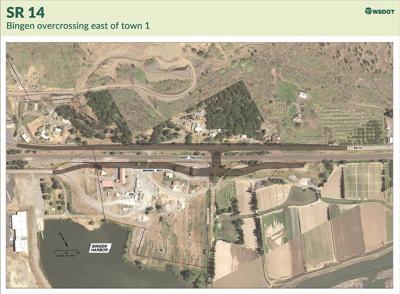
The Legislature authorized $22 million in 2015 for design and construction of a crossing that connects State Route 14 to Port of Klickitat property on Bingen Point. This would be an alternate route for traffic that currently uses railroad crossings to enter and leave the point.
WSDOT Project Development Engineer Casey Liles was expected to meet with the County Board on Tuesday, Aug. 1, to bring it up to speed on the project’s status.
County Commissioners Jim Sizemore, David Sauther, and Rex Johnston wrote on June 27 that they “are concerned that the original purposed of the Bingen Point Overpass project is not being followed. The purpose of the project is to provide not only reliable and safe access between Bingen Point and SR 14 but also as a means to evacuate hundreds of people working at the Port of Klickitat Bingen Point Business Park should a natural disaster or train derailment occur.”
The County Board, moreover, expressed “concerns regarding the design phase of project which appears to be moving forward with options that are not practical nor affordable.”
Commissioner Rex Johnston said his preference is “somethinng that will be functional and take up as little property as — whichever design we can build for the money we have available.“
WSDOT Project Engineer Kevin Reck wrote back to the County Board on July 12 that the agency’s goals are to provide safe and reliable access between SR 14 and Bingen Point “while keeping costs under the amount allocated by the Legislature.”
Reck also noted WSDOT “received helpful feedback from residents and elected leaders” on the design options presented during and following the open house it held earlier this summer.
“With this input,” Reck wrote, ”we are considering additional alternatives with the intent of presenting a preferred design to the public this fall” during an open house that is not yet scheduled.
According to a project timeline prepared for and made available at the June open house, WSDOT is working with two dedicated funding sources: one for design, the other for construction.
Construction funds won’t be-come available to the project until the summer of 2019.
“From what [WSDOT] told me, they are locked into a process and can’t move any faster,” said Jim Sizemore, chairman of the County Board. “Their hands are kind of tied because of the process they have to follow.”
“Even if we were ready to advertise for a construction contractor later this year, those funds are not available until 2019-2020,” said Bart Treece, WSDOT’s Southwest Region communications manager. “As it stands now, our target is 2020 for that portion of the work to begin. Given the nature of the revenue source, a mix of bonded money plus pay-as-you-go, projects cannot be advanced without Legislative action.”
Sizemore said the commissioners’ primary complaint is that WSDOT did not initiate the design phase earlier than it did (summer 2016, according to the timeline).
“We, the county, need that overpass built for big-time safety issues on Bingen Point,” Sizemore added. “At the end of the day, though, we are where we are, and the process is under way and moving ahead.”
The design phase of the project will be finished this fall. Comple-tion of this task will usher in the environmental phase, which is expected to take about a year.
Right-of-way acquisition is the next phase in the process (fall 2018 to spring 2020). Construction will take place between spring 2020 and the summer of 2021.
When it passed the $16 billion Connecting Washington transportation package two years ago, the Legislature also required WSDOT to implement the concept of “practical design.”
Practical design “is a process in which we identify the purpose and need of the project, along with a performance measure (travel speeds, reduction in delays and/or collisions) and build the project that accomplishes the goal or goals without overbuilding,” Treece explained.
In prior years, WSDOT would have developed and built a project to full design standards that would have still satisfied the need, but also added items that may not have been necessary, or out of character with connecting routes, Treece noted.
“To sum it up, we’re doing a lot of work on the front end to ensure the finished product is under budget and meets the economic development, safety, and mobility needs of the community,” Treece said, “and also provides safe and uninterrupted access between the port area and the highway.”


Commented
Sorry, there are no recent results for popular commented articles.