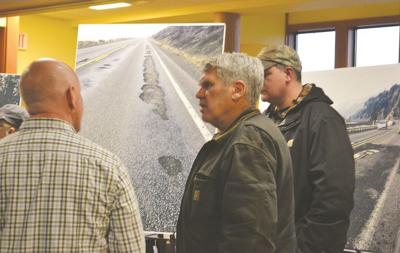
Washington State Department of Transportation maintenance superintendent Bill VanAntwerp (left) spoke with residents of Skamania County about short-term and long-term fixes to SR 14 last week during WSDOT’s open house in Stevenson. In the background, pictures of potholes along SR 14 reveal the road’s deteriorating state.
Washington State Department of Transportation maintenance superintendent Bill VanAntwerp (left) spoke with residents of Skamania County about short-term and long-term fixes to SR 14 last week during WSDOT’s open house in Stevenson. In the background, pictures of potholes along SR 14 reveal the road’s deteriorating state.
State Route 14’s growing collection of potholes has routine drivers more than shaken up over the road’s poor condition.
To address local concerns, Washington State Department of Transportation (WSDOT) held an informal information session during last week’s Wind River Road open house at Stevenson’s Hegewald Center to talk short and long-term road repairs.
Residents from across Skamania County voiced unrelenting frustration to WSDOT maintenance superintendent Bill VanAntwerp and communications manager Bart Treece during the open house.
“It’s ugly,” Treece conceded. “We’re going to get out there as soon as possible to do a permanent repair, but we can’t pave when it’s cold and wet.” If crews were to fill potholes holding water, the cold mix wouldn’t stay in place for long, he said.
WSDOT has secured some funding to continue patching the highway and has already taken advantage of dry days, such as last Friday, to make some quick repairs. Holes were patched along SR 14 east of Stevenson. During the patching process crews had several passing drivers express thanks as they rolled by, Treece said.
Currently, WSDOT is tackling short-term fixes that include filling potholes with cold mix to even out rough patches, installing “rough road” signage, and reducing speed limits.
“Short-term, we’re going to hold it together with some asphalt,” VanAntwerp noted, “temporary cold-mix type of stuff, till pavement temps warm up and we can do a good job.” Temperatures need to be around 63 degrees for paving, VanAntwerp said.
Filling potholes with standing water isn’t an option for maintenance crews. “Think of it like, we have this money to fill a pothole, I can go out there today and throw it in that hole that is full of water but I’m going to be right back out there two days later doing it again,” explained VanAntwerp.
“Was that the best thing to do? Or, should I take that money and put it toward a speed limit reduction or some signage to at least get people looking at it to understand, slow down it’s bad and we’re doing about everything we can,” he said.
WSDOT’s blog states that reducing speed limits along some areas of the state route will help “avoid additional deterioration of the highway from traffic moving at high speeds.”
The long-term solution for SR 14 could break ground sometime this spring, with the removal of existing damaged road followed by repaving of the highway.
“The two times we’ve seen the worse conditions on this road [SR 14] are after the train derailment in June and the ice/snow storm now, so it’s specifically way too much traffic on there,” said VanAntwerp. “It isn’t something you can necessarily plan for; that high volume of traffic isn’t going to happen every day.”
According to Skamania County Undersheriff Pat Bond, the rough roads near milepost 45 have more than rattled a few drivers as they drive by.
“We have had four [accidents] this month at or near milepost 45, two non-injury and two injury,” Bond noted in an e-mail. “They can be tied directly to the potholes or drivers attempting to negotiate their way around them.” There has been a total of seven accidents in the area since Feb. 1.
“The key is to slow down,” Bond said, “adhere to the 35-mph speed zone. The speed has been lowered as to avoid a collision or damage to vehicles. Some of the potholes are too large to avoid, don’t attempt to use the shoulder as they are very soft due to snowmelt and extensive rain.”



Commented