
Klickitat PUD will be holding three public meetings on Feb. 3 to discuss its latest power generation initiative, the closed-loop John Day Pool Pumped Storage Hydroelectric Project, which is currently being developed under a preliminary permit from the Federal Energy Regulatory Commission (FERC).
A KPUD notice dated Jan. 13 and addressed to The Enterprise as a “potentially interested party” states the utility is hosting the public meetings for resources agencies and the public to get acquainted with and discuss the project. The meetings are required under the FERC licensing process.
The meeting schedule for Feb. 3 includes a site visit at the Golden-dale Aluminum facility’s main building, 85 John Day Dam Rd., from 10 a.m. to 1 p.m. Participants must furnish their own transportation; carpooling is encouraged.
An initial public meeting will be held from 3 to 5 p.m. in the auditorium of the KPUD offices, 1313 S. Columbus Ave.; doors open at 2:30. A repeat of the first meeting will be held from 5:30 to 7.
So what is a closed-loop pumped storage hydroelectric facility?
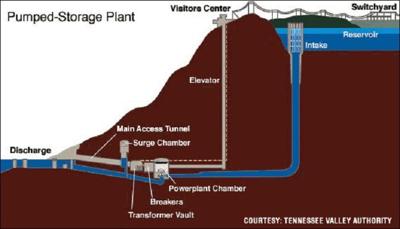
According to FERC’s Web site, pumped storage projects move water between two reservoirs located at different elevations (an upper and lower reservoir) to store energy and generate electricity. Generally, when electricity demand is low, like at night, excess electric generation capacity is used to pump water from the lower reservoir to the upper reservoir. When electricity demand is high, the stored water is released from the upper reservoir to the lower reservoir through a turbine to generate electricity. (See the diagram of a pumped storage project above.)
FERC defines “closed-loop pumped storage as projects that are not continuously connected to a naturally flowing water feature.”
According to an entry on Wikipedia, “Pumped-storage hydroelectricity (PSH) is a type of hydroelectric energy storage used by electric power systems for load balancing. The method stores energy in the form of gravitational potential energy of water, pumped from a lower elevation reservoir to a higher elevation. Low-cost, off-peak electric power is used to run the pumps. During periods of high electrical demand, the stored water is released through turbines to produce electric power. Although the losses of the pumping process make the plant a net consumer of energy overall, the system increases revenue by selling more electricity during periods of peak demand, when electricity prices are highest. Pumped storage is the largest-capacity form of grid energy storage available, and, as of March 2012, the Electric Power Research Institute (EPRI) reports that PSH accounts for more than 99% of bulk storage capacity worldwide, representing around 127,000 MW. PSH reported energy efficiency varies in practice between 70% and 80%, with some claiming up to 87%.”
FERC said in an August 2014 update that it has seen an increase in the number of preliminary permit applications filed for pumped storage projects. A preliminary permit does not authorize construction, but it maintains priority of application for license (guaranteed first-to-file status) while the permittee studies the site and prepares to apply for a license. This is where KPUD is in the process.
FERC says many of the recently proposed pumped storage projects can be classified as using a closed-loop system.
According to KPUD’s pre-application document (PAD) filed with FERC on Oct. 31, 2014, the project is a closed-loop hydro-power facility that consists of seven major parts and would use the Columbia River for initial filling and periodic refills. Depending on the final operating scheme, “the estimated annual output of the project could be as high as 4,200 giga-watt-hours,” according to KPUD’s PAD.
A lower reservoir, with a surface area of 100 acres and enclosed by a 165-foot-high rock embankment, would be built off-stream next to John Day Dam. Two enclosed up-per reservoirs, on the Columbia Hills above the main site, would be built with surface areas of 46 and 67 acres, respectively at a maximum elevation of 2,785 feet above sea level.
The project would be powered by a powerhouse with four reversible, adjustable-speed pump/turbine motor/generator units rated at 300 megawatts each. Water would be pumped into and circulated through two 21-foot-diameter underground waterways totaling about 9,500 feet in length. Power generation from the project would be directed into a nearby Bonneville Power Administration (BPA ) substation via a 3,000-foot-long, 230-kilovolt transmission line.
The project has been in the works since FERC issued KPUD a preliminary permit on May 5, 2009 to study the feasibility of the proposal. FERC granted a successive preliminary permit on Nov. 16, 2012, to continue the feasibility study.
Washington’s Legislature gave the project its stamp of approval in January and February 2012 with unanimous votes in favor of a substitute Senate bill that authorized “a PUD bordered by the Columbia River may supply any water, as authorized by a previously perfected water right under its control, to be used in a pumped storage generating facility. Among other conditions, contracts concerning the sale of these resources must be approved by a vote of PUD’s commissioners after a minimum of 10 days public notice.”
The executive summary of the PAD notes the project would provide “necessary ancillary services and energy storage to the Northwest Region and allow for more reliable management and integration of disparate renewable energy sources,” such as wind and landfill gas, into BPA’s power grid.
“Within the region, renewable energy development is growing, primarily through wind power generation,” the PAD states. “The project would provide additional ramping capacity (both up and down), as well as firming for wind energy regulation, coordination and scheduling services, and suppport of system integrity and security.”
The project is not without controversy, though. The Confederated Tribes and Bands of the Yakama Nation have gone on record with FERC in opposition to the project. A letter dated Oct. 27, 2014, from Johnson Meninick, the Yakama’s Cultural Resources program manager, to Skeahan notes the proposed project is within Yakama Nation Ceded Areas under the Treaty of 1855 with the U.S.
“It is the policy of the Yakama Nation to preserve, protect, and perpetuate all significant natural and cultural resources. Only the Yakama Nation can determine what is significant to the Tribe,” Meninick wrote. “Upon review of the proposed project and based upon extensive working knowledge of the proposed project area, the Yakama Nation is opposed to this undertaking as it would cause detrimental impacts to significant cultural resources near the John Day Dam and the Columbia Hills.”
Snowden resident and avid birder Dawn Stover also raised concerns about the project’s environmental impacts with FERC in a letter dated Nov. 30, 2014.
“The scope of this project is by no means ‘minor,’ nor are the resource issues ‘simple and minimal,’ as the applicant claims,” Stover wrote. “This project would cause major alterations and disturbances to lands and waters during the 5-year construction period and afterward.”
Stover continued, “Finally, it is difficult to see how this proposal is necessary or cost-effective, considering the major losses in efficiency that happen when wind energy (which is only about 30 percent efficient to begin with) is used to pump water uphill and then converted to hydropower-generated electricity when it runs back downhill. Something like 20 to 30 percent of the stored energy is likely to be lost during the conversion process, not to mention the water lost to evaporation (which might otherwise pass through the John Day Dam and other hydropower stations on the Columbia).”
Stover, moreover, argues that Klickitat County has already developed more renewable energy than is needed to meet demand.
“Adding more storage to the existing hydropower system would only incentivize the development of additional wind power projects, further elevating the risk to golden eagles and other wildlife,” Stover wrote. “Those long-term, cumulative impacts must be considered as part of any environmental analysis of the KPUD proposal.”


Commented