
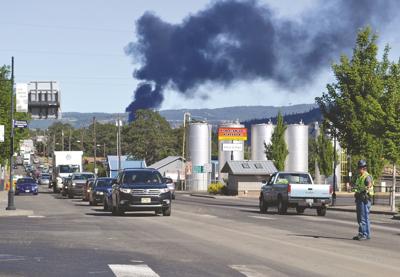
A column of smoke scarred the sky early Friday afternoon after a Union Pacific oil train, containing Bakken crude oil from Idaho on its way to Tacoma, derailed in Mosier on tracks paralleling Interstate 84 near Mosier’s wastewater treatment plant. No injuries have been reported as a result of the accident.
Union Pacific has identified a preliminary cause of the crash, saying a bolt that fastens the rail to the railroad ties may have been at fault. A final determination of the cause has not been made.
Sixteen of the train’s 96 cars derailed, causing a fire to ignite four of the derailed cars. Officials estimate that 42,000 gallons of crude escaped from four rail cars. Thirteen cars remain at the wreckage site and two have been emptied. The oil will be transferred to The Dalles for transport by rail to Tacoma, its original destination.
The fire burned in to the early hours of Saturday, until it was extinguished at approximately 2 a.m.
Union Pacific estimated 10,000 gallons were removed from the wastewater system after the crash, and projects the remaining 32,000 gallons to have either burned off and vaporized, or were captured by booms in the Columbia River, or absorbed by soil. An undetermined amount remains in wastewater lines.
Wasco County Sheriff’s deputies evacuated residents residing in a quarter mile area of the incident. By 8 p.m. Friday approximately 125 Mosier residents had been evacuated. The Red Cross opened an evacuation shelter at the Dry Hollow Grade School in The Dalles. The evacuation order was lifted Sunday after 10 p.m.
While residents were evacuated, Wasco County deputies patrolled the evacuated area to protect properties.
After burning for a few hours, the resulting smoke from the fiery rail cars prompted the Klickitat County Health Department to issue an Unhealthy for Sensitive Groups Advisory. The advisory urged sensitive individuals with asthma, repertory infection, lung or heath disease, and diabetes to limit moderate physical activity and remain indoors.
The Oregon Department of Transportation closed a 23-mile stretch of Oregon’s Interstate 84 around 1 p.m. The closure began at milepost 87 westbound in The Dalles, and extended to eastbound 64 milepost near Hood River. The interstate remained closed until 11 that evening.
During the closure, traffic was rerouted across the Hood River-White Salmon Bridge to State Route 14, which created lengthy delays for motorists on SR 14, the Hood River-White Salmon Bridge, and U.S. 197. The Port of Hood River suspended tolls as a result of the overwhelming traffic.
The Port of Hood River office was still recovering from Friday’s accident on Tuesday, but estimated cash tolls were suspended for about 12 hours. As of Tuesday afternoon, the port was still calculating lost revenue.
In Cascade Locks, after a request was issued by the Oregon Department of Transportation, the port district there also suspended tolls about four hours after some 7,000 vehicles crossed The Bridge of the Gods. The free tolls will be billed to ODOT by the port.
A call for BNSF railroad officials was issued around 3 p.m. after spectators were seen crossing over BNSF tracks to take pictures of the smoke column. BNSF officials responded by patrolling the tracks within Bingen and east of the city to ward off trespassers and prevent any accidents.
Around 3:30 p.m. Friday, the Klickitat County Emergency Notification System issued a county alert urging public motorists to avoid traveling on SR 14 between Bingen and Dallesport. At the time the agency anticipated the circumstances to be a “long term event that will affect traffic on both sides of the Columbia River.”
Washington State Patrol responded by providing traffic control through Bingen while re-routed motorists congested both east and westbound lanes of SR 14. Reported travel time of up to three hours were reported heading from The Dalles to White Salmon.
Gov. Jay Inslee released a statement a little after 4 p.m. Friday, acknowledging the derailment as “yet another reminder of the risks and concerns of crude-by-rail transport in our region.” Inslee also joined Oregon Gov. Kate Brown in commending the “swift response from Oregon’s public safety and transportation officials.”
Agencies responding to the incident included: West Side Fire District, Wy’East Fire, Lyle Fire District, White Salmon Fire, Appleton Fire, Klickitat County Fire District 3, Dallesport Fire, the U.S. Forest Service, Oregon Department of Forestry Mid-Columbia Fire and Rescue, Gresham Hazmat, Wasco and Hood River county sheriff’s offices, Hood River Police Department, Oregon State Police, and Intertribal Fisheries law enforcement.
The Washington Department of Ecology placed about 1,000 feet of containment boom on the Columbia River after an oil sheen had been spotted near the derailment site. The booms were still in place Monday, June 6, while environmental crews continued the search to locate, and control, the source of the sheen.
Booms remain in place as a precautionary measure. No new signs of oil sheen have been seen on the Columbia or other channels. Environmental crews are continuing efforts to identify and control the source of the sheen.
A boil water order was lifted for Mosier residents Monday at 2 p.m. after water sample tests showed water from a back-up well was safe to drink. The accident damaged a wastewater treatment plant pipeline; a short-term fix has allowed operation of the city’s wastewater treatment plant to continue.
The temporary fix has allowed the city to restore sewer service to local customers. Mosier’s wastewater will be collected and trucked to Hood River for disposal due to the limitations of the temporary fix.
In Hood River, a community gathering was held at Overlook Memorial Park Saturday afternoon to call for an end to dangerous oil trains. The event was followed by a march through downtown Hood River.
Oregon political leaders called for a moratorium on oil train traffic through the Columbia River Gorge Monday. Oregon’s Senators Jeff Merkley and Ron Wyden, Gov. Brown, and Representatives Earl Blumenauer and Suzanne Bonamici released a joint statement calling for a temporary halt to oil train traffic in the Gorge in light of last Friday’s derailment.
The joint statement expressed concerns with Union Pacific’s decision to continue rail traffic through the area while the area was still in recovery mode. Leaders wrote: “It is too soon to resume oil train traffic through the Columbia River Gorge. Union Pacific should not resume oil train traffic before meeting with the community of Mosier and giving a thorough explanation for the cause of this accident and an assurance that the company is taking the necessary steps to prevent another one.”
According to the statement, “A train full of toxic crude oil derailing, burning, and exploding near homes, schools, and businesses is a worst fear realized for people who live in Mosier and in other communities along the tracks throughout the Gorge.”
Oregon political leaders said they plan to push for the Department of Transportation to “take a hard look at alternative routes for oil and hazardous material trains that would put fewer Oregonians at risk of a dangerous crash in their backyards.”
Mosier’s city council passed an emergency motion Sunday evening, calling on the Union Pacific Railroad to remove oil from damaged cars before resuming rail traffic. Trains resumed using the tracks Sunday evening, after they had been repaired.
According to Mosier’s Volunteer Fire Chief and Joint Incident Command Representative Jim Appleton, the geographic response plans Oregon has in place worked well and allowed multiple agencies to come together quickly and respond to environmental, public health, and community needs.
Federal, state, tribal, and local authorities remain at the command center at the Mosier School to coordinate response until the cleanup is complete.


Commented
Sorry, there are no recent results for popular commented articles.