
After casting your vote, where does it go? You send it into the mail box’s abyss, or slide it into a local ballot box and poof, you’ve voted. For the Klickitat County Auditor’s Office, a cast vote is just the beginning.
At Klickitat County’s Auditor’s Office votes aren’t really counted, they’re scanned. Before a vote is scanned in to the system, it’s collected from either a ballot box or received in the mail.
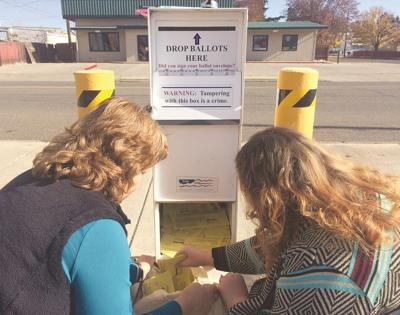
Last Friday’s sunny weather made for an easy collection from Goldendale’s ballot drop box for County Auditor Brenda Sorensen. As she and a co-worker emptied the ballot box a steady stream of voters passed their ballots through the slot, or directly in to the canvas tote Sorenson and her coworker used to collect ballots.
Before opening the ballot box, a small blue tag is removed and placed on the canvas tote. “What this is for, specifically, is to make sure that no body has broken that seal and gotten a key and gotten in to the box. Every time it’s got to match up,” explained Sorensen referring to the accountability log and blue-tag-seals.
Ballots are collected and placed in the canvas bag, with the blue tag from the ballot box clipped to a handle for identification. Sorenson then writes her name, date, the number of a new tag, whether they opened or closed the box, and then gets her coworker to cosign the log. The recorded tag is then placed on the box, which is locked open, then the two head back to the courthouse for the next step.
Votes are processed as soon as they start showing up at the Auditor’s Office, Sorensen explained. Twenty to 19 days before an election, ballot drop boxes are locked open, ready to receive votes. “As soon as they start coming back in we start,” Sorensen said.
As of last Friday, Sorenson estimated about 35% of the county had voted, she anticipated about an 80% turn out as the final percentage. “A lot of people are waiting to the last minute,” Sorensen added.
In the Auditor’s Office votes are process is batches, those not being processed are kept in a safe-locker protected by a hefty lock, and blue identification tag. The locker also has an accountability log, requiring two people to sign and record the tag number each time the locker is opened and a new tag is installed.
The first step of processing a batch of collected ballots is verifying the voter’s signature on the envelope. Unsigned envelopes are put on hold until the voter can send in their signature. Signature Scanners undergo Washington State Patrol signature recognition training before taking on the task.
When an envelope is scanned, the system pulls up the voter’s signature from their voter registration. From there the scanner looks for three points of similarity within the signatures before marking the names as a match.
Non-matching signatures aren’t uncommon on ballots.
“Everybody’s signature changes over time,” said Sorenson. “There’s three points, and if you find three points your good, but if you’re not then you send them a letter saying ‘hey your signature doesn’t match.’ Sometimes it’s age, sometimes it’s just people change their signature, sometimes it’s health reasons.”
If there’s any question of doubt as to whether a signature matches, the scanner pulls two colleagues to confer before making the decision to mark the signatures as a match or not. Ballots without matching signatures are put on hold in a new batch. The system then generates a letter for the recipient to verify their new signature which is sent out the next day.
Ballots aren’t officially counted when signatures are being scanned, although it gives the next person an idea of how many ballots are in a batch.
After a ballot’s signature has been matched to the one on a voter’s registration card, it’s removed from its envelope and inspected for any defects. “We’re looking to see if there’s overvotes, or write ins, or if there’s any kind of stray markings,” said Sorensen. “We make sure there’s no spoil marks in the bar codes, because then it’s a spoiled ballot and has to be duplicated.”
“You can tell they’re looking over their ballot at breakfast or dinner,” Sorenson said referring to when ballots come in with food stains. Ballots with stains are duplicated in order to be processed. Some ballots have notes scribbled in the margins, “We’ve had some really nasty comments,” noted Sorensen.
While one person inspects ballots, another looks on to make sure everything is in order. Ballot processing is all about having a second set of eyes to keep things in check.
Inspected ballots are then handed off to Brandy Sullivan, the Elections Administrator, to scan in to the system and save to a Mobile Ballot Box (MBB). The computer Sullivan works on has no internet connection as a precaution against hacks.
“There’s a lot going on,” said Sullivan while scanning ballots. Part of Sullivan’s job is resolving any issues with a ballot.
For example, if a voter marks one name on their ballot and then crosses that name out before recasting their vote for another candidate, it’s considered an overvote. The scanner will pick up on the overvote and highlight it for Sullivan, who will tell the program which entry is the casted vote. A true overvote won’t be counted.
Sometimes the intent of a voter is questionable. “The state puts out a book for us called Voter Intent, which has lots of examples of the different things voters might do, which helps us tremendously,” said Sullivan. “But sometimes you get an example where you may not find it in here.”
Those ballots are sent to a canvasing board, made up of the prosecuting attorney, Auditor, and board of county commissioners chairman, to determine the voter’s intent.
Once ballots are scanned, Sullivan moves to ballots with write-ins and manually enters all candidate write-ins. “In a presidential election we tend to see a lot of write-ins,” said Sullivan.
At the end of scanning, Sullivan saves all the cast ballots to a Mobile Ballot Box (MBB), which is like an external hard drive. To access saving to the MBB, Sullivan has a set of keys with an attached pin. “On election night, at eight o’clock I will take that card and put it in the other computer,” explained Sullivan.
“We’ll do an upload election night, we’ll do one the next day, and the next day, until we’re all caught up,” added Sullivan. The uploaded results are then sent to the state who publishes the tallies online. From there the process is mostly done.
After elections, the Auditor’s Office has a retention schedule with the secretary of state’s office. For federal elections ballots are kept 22 months, special elections require 60 days, before the ballots are shredded.
The Auditor’s Office works through election ballots from start to finish. “We assemble the ballots ourselves in the office, we print our own ballots, we mail them, [and] we open them when they come back,” explained Sullivan. “We do everything.”


Commented