Growing up, some kids go through a career-choosing phase, wanting to pursue the path of a doctor, marine biologist or professional athlete. For Dr. Joni Greenberger, her desire to become a vet was sparked at an early age and drove her pursuits to veterinary school, where her passion continued.
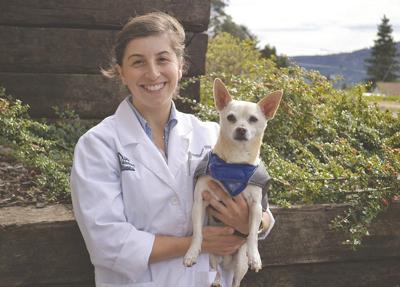
Greenberger is Alpine Veterinary Hospital’s newest vet, a transplant from Portland, Ore. Greenberger spent a lot of time in the Gorge before making the move this summer.
“I moved here the end of July, but I lived in Portland before and I was out in this area all the time and definitely fell in love with it over the last couple of years,” said Greenberger. After attending Tufts University School of Veterinary Medicine in 2010, Greenberger practiced on the east coast before moving to the Pacific Northwest in 2014.
“I have a background in sports medicine and rehabilitation,” explained Greenberger, “so that was the majority of what I was doing [in Portland], but previous to that I had been a general practitioner in New England and really liked the whole general practice, rural medicine, being a family Vet, sort of thing and was really excited to get back to it.”
The desire to be a veterinarian started at an early age for Greenberger. “I was definitely one of those kids that wanted to be a vet since I was about four or five years old,” she said. “I always knew I wanted to be a vet, although I wasn’t sure what kind. For a little while I wanted to be a wildlife vet, and then for a little while I wanted to be a large animal vet, but by the time I ended up at Tufts in Massachusetts, I was pretty interested in general medicine.”
Pursuing general medicine in New England led her to working with sled dogs, which then introduced Greenberger to another practice within veterinarian care: sports medicine and rehabilitation.
Approaching her furry patients through the sports medicine scope is a little different than general medicine, Greenberger explained. “Basically it’s a little bit different approach from your typical pet. We have more concern about confirmation and structure, and how that translates into function for the dog, or occasionally other kinds of animals,” explained Greenberger.
Most of sports medicine is either dogs or horses nowadays, Greenberger noted, “Because those tend to be animals that we use for different sports and different jobs,” Greenberger added.
“As an example of a difference between a sports medicine approach and a traditional approach is, in sports medicine we like to wait a little bit longer to neuter or spay animals because we like the effect of the hormones on the growth of the bones and the development of the muscles,” Greenberger said. “If a dog is going to be serving a function, we want that to be really maximized.”
Even though the discipline is called sports medicine, Greenberger says a lot of the work she does is with older animals with arthritis, chronic neurologic disease, or muscle wasting. “Things that traditionally have just been attributed to age, we’re now saying ‘OK age is not really a disease, why do we have this muscle wasting, why are we losing this function, how can we address the nerve roots that are affecting this?’”
“It’s just a little bit more of a comprehensive approach, a little bit more holistic in a way,” explained Greenberger. “I do use some complementary modalities as part of it as well. I’m certified in acupuncture and I do end up using acupuncture for a lot of my patients. We do a little bit of herbal therapy, a little bit of nutraceutical work. So, taking just a little more of a holistic approach to the care of the animal.”
Working in Bingen’s Alpine Veterinary Hospital has been a mix of patients, from routine care to treating bite wounds and infections. “I really do like the variability of it, I like the unexpected nature of it. We see a lot of vaccines and routine care, which is always fun. It’s always nice to get back to the puppies and kittens,” Greenberger said with a smile.
“I was trained as a surgeon before I got in to sports medicine, so I’m definitely excited to get back to the surgery side of things too,” Greenberger added.
When Greenberger isn’t attending to barking, meowing, or any other calling animal, she’s outside whitewater kayaking or riding a trail.
“One of the big reasons why I’m out here is definitely for the outdoor recreation side of things,” Greenberger confessed. “Kayaking is definitely the biggest draw. I pretty much do that whenever I’m not working,” she said with a laugh.



Commented