
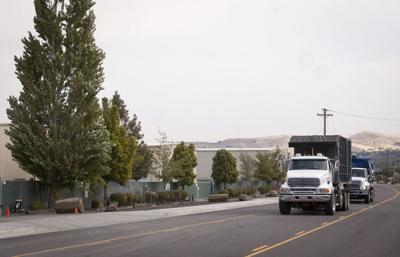
Eight birds were reported killed in the September incident at The Dalles Transfer Station, which caused a temporary evacuation of the facility.
The white powdery substance recovered at the facility was similar to an insecticide called Dieone, according tests done for Waste Connections, Inc., which owns The Dalles Transfer Station.
Calls placed to the transfer station in the weeks after the incident were not returned, and a staffer there eventually said no comment would be made. The Chronicle then called the Oregon Department of Environmental Quality. It, in turn, sought fuller reports from the transfer station, which it recently received and then forwarded to the Chronicle earlier this month.
The DEQ provided a report by a transfer station staffer who said that at 11:30 a.m., Sept. 18, two employees reported a customer dropped off a mixed load with dirt, and when it dropped off the conveyor belt, it created a white cloud that went into the air. The employee immediately vacated the station, and noted that eight birds were dead in the general vicinity where the substance was.
“I asked if he was certain that the birds died within the transfer station and were not in the load and he stated, that yes, the birds were alive hanging around earlier and then just suddenly died,” the staffer stated.
That staffer closed the perimeter gates immediately, called the district manager of the facility and then the non-emergency number for Mid-Columbia Fire & Rescue. Fire officials told them to evacuate immediately and meet fire crews across the street.
They were allowed to re-enter the property at about 4 p.m.
According to a report by Erwin Swetnam, district manager at the transfer station, his staff called him to tell him about the spill, and wanted to call DEQ right away. Swetnam, who was in Hood River, said to call the fire district first, and that he’d be on his way over.
Swetnam called a Portland company, National Response Corp., for cleanup. They were on scene by 5 p.m., and collected about a half a jar of dust for analysis and left by 7 p.m.
Swetnam said in his report that “no clean [up] was needed as most of the material either went out the open doors when the event happened or was in the trailer below the conveyor belt.
The facility remained closed the next day, as a precaution, he wrote, but “birds were back in building, no odd smells, everything looks good. I did call NRC to check on testing nothing had come back. He said we were fine to open but we did not just as a precaution.”
He said the building reopened on Saturday. “Lots of birds, some customers asking questions but all was fine.”
Swetnam notified the local DEQ representative and also city public works, the city manager and city attorney, he said in his report. The public works department, which is a few blocks from the facility, went into lockdown for a few hours as a precaution the day of the spill.
While the transfer station staffer noted bird deaths in her report, it is unclear whether Swetnam told DEQ about them when he called them, said Shari Harris-Dunning, natural resource specialist for the solid waste program at the DEQ office in Bend, in an email to the Chronicle.
“There does seem to be a discrepancy in the information initially provided to DEQ,” she said. The DEQ call-taker “was informed ‘birds are chirping’ which was inferred as no impact to birds/wildlife and [the call-taker] doesn’t recall information about dead birds,” Harris-Dunning said.
Harris-Dunning said Swetnam’s report “does look different than the other memo” from the transfer station employee in that it doesn’t mention bird deaths.
“I think I’m beginning to connect the dots on what may have happened with respect to what information was relayed to us,” she said. “Erwin was not on site when the incident occurred. I believe initial information did not include anything about the birds but more about the powder and getting NRC on board to deal with the incident.”
Swetnam did not return several calls for comment.


Commented
Sorry, there are no recent results for popular commented articles.