
A nationwide, longstanding drop in volunteerism across all interests has so impacted the fire service that federal grants have been awarded to boost volunteer firefighter rosters.
Mid-Columbia Fire & Rescue has begun its second four-year grant-funded position aimed at increasing volunteerism.
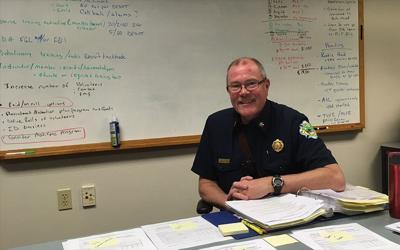
Division Chief Rob Torrey started work in January at the fire district, bringing with him over 30 years of experience in the fire service. His area of responsibility is training and volunteer recruitment and retention. The grant actually covers both MCFR and the Dallesport Volunteer Fire department, said MCFR Chief Bob Palmer.
Torrey has already dived into the process of streamlining training processes for new firefighters — both volunteer and paid — and making it easier for officers to use the system.
Training is the biggest thing that engages volunteers, Palmer said, and plans are to increase training opportunities. “We want to keep them trained and confident in their skills.”
He added, “They need to be trained well and they need action. That’s why they’re here, for the training and excitement of the job.”
The fire district’s new $850,000 training tower is now operational, and it will be put to use not only by MCFR, but by fire districts around the region. “We have some really good tools to train with,” Palmer said.
The days of volunteers having to do whatever the department needed of them are gone.
Now, volunteers can choose how they want to help, be it support work, emergency medical service, or wildland firefighting, Torrey said.
The best recruiters for becoming a volunteer firefighter are volunteers themselves, Torrey said.
The district wants volunteers to experience the job as much as possible, and they are even invited to pull a shift at the station.
Any fire department tends to have a large roster of volunteers, but relatively few of them are active volunteers, Torrey said.
Gone are the days when business owners formed the backbone of the volunteer corps, and when they needed to leave on a fire call, it was simply a matter of them heading out and saying, “the last customer locks the door,” Torrey said.
Nowadays, volunteers are employees, not employers, and their time is not their own.
Volunteers are “a true necessity to the organization,” Palmer said. “They’re a limited commodity.”
The district is also stepping up its training program.
Legal requirements and accountability for firefighter training have increased, driving the need for more training, Torrey said.
He said departments nationwide have “quietly played a game of risk management,” where they reason: “I know this is what we need, but this is all we have.”
Requirements differ from one oversight entity to another, sometimes significantly.
For example, while the state only requires 60 hours of training a year for firefighter 1 skills, Torrey said, a nationally-used rating entity called ISO requires 240 hours a year just in fire suppression.
Palmer lauded Torrey, saying, “Rob has been instrumental over the past month, setting these expectations so we can meet the requirements.”
Torrey’s office has a large table in it, which was recently covered with neat piles of paper as he worked to update the district’s training procedures.
A self-described “detail guy,” he said he’s essentially doing an audit of training standards.
He is creating step-by-step procedures for drills, and will work with staff to create consistency across all three shifts.
Firefighters all come from different agencies, he said, all of whom have different ways of doing things.
The final product will be a streamlined training process, which will be put in writing.
He began his own fire career as a volunteer, while he was still in high school.
He became a full-time firefighter in 1984 at the Redmond, Wash. Fire department. He worked there for 31 years and retired as a captain.
Then he headed to Superior, Montana to work as the paid chief of a volunteer department. “I was the Superior fire chief. No pressure there.”


Commented
Sorry, there are no recent results for popular commented articles.