
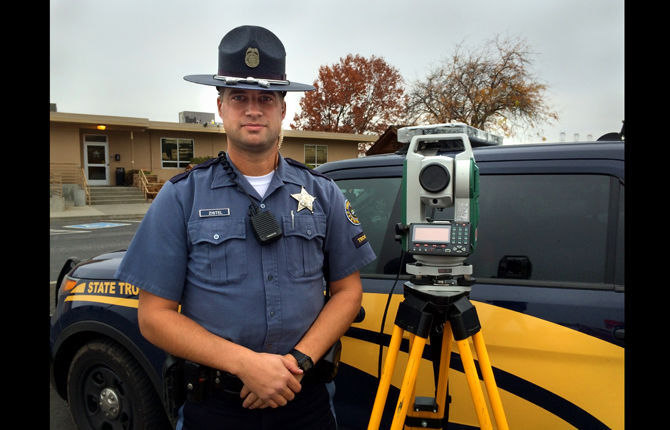
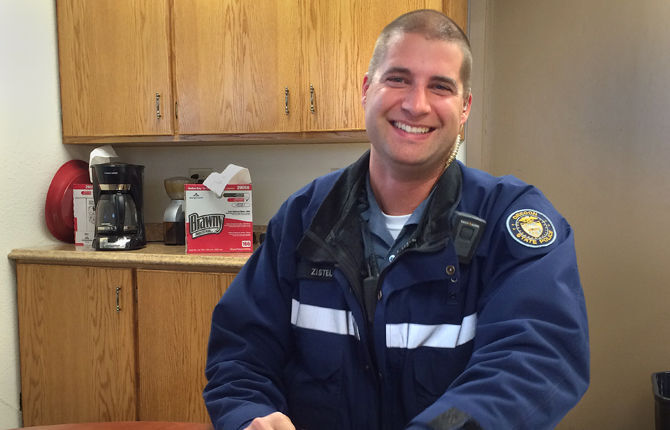
Some 10 years ago, a then-teenaged Matt Zistel emerged relatively unscathed from a crash on a snowy, icy mountain road, but with a newfound career goal: becoming a state police crash investigator.
Today, Trooper Zistel is assigned to the Oregon State Police The Dalles Area Command — he’s been here since 2009 — and has worked as a collision investigator for several years now.
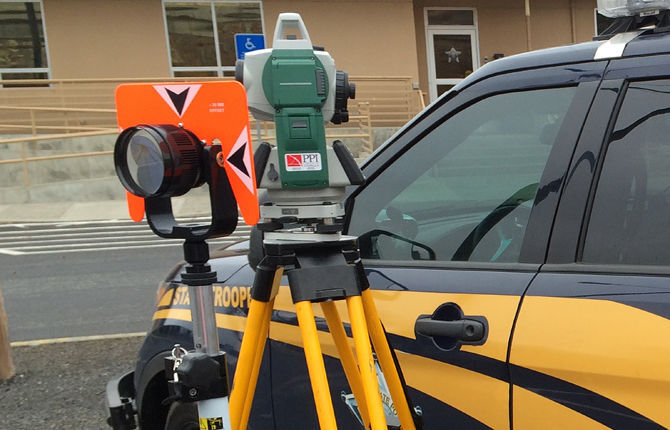
The tools of his trade include surveying equipment to measure distances, nails to pound into the pavement to serve as markers, cans of spray paint to mark locations, a camera, and a thick book of ready-made equations to cover every conceivable crash scenario.
That day when he was 18 or 19 years old and saw a jackknifed semi sliding downhill toward him, he resigned himself to the inevitable crash. When troopers showed up to investigate, “I liked how they handled it and what they did.”
What drew him was “to have someone come in and take care of the situation, and I guess having the truth about the situation makes it easy, so I want to be able in turn to do that for other people.”
A crash is a very traumatic event; even minor crashes can be traumatic for some people, so to be the “calm in the storm for people” appeals to him.
“I enjoyed crashes from the day I started, which sounds bad,” he said.
WHAT HAPPENED?
He’d already been the case lead on 109 crashes when he took a month-long course in 2013 to become a technical collision investigator. By mid-2015, he had investigated over 167 crashes, seven of them fatal. He has assisted on nine other fatal crashes.
Asked if he’s a very precise person, he said, “Yep, you have to be.”
“You’ve got to figure out what the story is and make sure that story is correct,” he said.
The specialized crash investigators are called when a wreck is serious. “The reason you’re doing this is because somebody got killed or it’s a criminal case,” he said.
Because of the seriousness of the cases, work is double-checked. “If you’re off by a fraction anywhere it can mess it up.”
The work is math-intensive, and Zistel — who was home-schooled and lists math and history as his favorite subjects — admits to being a nerd, which earns him a touch of razzing at the office.
“I do not carry a pocket protector though, just to let you know,” he said in his defense, after a co-worker quickly confirms he’s a nerd when a reporter asks.
“Math would have to be something you enjoy or don’t mind doing. Most of our work is numbers,” he said. Piecing together what happened in a crash is “like a connect-the-dots for big kids.”
One survivor of a crash told Zistel after reading his crash report, “That’s exactly what happened.” “That makes me feel good, knowing I did my job correctly in finding out the truth of what happened.”
The equations he does are written out longhand, so they can be checked for errors at each step.
The work is very exacting, and measurements for distances on crashes — such as the length of skid marks, or how far away a helmet landed from a motorcycle — are made to tight tolerances.
When he works a crash, the job can take anywhere from one to six weeks. His work — which is heavy in trigonometry and algebra, and, critically, the basics of physics — is checked by a collision reconstructionist.
PHYSICS
Gravity creates friction between a tire and road surface which is what holds vehicles to the road as they travel. G-force stands for the force of gravity, and one g equals the force of gravity on the earth’s surface. When we exceed one g, that’s when the earth lets you go and you spin out of control.
“Everything revolves around gravity because everything sticks to the earth,” Zistel said. “That’s how we get friction values.”
Different roadways carry different amounts of friction. When concrete is new it has a higher level of friction, and when asphalt is new it has lower friction. Then, “the older it gets, the grippier it gets.”
“We studied asphalt as part of our class, believe it or not,” Zistel said.
He has a tool that measures the friction of the road. He suctions it in place, levels it, then, after disabling the anti-brake system, accelerates to 30 mph and slams on the brakes as hard as he can to lock up the tires and skid the car.
This test, which produces a friction value for the road, is only done when road conditions are safe enough.
He can lay down some scary facts: If you are going just 42 mph on black ice and try to stop suddenly, you’ll skid approxi-
mately 589 feet, the length of nearly two football fields, before you come to a stop. Going 100 miles per hour on a dry roadway, it would only take a vehicle approximately 477 feet to stop.
That’s the value of friction in the ability to stop.
COUNTLESS FACTORS
Seemingly countless factors play into a crash. Zistel has to not only factor in the type of roadway, but its angle, the type of vehicle, and its braking capabilities.
“Your equation could change if, say, the right front brake doesn’t work,” he said.
In his work, of course, he has seen some very grim things. In one wreck, the car was so mangled “there was no shape to the car. It was a ball of metal.”
Usually he marks the locations of the tires to orient the vehicle’s final resting position. In this case, “there was no taking pinpoints of tires. We just put dots around the car, which was a mass.”
He also looks with trepidation at the increasing popularity of the miniaturized Smart cars and when one will inevitably be in a crash. “Not looking forward to those.”
The size and composition of a vehicle can save lives. The long, big, steel-framed vehicles of the 1950s and 60s, with lots of metal in them, were more dangerous because “everything stopped at once” and crash forces
went right to the occupant’s bodies.
More modern vehicles are made of softer materials that crumple, absorbing crash forces. Even a fraction of a second of that absorption can spare a life. In a crash, that kind of vehicle is wrecked, but it can spare your life.
He also studied body injuries, because the type of injury can determine where a person was in a vehicle. This becomes useful when he gets to a crash and nobody will admit to being the driver.
“Probably the one that’s the coolest is seatbelt marks,” he said, since they go one way on a driver and another on passengers. The car itself also offers clues on who a driver was, such as the pedal position and steering wheel position.
At a crash, one simple but critical job is holding what’s called “the dummy stick.” Zistel quipped, “Usually the one who can’t think too much holds that.”
It’s actually kind of tricky to hold the stick exactly right. “If the person is that bad at holding the stick, you can give them this,” he said, showing a stabilizing tripod that joins a host of other equipment in the back of his vehicle.
The dummy stick is actually a prism pole that features a mirror. A laser is bounced off the mirror back to Zistel’s surveying equipment, which then records measurements including distance and elevation
“We laugh at the dummy stick but it’s still an important part of what we do. Extremely important,” he said.
And once Zistel gets his surveying tripod set up,
no one else is allowed near it, because its exact positioning is critical to getting accurate measurements.
UNIQUE VIEWPOINT
Becoming a crash investigator means looking at the world in different ways. For instance, he loves the white fog line on the shoulders of freeways, because they collect tire information so well.
“Going over fog lines is amazing,” he said. “You can get amazing pictures of that. That’s why I like fog lines so much.”
Tires leave lots of information: Skid marks measure how much the vehicle slid, tire prints are tire
impressions in soft material that show tread design, and tire furrows are where a tire leaves a groove, such as in gravel or soft dirt.
A yaw mark is when the tread of the tire leaves striations as the vehicle is going out of control.
But skid marks are the most common information tires leave. “People have a tendency to freak out and slam on the brakes,” he said.
His verdict on tailgating is that “it’s horrible.” Say you’re two car lengths behind someone. “By the time your brain perceives the brake lights, you’re gonna be in the back of that car.”
Being a crash investigator can be disruptive to home life, since he gets called out to crashes even off duty. Last year, he was called out on Christmas Eve, and didn’t get home until 3 a.m.
“It can definitely add strain and mess schedules up,” he said. But he lauded his wife for her support. “My wife is 100 percent supportive of me, she’s amazing.”


Commented
Sorry, there are no recent results for popular commented articles.