
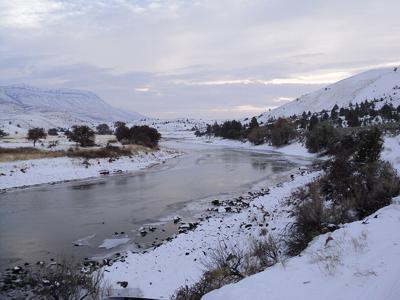
When Joey Sheirbon pulled a once in a lifetime Oregon bighorn sheep tag in 2014, he had a few decisions to make.
The first: Who he was going to take with him. The second: How he’d get to his chosen unit — west of the John Day River in mid-November.
“I was shocked when I saw I drew the tag because it’s kind of like winning the lottery,” Sheirbon said, adding that only nine tags are drawn in Oregon each year. “I guess the next thing after I realized I drew it was who was I going to take with me, and how were we going to make it happen.”
He was allowed to take a crew to help him with the hunt, although he was the only one who would be able to shoot. He chose longtime friends Dwight Moe and Bob Edwards.
“You take a select group of people when you go hunting, because those people are your lifeline when you’re gone from civilization,” Moe explained. “You’ve got to trust those people … your hunting partner is your family.”
With his crew in place, Sheirbon tackled the next problem.
“You only get 7 days, and it’s a once in a lifetime tag, so you have to make it happen,” he said. “My tag we drew, there’s not a lot of public access, so I had to make a choice, whether I was going to pay a trespass fee and hunt on private land, or whether I was going to take rafts and float down the John Day.”
They decided to float down the river because “we finally came to the conclusion we wanted to experience the full hunt,” he said.
Their choice wasn’t without difficulties. They needed rafts, and would be able to bring a limited amount of supplies. They borrowed a raft from a local fishing guide, and a pontoon boat from another friend. Since none had ever rafted on rivers before, let alone in November, they got a quick education on how that worked.
“We were bare bones — a tent, a little propane heater and a lot of dried food, and a lot of heavy hunting clothes,” said Sheirbon.
“I’m kind of the cook, so I made sure I had food for 10 days or better, because you don’t know what you’re going to run into,” said Moe. “We were still skinny on what we could take — you can take only so much on the river. At that point in time, the river levels were at 750 cfs (cubic feet per second), and that’s the very minimum you can float with the equipment we had.”
But they still faced some challenges.
The day before they left, on Nov. 12, 2014, the temperature was 60 degrees. And on Nov. 13?
“The morning we left, it had just started to snow,” said Moe. It was the beginning of the November cold snap that gripped the state.
When they arrived at the Clarno Rapids, the ground was covered with about 6 inches of snow; Moe estimates the temperature was around 20 degrees.
They arrived on a Thursday, and spent all day Friday floating down the river … unless they were dragging their rafts themselves.
“We did have to drag through some gravel bars, so there you are dragging a boat that weighs 400 pounds, 500 pounds full of gear,” said Moe.
“There we were, in 20 degree weather, in the water dragging a boat,” Sheirbon added. “The bad thing is once you commit, there’s no going back; you have to float your way out the bottom.
Friday evening, they set up camp after traveling about 25 miles, now in Sheirbon’s tag territory. Saturday morning, they were ready to begin the hunt — it was opening day.
The first morning was spent scouting, with Edwards spotting some sheep on the other side of the river that he wanted Sheirbon to take a look at.
“Sheep stay closer to their area, they don’t roam as much as elk or deer do,” Moe said. “Saturday night, we sat around camp, had a bonfire, and discussed Sunday’s plan.”
By this time, temperatures had dipped to -6 degrees, and they were sleeping with their water bottles to keep them from freezing.
“It all sounds terrible, but if you’re dressed warm, it’s fine, or if you’re in your sleeping bag, it’s fine,” said Sheirbon.
Sunday brought them to the other side of the John Day, where Edwards had spotted the bighorns the day before. They found the sheep, and, with Sheirbon picking his first, second and third choices, went back to camp to await Monday’s hunt.
“Monday morning, we got up and we decided that Dwight was going to go back on theother side of the river to locate the three sheep we’d chosen,” he said. “Then Bob and I started hiking up the hill on the side I could hunt. So I’m assuming we were probably 4 to 5 hours in the morning, locating the three sheep that I had on my hit list.
“Finally, Dwight had spotted the number one on my hit list, and of course it’s the farthest one downriver. And about this time, Bob and I got up to the elevation where I was able to look down the river, and all the slack water was frozen solid … we were not going to be able to float down the river. So that was my decision — I was going to kill a sheep that day, it was just whatever of the sheep I was going to get a shot at.”
The two began to proceed to their first choice, reaching it around 3:30 p.m. after a belly-crawl through at least 6 inches of snow the distance of roughly a football field in order for Sheirbon to get off a shot.
He got his bighorn sheep; now, he just had to get it back to camp, with Moe coming back with pack boards.
“We probably spent an hour taking photos because it’s a once in a lifetime thing, so now we’re talking 4:30 p.m., so we had to hurry up. We had to dress it out and quarter it up, and then we had to start packing it out, and by then, it’s getting dark on us.”
Their hour-long pack back to camp in the dark — and through steep, “terrible” terrain — was aided by headlamps and, once safely back at camp, there was finally time to celebrate.
“Once we got back to camp, it was all high fives and we were on top of the world,” Sheirbon remembered. “I got a nice sheep.”
But with the river frozen, they had to start thinking of another plan to get them back to civilization.
“We were evaluating what we were going to do because the river was frozen solid below us — were we going to try dragging our rafts downriver over ice, or leave all of our gear, find a paved road and flag someone down, then wait until it thaws to float down and get our stuff?” he said.
They ended up going with Plan C — “Phone a friend,” said Moe.
“I had a satellite phone so we could call out and see what the temperature was, when it would warm up, what was the water flow — the water had dropped below 500 cfs, with 6 inches of ice frozen out into the river, so we knew at that point in time, or option was not to go down the river,” Moe said.
They called a friend who lived in the area, who agreed to pick them up at an old goat trail about a mile from their camping site. One slight hiccup — he was supposed to pick them up at noon, but couldn’t get there until 4 p.m.
“We built a fire and then worried, what if he couldn’t get there because of the conditions?” said Moe. “There was still snow on the ground — do we need to prepare to spend another night and set the tents up?
“Boy, isn’t that a relief when you see a vehicle come through the sagebrush.”
After loading their supplies into the pickup truck — and enduring an hour drive on a goat trail — they hit paved road.
“We were on cloud nine because we’d got our sheep, we were in my pickup and we were on paved road,” said Sheirbon. “The heater was on, and we were headed home.”
Sheirbon’s bighorn sheep officially measured 167 and seven-eighths; to determine size, officals measure the length and diameter of the horns.
“I’m very happy with the sheep I got — it has a lot of character to it,” he said.
While the hunt took a lot of planning and they faced many issues due to the weather, Sheirbon is satisfied with his experience.
“For this being a do-it-yourself hunt … there’s something about doing it yourself and with your best friends, and having those stories and memories to take home,” he said.


Commented