
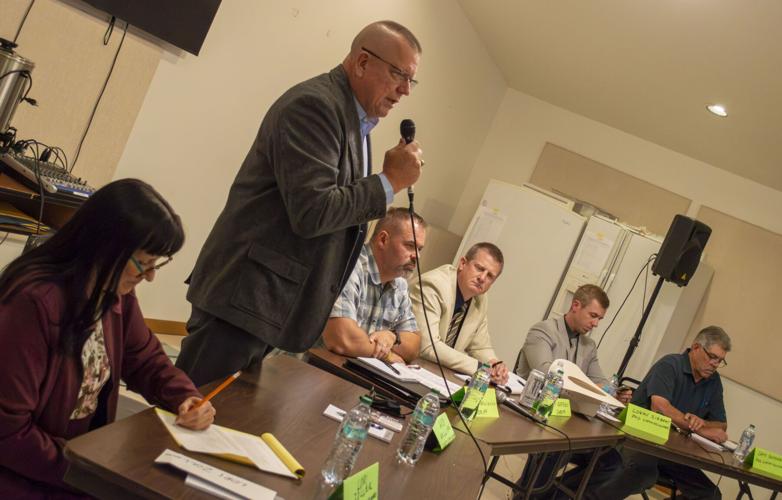
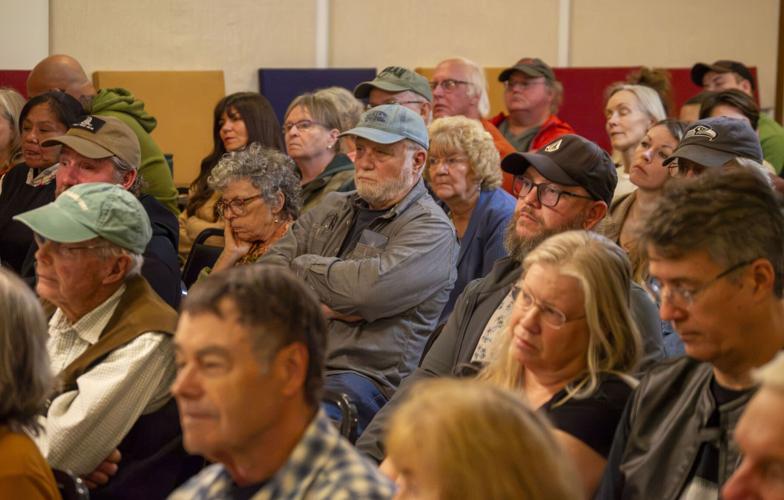

KLICKITAT CO. — With Election Day in less than two weeks, candidates for county commissioner, sheriff and public utility district commissioner made their case to voters and answered questions from the audience one final time during a forum at the Lyle Lions Club Community Center on Oct. 15.
Hosted by the Klickitat-Skamania League of Women Voters, a recording of the forum is available on their Facebook page. Responses have been edited for length and clarity.
Klickitat County Commissioner District 2
Incumbent Republican Lori Zoller has served on the board since 2023, but she brings about 30 years of experience with the county, primarily in watershed planning and salmon recovery. The Trout Lake resident previously worked for Washington’s Department of Natural Resources in timber sales and helped open the first rafting company on the White Salmon River.
“I have border collie DNA, and I think I’ve lived up to that standard. I believe that I’ve worked hard seven days a week, with my pleasure, to serve the people of this county,” Zoller said. “I love my job, and I hope to have your vote to come back and serve again for the next four years.”
Republican Andy Kallinen is a veteran, certified peace officer and a longtime Washington State Parks Ranger. He also serves on the Union Local 1466 Executive Board and was recently elected to High Prairie’s Community Council.
“I will listen to your concerns. I will protect our resources and fight for our communities,” Kallinen said. “I’m not running because I need this — I’m running because I think I’m needed. After 20 years of military service in the reserves and 30 years of state service, I’m ready to retire from the best job I never planned for, and I’m ready to take on the most important job I have ever applied for.”
Q: With variable revenue from the landfill, rising jail costs and property taxes that are routinely outpaced by inflation, what do you see as Klickitat County’s path toward fiscal stability?
ZOLLER: I’m proud to say that, for the last three years, we’ve had a balanced, stable budget. We have a lot of money in reserves that we’re holding for a rainy day, and we’re meeting all the goals that we have with our departments. We aren’t looking at layoffs. We aren’t looking at raising taxes. We’re hopefully going to use our economic development department to look for some new resources. Republic Services is doing well at the landfill, and we did well on our investment revenues this year.
KALLINEN: Wind, solar, data centers — we’ve had a lot of big projects coming into the county. When wind first came, it was being taxed at one rate, but now it’s being taxed as private property with depreciation. I think there are ways to reexamine that; the same goes for solar, and then we need to expand the landfill users. With a background in parks, I’d also like to see better use of our campground facilities. I think there’s opportunities to generate some additional revenue there as well.
Q: Do you support a data center moratorium?
KALLINEN: I fully support a moratorium to give our staff enough time to build the best policies, ordinances, zoning, guardrails and safety rules that we can to protect our resources and protect our communities. They’re in a race against these six hyperscale data center teams that are worth billions of dollars, if not more. There’s no sense to race against them when we can’t see the clock.
ZOLLER: I’d like to clarify a couple of points. Number one, there’s nothing on the horizon that’s an emergency. We know from the Bonneville Power Administration process that it takes six to twelve years to develop a data center feasibility policy. Second, they come to our local utility and Washington’s Department of Ecology to negotiate utility rates and water before they ever come to the county. Third, the moratorium came to us as a surprise from our seatmate, and that document still hasn’t been vetted by our legal counsel.
Q: What are your expectations for the comprehensive plan update?
ZOLLER: My expectations are to get it done. The first time around, it was a very cumbersome process. We came up with a new program that allows the community councils to be more involved, so that you can have those conversations without staff at the table, so that you can work on those worksheets, turn them into the planning department and help speed that process. The comprehensive plan is crucial for the county in moving forward; we need to finish that plan.
KALLINEN: My expectations are that it fulfills the very name of it — that it’s comprehensive. What I’ve seen is a sort of whack-a-mole approach. Whether it’s accessory dwelling units, short-term rentals or data centers, we need to give our staff and the planning and economic development departments the breathing room they need to work on the comprehensive plan, so that everything meshes together.
Q: How do you plan to use your legislative oversight and budget authority to help our school system address student challenges in the coming years?
KALLINEN: Well, much of the funding for our schools comes through the state, but being a child of parents born in the Great Depression, I maximize funds and resources everywhere I can. As a state employee charged with managing a $2-3 million budget, we take care of those dollars — treat it like they’re ours — and we’ve got a $30,000 positive variance for this current biennium. I intend to apply those same miserly and economical choices to the county.
ZOLLER: I serve on a state timber board, and we recently learned that Washington’s Department of Natural Resources has to cure a huge budget deficit. Their fix was to increase the amount they take from our state timber sales by roughly 25% alongside even larger federal pullbacks, so every one of our junior taxing districts are going to lose. But I’m working on another idea to take our trust properties back and creating our own timber trust that the county can manage, and that would bring money back.
Q: Do you think that regulations applying to corporations in the county are adequate?
ZOLLER: The regulations for corporations come from the state, so the things we can do are through land use planning and zoning, just like we’re doing right now with data centers. We have looked at corporations potentially supplying childcare funds. There’s no reason why they shouldn’t build daycares within their facilities and take a few extra from the community. We can get creative.
KALLINEN: As Lori said, a lot of that is driven by the state, so zoning is key. That stems out of the comprehensive plan — making sure the right regulations are in the right places, and giving our staff adequate time to figure out how they use our water, how they use our resources, how they pollute.
Q: Will you improve funding for emergency services? If so, how?
KALLINEN: Public safety is government’s first responsibility. I intend to look for revenue in places our county hasn’t tapped, like with campgrounds and tourism, and doing a better job of pursuing the tax revenue potential from our wind and solar development. If data centers are sited here, I’d like to see a public safety endowment as a community benefit that produces enough interest to pay for two full-time deputies, and then surplus to save up for 911 upgrades and other unforeseen things needed down the road.
ZOLLER: With our new reorganization of emergency services, we found efficiencies and changes with employment that made the budget better. We would sustain that, but also find ways to add the improved facilities, the improved communications that they need, and we are working on those things right now. Every industry or business, big or small, brings us tax money, so I think we need to diversify the way we look for money.
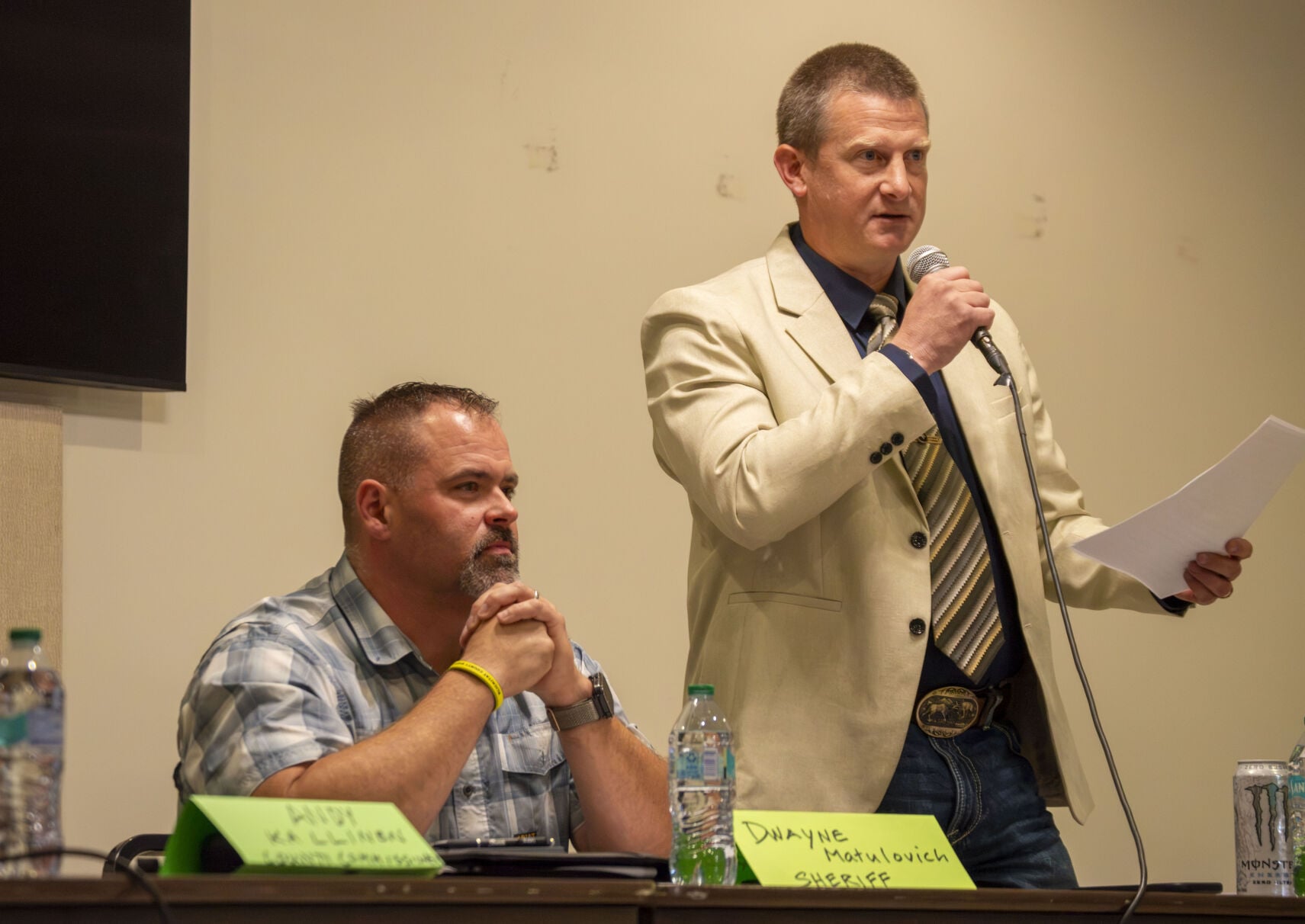
Tony Warren, candidate for Klickitat County Sheriff, reads his opening statement to the audience at last Thursday's forum while Dwayne Matulovich, his opponent, listens.
Nathan WilsonKlickitat County Sheriff
Dwayne Matulovich, running as an Independent, is a lifelong Washingtonian who first served as a volunteer firefighter in Skamania County at age 16. He started on patrol with the Bingen-White Salmon Police Department in 2004 and then lateraled to the Goldendale Police Department in 2008. He joined the Klickitat County Sheriff’s Office (KCSO) in 2015, left in 2023 and has been working for Burlington Northern Sante Fe Railroad since.
"I'm the only candidate who has the support of the police chiefs, past and current, from this county," Matulovich said during his introduction. "They've worked with me. They know my ethics and morals, and they know I can do this job."
Republican Tony Warren was born in Skamania County, where his father served as sheriff and where Warren began his law enforcement career as a reserve deputy in 1997. Warren earned an online degree in criminal justice and joined the Bingen-White Salmon Police Department in 2008, working as a detective for five years until resigning in 2019. Warren then launched his own excavation business that he continues to operate while acting as a detective sergeant for KCSO, which he joined in 2021.
"I have the support of the majority of my department behind me," Warren said. "No matter your background, your profession or your political views, we all want the same thing when the sun goes down: We want our families to be safe, our homes to be protected and our community to thrive."
Q: Do you think the sheriff’s office has been led effectively by Songer, and what’s one policy you would change or keep the same?
MATULOVICH: I don’t want to diminish what he’s done because everything can be done better. However, a policy that comes to mind is the warrant team. There actually is no policy for the warrant team, which I think is a huge liability.
WARREN: I have the utmost respect for Sheriff Songer and his career — I think he has done well. Where he has fallen short in the last few years is the administration’s lack of involvement in our day-to-day operations. I have no intent of sitting behind a desk at all times. One of the policies or procedures that Bob is really strong on is the protection of freedoms and rights. I intend to be just as strong.
Q: What’s your vision of a first-class sheriff’s office?
WARREN: We have a fair amount of room for improvement. We need to work on our public image and be more involved in community operations and events. I really want to strengthen the presence is the schools. I’m not thinking a full-time school resource officer, but a deputy that’s asked to spend an hour a day at various schools to foster relationships with children, talk to staff and hopefully curb any violence.
MATULOVICH: With a working administration, we can get more bodies out on the road, stay in touch with the deputies and stay in touch with the community. The other part would be increasing training opportunities for the deputies, especially instructor development, so that we can have a strong reserve program. With more reserves, I also want to look at a school resource officer program.
Q: What do you see as the future of the posse?
MATULOVICH: The future of the posse is a volunteer organization, distinct from search and rescue, that’s more focused on disaster preparedness, especially because this area is prone to fires. Rather than going through the woods looking for missing persons, they could help out at fire camps, and I do not want them representing law enforcement in any way — that’s why I’m big on the reserves.
WARREN: I think our posse program is great to have. They show up and help when they’re called upon. Sometimes that’s an extra set of eyes, running errands at crime scenes or managing parking at an event. They’re reminded at every meeting that they do not have any legal authority. I think we need to ensure that the communities know the difference between a posse member and a certified officer, what to expect of their behavior and duties, but I’m in favor of keeping them and utilizing them as much as we can.
Q: Describe the ethical standards that have been with you throughout your career?
WARREN: Hard work and dedication — that’s important to me. Deputies and officers need to be able to show up, give 110% and do the job. I’m not without fault; I’ve made mistakes of my own. I’ve learned from that and I have moved on, as everyone else should.
MATULOVICH: In law enforcement, you have to live to a higher standard than everyone else. You can’t go down drinking at the bars and then go out and patrol for DUIs. Every officer must operate under the expectation that we’re always watched. People hate riding with me because the most I go over the speed limit is five miles per hour, because somebody’s watching.
Q: How will you handle the enforcement of laws that you disagree with?
MATULOVICH: I feel strongly about the separation of powers. Law enforcement stays in the executive branch. If I don’t agree with a law, we take it through the judicial side.
WARREN: My opinion on what may or may not be enforced is going to align with what the community wants to see and what the Washington State Sheriffs’ Association is putting out for recommendations. They banded together on some of the recent, obviously unconstitutional laws, and we’re winning those challenges. In the meantime, during court battles, I will not be enforcing blatantly unconstitutional laws.
Q: Since you both worked under Sheriff Songer, what makes you different from Bob?
WARREN: Again, Bob’s great. I think my focus, as I stated earlier, is going to be more on the office and the deputies, which I think Bob lost in the last few years. It’s maintaining that strong community relationship, the focus on community safety and focus on the deputies — their day-to-day operations, their well-being, their training, their career progression.
MATULOVICH: I care about liability. That’s a difference between me and Bob. The other thing that I really want to do is listen to the people, talk to the people and I don’t care about the politics. I don’t want to alienate — that’s why I’m in the middle as an Independent. I feel it should be nonpartisan because we may not agree, but I want those conversations.
Q: If you receive reports of voter intimidation at ballot boxes, how would you respond?
MATULOVICH: One of the responsibilities of the sheriff’s office is to keep the peace, and that’s what we would do. We would go down and make sure the peace is being kept, and that intimidation is not occurring.
WARREN: We can’t have that — that’s not acceptable. We would deploy troops there to move them along if we can. Everybody deserves to have their opinion and their right to vote, and to not feel threatened or harassed for doing so.
Q: Name one or two programs in the current sheriff’s office that you would remove or change.
WARREN: Strengthening the reserve program would be great; however, I don’t know how feasible that’s going to be. Sometimes you spend all that money to get them trained, they’re here for a year or two and then they go somewhere else full-time. We talked about having some deputies serve as school resource officers part-time, and we also have a marine program. We need to find time to get deputies doing marine patrols and we do have one aging boat that we should look at upgrading.
MATULOVICH: One of the programs I would change is obviously the posse program. I do not want them to represent law enforcement or look like it, and again, that’s why I’m big on reserves.

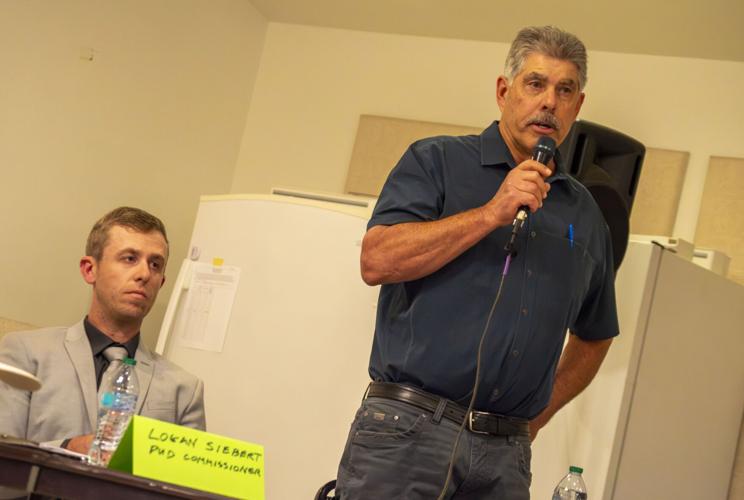
Longtime Klickitat Public Utility District Commissioner Dan Gunkel responds to a question at last Thursday's forum. To his left is Logan Siebert, who's looking to take his seat.
Nathan WilsonKlickitat Public Utility Commissioner Position 3
Incumbent Commissioner Dan Gunkel has held his seat since 1991. Klickitat Public Utility District’s (KPUD’s) rates have fallen from third most expensive in the state to tenth during that period. He’s served on Energy Northwest’s executive board, chaired the Nuclear Oversight Committee and operates a third-generation family farm in Maryhill.
"I have a lot of experience in leadership. I will continue to apply those experiences to deal with the big projects that are coming up," said Gunkel, who emphasized that rumors of a proposed substation in Lyle, first covered by the Goldendale Sentinel and later by Columbia Gorge News, are unfounded.
First-time candidate Logan Siebert is an entrepreneur and moved to Klickitat County in 1999, launching Siebert Custom Slaught and Meats LLC six years ago. He’s a reserve officer with the Goldendale Police Department, spent three years on the Goldendale Rodeo Bible Camp’s board of directors and has given a decade to local 4-H development.
"You've heard a lot about experience in this race," Siebert said. "Experience is something you gain on the job — integrity is who you are before you ever walk in the door ... Big decisions are coming for Klickitat County, and the people who pay the bills deserve a voice on that board."
Q: On Sept. 22, the KPUD Board of Commissioners announced it would no longer sign nondisclosure agreements, but only for future large load and generation requests. Gunkel, what motivated that decision, and with at least six hyperscale data centers already being proposed in Klickitat County, do you think it came too late? Siebert, do you agree with that stance?
GUNKEL: The PUD is a very open and transparent organization. The board, over the time that I have served, has always paid attention to its customers, and we heard loudly and clearly that NDA were unacceptable. We responded quickly and eliminated those that were to come. For the ones that are in place, we are currently working through a process to terminate all of them.
SIEBERT: I do agree with the PUD striking NDAs — I agree with that 100%. I don’t feel like there should have been an NDA in place in a public utility district.
Q: What do you see as the most pressing decisions you will face, or have faced, during your six-year tenure?
SIEBERT: I think the biggest issue is going to be data centers. We’re pretty much strapped for power in the Northwest, and with such a large load coming into our county, it’s going to be hard to supply them with power. That’s a BPA question, but it’s also a concern of ours, as it would bump us out of our low-density discount, which is roughly $80,000 a month off our utility rates.
GUNKEL: As always, the most pressing issue is rates and how to continues to offset those rates, and the other is data centers. Six years ago, we updated our policy on large loads to a very robust state, which includes provisions related to community benefits. For example, a 1,000-megawatt facility could generate as much as $7-14 million annually, and the county has separate benefits.
Q: In what way do you see the proposed data centers affecting county residents’ lives and pocketbooks?
GUNKEL: I’ll go back and clarify one thing again: data centers are only cited by the county. The PUD deals with power supply, and let me be clear — they will buy power from someone else, not through Bonneville, but an independent third-party elsewhere. Any improvements required, the developer will pay 100% of the cost, and when they build the transmission and a substation, they will deed it to KPUD. We will then move the power for a fee, and it will generate the figures I told you earlier.
SIEBERT: I can see it affecting the community members’ lives. For one, it’s a giant eyesore. Some of the other data centers in Washington state have actually raised people’s rates long-term, so I don’t think that they are super cost-effective for the ratepayer. I could see if we charge pass-through costs on them that they could be, but I don’t see them making ratepayers’ monthly bill every month any easier.
Q: Please address the pricey decisions for EV chargers, specifically demand load surcharges.
SIEBERT: I don’t know a whole lot about EV charging stations. That’s one thing I’ve been continuing to learn on, and I will continue to do so.
GUNKEL: There have been one or two installations where the upfront due diligence wasn’t complete, and the applicants are suffering because the usage is not high enough to cover the demand charge and make the fees paid to the utility reasonable. There’s some funding currently available to assist with these rural charging stations, and the board will be looking at options in the future.
Q: Do you agree with full disclosures and audits?
GUNKEL: I absolutely agree with full disclosures and audits. I have the audits performed recently listed on my website, just so that there’s total transparency available to anybody who wants to check it out.
SIEBERT: I also agree with full disclosures and audits.
Q: What do you believe a PUD commissioner is responsible for?
SIEBERT: I believe a PUD commissioner is responsible for keeping the rates affordable for their constituents. I believe that they need to listen to their constituents. I believe they need to negotiate with big tech and make sure they pay their fair share, but mainly, the big thing I’m hearing right now is better communication.
GUNKEL: PUD commissioners are responsible for hiring a general manager, setting their goals and reviewing their performance annually. Along with strategic planning, the PUD commissioners are also responsible for setting the rates to ensure the PUD is financially viable. I’d like to point out that KPUD is now an A-rated utility, and that is a huge benefit for all future capital projects, because it guarantees a lower interest rate.
Q: How will you address the responsibility for creating a more sustainable future for the environment?
GUNKEL: I’m very proud to tell you that all of the generation projects that the board has built and executed over the last 30 years are all green — they’re all renewable. Our current intake of power is over 90% carbon-free, so I think we’ve been focused on that since day one because it was the right thing to do.
SIEBERT: If I become PUD commissioner, I’ll be inheriting a lot of projects that have already been completed. I did work in wind for a short time; state and federal standards, they are green, but they’re far from green in reality. They make a heck of a mess and are hard on the environment. Also, I would like to see that these large load industries coming into our county have a frim exit strategy.
Q: Will you change pruning practices to save people money?
SIEBERT: I would definitely like to look over the budget and see where we can save money for the ratepayer for sure. With any good business, you have to look at your balance sheets, your assets, all of that. The PUD is just like a big business.
GUNKEL: Four years ago, we adopted a new right-of-way maintenance program and increased the budget. It has significantly reduced outages. It has also significantly reduced fire hazard, and I have no plans to reduce that pruning budget because it’s been very effective. When you have fewer outages, your linemen are also working less overtime, which means more savings. The rates that utilities are paying for fire insurance makes pruning even more important as well.
Q: How would water requirements get delivered to data centers, and are infrastructure changes needed?
GUNKEL: I’m going to assume this question relates to the old aluminum plant. There is a water right and infrastructure there. KPUD owns the water rights, and it is feasible for the utility to be the water service provider for a data center; however, they will need the latest and greatest improvements and best available technology. Washington’s Department of Ecology will back us up on that one. Rest assured, there will be a lot of oversight on the water facilities, and there will be a service fee that goes along with those deliveries.
SIEBERT: Well, I’m not too certain about the infrastructure needs because I’m not sure what site is being referred to. However, I’m for protecting our resources as much as possible. I would push for the latest and greatest technology, as Dan said, and the least amount of water used as possible.


Commented