
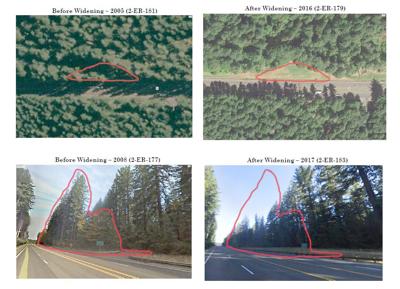
Mt. Hood site included burial ground, stone altar
Two Native American tribes are currently suing the U.S. Department of Transportation for the 2008 destruction of a sacred site located near Mount Hood.
On Oct. 4, members of the Confederated Tribes and Bands of the Yakama Nations and the Confederated Tribes of Grand Ronde asked the Supreme Court to hold the federal government accountable for the bulldozing of Ana Kwna Nchi Nchi Pata — a sacred site near Mount Hood containing a burial ground and ancient stone altar — to add a turn lane to the highway.
Wilbur Slockish, Hereditary Chief of the Yakama Nation, and Carol Logan, who is a spiritual practitioner and elder in the Confederated Tribes of Grand Ronde, regularly visited the site — the name of which translates to the “Place of Big Trees”— for decades to pray, meditate and pay respects to their ancestors through memorial ceremonies.
According to Joe Davis, legal counsel at Becket Law, the law firm representing the tribes, the members of the tribes had been defending the site for years. In fact, Davis said in the mid-'80s, the government wanted to add a turn lane in that same spot.
“There was this huge community outcry with people pointing out not only the environmental values of this, the stretch of highway with old growth trees, but also that there was a religious site, a grave site on the side of the road,” he said. “The government took those comments into account and changed the project.”
Then, in 2008, the government went back on its decision and did exactly what they opted not to 20 years prior, ignoring the pleas to protect the site and bulldozing it to add a turn lane to the nearby highway. According to a press release from Becket Law, the government even admitted it could have added the turn lane without harming the site.
Becket, which deals with cases of religious liberty, believes the case violates the Religious Freedom Restoration Act, which is a law that states the government can only burden religious freedom if they pass “strict scrutiny,” meaning they essentially have to have a “really good reason for doing it,” Davis said.
However, the case — dubbed Slockish v. The U.S. Department of Transportation — previously went in front of the Ninth Circuit, who ruled against Slockish and the tribes.
Davis said that according to the ruling, substantial burden only really applies to two specific circumstances: When the government says it will penalize someone for practicing their faith or when the government says it will deny someone a benefit for practicing their faith.
“Let’s say they put up signs and said, ‘No trespassing,’ and then they penalize Native Americans for going on to the site and practicing their religious exercise. (The Ninth Circuit is) mostly sure that’s a substantial burden,” Davis said. “But if they just destroyed the site altogether, and make it impossible for them ever again practice their religion at the site, the government said that’s not a substantial burden. And that’s the sort of absurd thing that the Ninth Circuit agreed with.”
Davis said the Supreme Court will likely hear the case sometime from late 2022 to early 2023.
“We’re optimistic that the court will be very interested in seeing the need to protect Native Americans and their religious liberty,” he said.
For more information on the case and Becket Law, visit www.becketlaw.org/media/native-americans-seek-protection-for-sacred-land-at-supreme-court/.


Commented
Sorry, there are no recent results for popular commented articles.