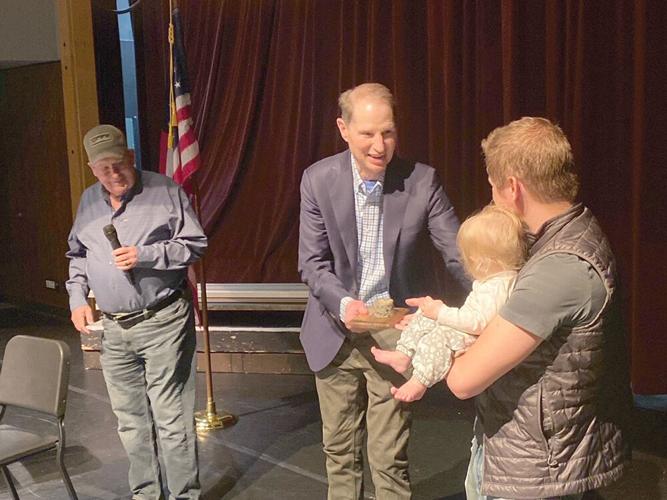
Mike Fox, Port of Hood River commission chair, and Grant Polson, Hood River City Council member, gift Sen. Ron Wyden with a core sample from the Hood River-White Salmon Bridge to thank him for the federal funding he worked on for bridge replacement. Wyden visited Hood River as part of his town hall tour.
Mike Fox, Port of Hood River commission chair, and Grant Polson, Hood River City Council member, gift Sen. Ron Wyden with a core sample from the Hood River-White Salmon Bridge to thank him for the federal funding he worked on for bridge replacement. Wyden visited Hood River as part of his town hall tour.
THE DALLES — U.S. Sen Ron Wyden spoke of the “local and modest and targeted” help Oregon’s senators have brought to Wasco County at his 1,087th town hall last week in The Dalles.
He listed affordable housing on Chenowith Loop in The Dalles, funding for the advanced manufacturing program at Columbia Gorge Community College, and $1.5 million to start work on turning Chenowith Middle School into an early learning center. He’s also helped direct federal funding to address water issues in Mosier, and to build a community center and fire hall.
Responding to an audience concern about misinformation, Wyden said the internet, which he still considers a “big blessing,” has “changed everything.” It gave a voice to the powerless.
But he believes platforms need to do much more moderating, and he’s written a bill to force more accountability on platforms for the algorithms they design.
He sees algorithms as “a big source of the problem” behind misinformation. Algorithms are used to determine what content we see, based on what we interact with on the internet. Critics say algorithms can rapidly show people increasingly extreme content, and can play a role in radicalization.
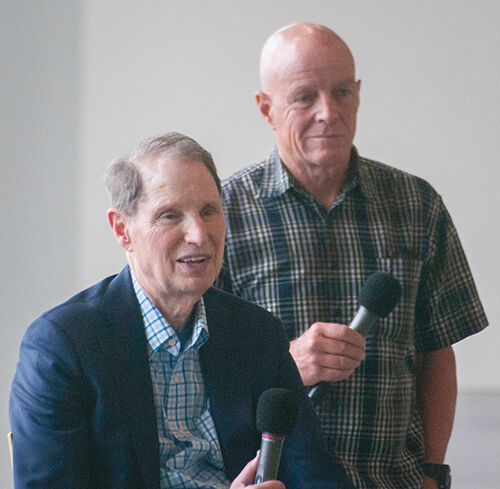
Sen. Ron Wyden and Mosier Mayor Witt Anderson.
Flora Gibson
Wyden wants algorithms to “help us rather than hurt us.”
He also cited the concern behind artificial intelligence, or AI, which can be used to create “deep fakes,” or fake images, recordings or audios that mimic a real person. He said later, “I think we’re all gonna be kind of blown away at the implications of AI.”
Wasco County Commissioner Phil Brady asked how we can balance energy production with energy consumption. Big strides are being made in green energy, Brady said, including solar panel installations in south Wasco County.
Wyden said he believes “we’re just getting started on renewable energy.” Legislation he wrote already has generated $400 million of investment in renewables. He believes project permitting has to speed up.
Dan Spatz, who now works for City of The Dalles but previously worked at Columbia Gorge Community College, thanked Wyden for his early help in getting local help for the community broadband internet network, QLife.
Spatz asked what might be next in rural broadband. Wyden said Oregon has $600 million to spend, largely thanks to a recalculation of where unmet needs are.
The funding will be for schools and telehealth, but also healthcare cybersecurity, Wyden said, since that is a matter of “life and death.”
He mentioned a Minnesota health system that was hacked because it lacked basic, front-end protection. Front-end protection includes two-factor authentication, where somebody who is trying to enter a system has to prove who they are by two different methods, such as entering a password, plus entering a code sent to their phone.
Another speaker asked what can be done to reform the courts and protect the rule of law. Wyden got animated, saying nobody was above the law, from former presidents to the current president’s son.
Wyden said his investigators got a tip from a whistleblower that U.S. Supreme Court Justice Clarence Thomas got a loan from them for a $270,000 RV, but wasn’t paying back the principle, just “some interest.” He said his investigators were going to look at whether taxes should’ve been paid.
Wyden had a lengthy exchange with a woman who helps people file taxes through the AARP Foundation Tax-Aide program. She said she’s worked with one man for three years now to rectify the theft of his Social Security number.
She said this problem is happening to more and more people. Often, she said, a teen gets their Social Security number stolen online, and once anyone in the family has compromised ID, nobody else in the family can file electronically.
Now that the IRS is urging people to directly file for free with its free software system, she wondered if there was a safeguard in place to protect against this aspect of identity theft.
Wyden said the U.S. is one of the few western industrialized nations that makes it hard for people to file taxes. “Basically, the government has your information already,” he said, including sources of income.
But tax software entities have lobbied “like crazy” against the IRS’s new free file program, Wyden said.
A trial of it in 12 states last year proved very popular, he said, and he added Oregon is the first state to sign up for direct file. The state worked to ensure the IRS free filing option also connects with the state tax return. He stressed using the IRS free filing system is voluntary, not mandatory.
It will take education campaigns to ensure people don’t improperly give out passwords, he said. He encouraged everyone to use the free file, which will also include an option to talk live to a person if desired.
Also anticipated is that people who had their identity stolen won’t have to get new temporary ID numbers every tax season, but will have a permanent one.
He told a reporter after the town hall that nobody had asked what is most on his mind, and that’s changing the tax code so billionaires can’t use three words — buy, borrow, and die — to “pay little or no taxes for years on end.”
When everyone else has to pay taxes out of every paycheck, “It’s not right for them to be able to go for years on end paying little or nothing.”
He said, “I’m determined to get this passed. This is why I’ve wanted to be the chairman of the finance committee.”
He said he’s glad people can achieve financial success, “but success and fairness shouldn’t be mutually exclusive. We can have both.”



Commented
Sorry, there are no recent results for popular commented articles.