A few weeks after the Grasshopper Fire started, a friend and I drove into the burn scar. Smoke still hovered in the hollows near Friend, Oregon, but the fire had moved on, leaving blackened pastures. Forests had turned ghostly: trunks white with ash, leaves brown or gone, decades worth of dead grass skimmed off the ground.
In low, rain-dampened spots, invasive grass and native, stubborn horsetails were resprouting, bright green against black soot. Thick groves of young oak and pine, grown up too close together in decades without fire, were totally dead. But we stopped under a huge oak, leaning alone on a torched pasture fence, and it was still alive, shooting soft lime-green leaves from its scorched branches. It probably remembers the last time this place burned.
Oddly, it had flowers. It’s not supposed to do that until spring. Perhaps the fire’s heat tricked it. Either way, I hope it lives.
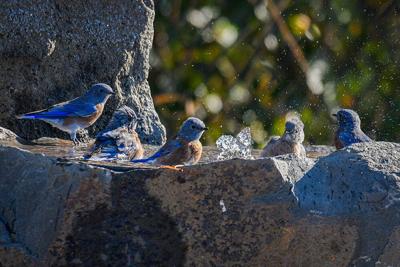
And in the brown landscape, there were bluebirds. So many bluebirds.
Parked under a powerline, we listened to half a hundred of them calling: liquid, soft chirps, from dozens of throats. Silhouettes lined the wires, fluttering. Blue flickered in the dead pine groves. In among ghostly whitened oak trunks, sparrows and juncos and bluebirds moved over the ground, eating I don’t know what: toasted insects, perhaps? The seeds were mostly burned, but perhaps enough remained.
Why were they here? I counted more than 100, and I’m sure that’s conservative. Did the fire burn their cozy territories, leaving hundreds of tiny, hungry bodies to scrounge the burn together for food? Or did they migrate south from somewhere, and find the burned area a congenial stopover?
eBird’s abundance animations, compiled from citizen science data, show Western Bluebird numbers surging in Oregon, Washington and Idaho in September and October, then vanishing to California and points south by end of year.
Apparently, northern Oregon is a last good place to hang out, and fatten up, before skedaddling south for winter.
I just want to know what they were eating, so industriously and musically, in a land where all I could see was ash and dust.



Commented