Welcome to May, our last full month of spring, and warmer weather that is a welcome to most. Days are longer in May, and thus not as much time for viewing the night sky.
We gain more than an hour of daylight during the month, and by the end of May, the Sun does not set until almost 9 p.m., daylight saving time. Full darkness does not come until after 11 p.m., and the sky begins to lighten as early as 2:45 a.m. However, those evening twilight hours still present magnificent views, and the warmer temperatures make nights more pleasant.
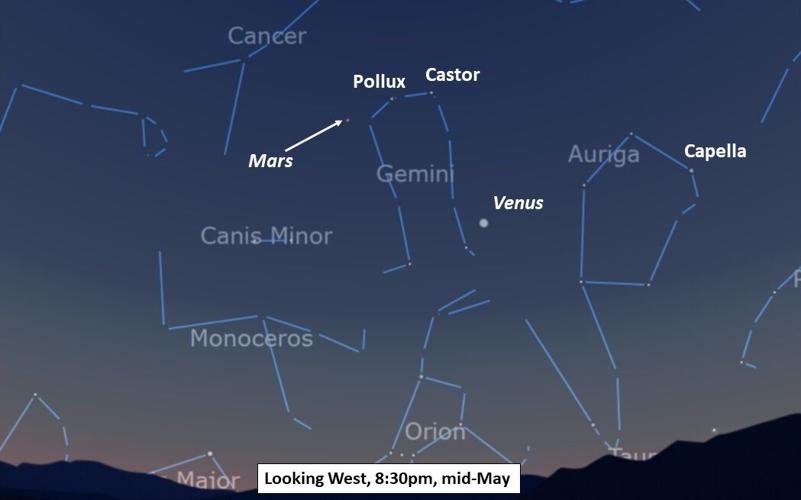
As far as the planets go, Venus again is most prominent in our evening skies. I often get questions about Venus, with folks wondering what it is, as it is so bright. Compare Venus to the bright star Capella, which is to the right of Venus, low in the evening sky. Capella is the fifth brightest star in the night sky, yet Venus outshines it by a large margin. Venus begins the month between the “horns” of the constellation Taurus, and moves into nearby Gemini by the end of May.
Mars also remains in the evening sky, growing fainter than last month. In May, Mars will be some 167 million miles from us. Mars will not be close to us again until late 2024. Mars is still bright though, about the same brightness as Castor and Pollux, the “Twins” of Gemini. Mars will be below the Twins early in May, and to the left of those stars later in May.
Jupiter and Saturn are near the Sun this month, and visible in the morning sky. Look for Saturn low in the southeast before sunrise. Jupiter is not visible early in the month, being located close to the Sun as we see it. Look for it later in the month, low and in the east before sunrise.
May’s full Moon occurs on the 5th, with new Moon following on May 19. The full Moon will be very low in the south this month, not rising (on the 5th) until about 9 p.m., due south in Libra. On the 7th, the Moon will be just to the left of the bright star Antares in Scorpius.
On the 13th, the Moon will be below and to the left of Saturn in the early morning sky. On the 17th, the thin crescent Moon will pass right in front of the planet Jupiter, known as an occultation. Unfortunately, this will occur when the two are about 2 degrees above the eastern horizon, at about 4:50 a.m. Saturn will reappear from behind the Moon at about 5:30 a.m., when it will be a bit higher in the sky, about 9 degrees above the horizon. That is about the time of sunrise, so this occultation will unfortunately be difficult to see.
Face the north on a May evening, and look high above. You should be able to see the constellation Ursa major, with the Big Dipper asterism, high overhead. Below Ursa major will be the Little Dipper, Ursa minor, with the north start Polaris. If you step out in the morning, just before sunrise, you’ll see Polaris in the same position, but the Big Dipper will now be below it, closer to the horizon. At our latitude, the Big Dipper does not dip below the horizon; it is “circumpolar.”




Commented