Welcome to April, our first full month of spring. Days are warming as the Sun reaches higher in the sky, and day length grows.
At the start of April, we have about 12 hours and 51 minutes of daylight. By the end of April, we gain another hour, with about 13 hours and 50 minutes of daylight. The downside for stargazing is that, by the end of April, it does not get fully dark (end of astronomical twilight) until after 10 p.m. Especially with daylight saving time, you have to be a bit of a “night owl” for evening stargazing.
OK, since I brought up the term “astronomical twilight,” let’s define that. Twilight is that period of time between when the Sun sets (or before it rises) and full darkness.
Immediately after sunset, we have what is called “civil twilight,” which lasts until the Sun is about 6-degrees below the horizon. There is typically enough light to conduct outdoor activities without artificial lighting, and bright stars or planets can be seen. Nautical twilight occurs when the Sun is between 6- and 12-degrees below the horizon, and typically artificial light is required for us to conduct outdoor activities. Bright stars can be seen; the term comes because sailors can take readings from bright stars to determine their location. Astronomical twilight is that time when the Sun is between 12- and 18-degrees below the horizon, and moderately faint stars can be seen with the naked eye.
Our Moon begins April nearly full, located in the constellation Leo. If you are an early riser, look for it low in the west in early April, and in the south (by the 10th) in Scorpius. Full Moon comes on April 5, with the bright Moon in Virgo. New Moon comes on April 19. On the 22nd, look for the thin crescent Moon low in the west, just below the bright planet Venus. On the 25th, the crescent Moon will be just above Mars, in the constellation Gemini. By the end of the month, the Moon will be just below Leo again.
If you look to the south in April, you’ll see the distinctive “backwards question mark” of Leo, the head and shoulders of the lion. The bright star at the base of the “question mark” is Regulus, the brightest star in the constellation and the 21st brightest star in the sky. Regulus is actually a quadruple star system, but we are able to see only the brightest member.
Looking to the east, you’ll find another couple of bright stars rising: Arcturus (fourth brightest) and Vega (fifth). Arcturus, in the constellation Bootes, will be pretty much due east. Vega, in Lyra, will be in the northwest, just peeking above the horizon by 9pm in early April. We’ll see them better in the summer months, when those constellations are high overhead.
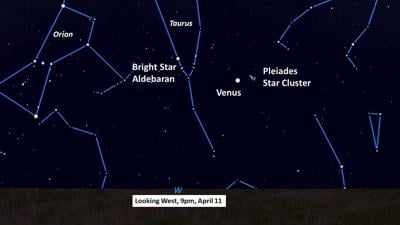
Venus and Mars are the only two bright stars in the evening sky. Venus is brilliant and unmistakable as the brightest “star” in the western evening sky. Venus can serve as a good “pointer” to other objects; on the 11th, look for Venus to be nestled right between the star cluster Pleiades, to the right of Venus, and the bright star Aldebaran, to the left of Venus.
The Lyrid meteor shower occurs in April, peaking around the night of April 22-23. Although the shower does not typically have a great number of meteors, the Moon will be out of the sky, and the dark skies will make seeing them easier.





Commented