People of all ages found that splashing around in the cold waters of the Columbia at Waterfront Park was a great way to keep cool when temperatures jumped into the high 90s on Wednesday.
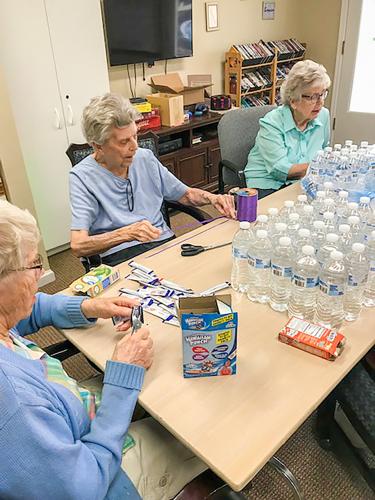
Parkhurst Place Assisted Living residents are gearing up for the first of summer high temps coming this week by helping the Hood River County Meals on Wheels Program. Pictured (from left) are volunteers Joy Colliver, Donna Smith and Helen McPherron helping attach a drink packet to each bottle of water, to be disbursed along with hydration awareness information this week and throughout the summer to the program recipients.
People of all ages found that splashing around in the cold waters of the Columbia at Waterfront Park was a great way to keep cool when temperatures jumped into the high 90s on Wednesday.
Emily Fitzgerald
Parkhurst Place Assisted Living residents are gearing up for the first of summer high temps coming this week by helping the Hood River County Meals on Wheels Program. Pictured (from left) are volunteers Joy Colliver, Donna Smith and Helen McPherron helping attach a drink packet to each bottle of water, to be disbursed along with hydration awareness information this week and throughout the summer to the program recipients.
Temperatures are expected to climb into at least the mid-90s this week in some parts of Oregon. Health officials are recommending people prevent heat-related illnesses that can lead to heat exhaustion and heat stroke.
“People may not realize that heat-related illnesses can be deadly,” said Tom Jeanne, the deputy state health officer at the Oregon Health Authority (OHA) Public Health Division. “Extreme heat conditions pose a higher risk for children, people 65 and older, and those with chronic health conditions as well as athletes and outdoor workers.” Also at higher risk are people with low incomes because, said an OHA press release, they often can’t afford air conditioning for their homes or they live outdoors where they are more exposed.
The Oregon Public Health Division offers the following tips for staying safe and healthy during extreme heat conditions:
Stay cool
Stay in air-conditioned places, if possible. Avoid relying on a fan as your main cooling device, particularly when the temperature is 90 or above.
Limit exposure to the sun from 10 a.m. to 4 p.m., when UV rays are strongest. Try to schedule activities in the morning and evening.
Use cool compresses, misting, and cool showers and baths.
Never leave infants or children in a parked car. Nor should pets be left in parked cars — they can suffer heat-related illness, too.
Even during the summer, the power can go out. Have a plan to stay cool when the power goes out.
Stay hydrated
Regardless of your level of activity, drink plenty of fluids, even if you are not thirsty and especially when working outside.
Avoid alcohol or liquids containing large amounts of sugar.
Make sure your family, friends and neighbors drink enough water.
Stay informed
Keep up-to-date on the temperature and heat index when planning activities to find ways to stay cool and hydrated. The heat index measures how hot it feels outside when factoring in humidity with the actual air temperature. Visit www.osaa.org/heatindex or www.weather.gov for up-to-date weather watches, warnings or advisories.
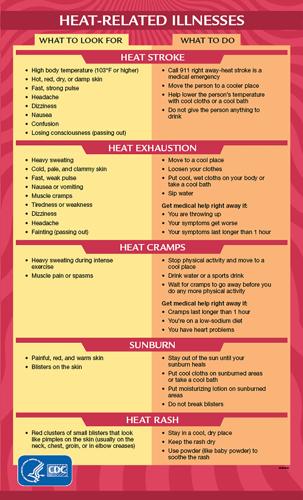
Learn how to prevent, recognize and treat heat-related illnesses. Know the warning signs of heat stroke, heat exhaustion, heat cramps, sunburn and heat rash, and how to treat and prevent them (see infographic at right for details).
Be aware of any scheduled power outages your utility company plans. If you do not have air conditioning or you live outdoors, visit air-conditioned places or a cooling shelter (see sidebar below for details).
Stay safe
Check on friends, family and neighbors who may have a higher risk of heat-related illness at least twice a day.
Always supervise children when they are in or near water, including bathtubs.
Wear personal flotation devices when out on boats, near open bodies of water or participating in water sports.
Use sunscreen with at least SPF 15 when going outside.
People with a chronic medical condition such as heart disease, high blood pressure, diabetes, cancer or kidney disease, may be less likely to sense and respond to changes in temperature. Some medications can worsen the impact of extreme heat. People in this category should learn the effects of their medications and pay extra attention to drinking enough water, accessing air conditioning and knowing how to keep cool.
Those who work outdoors or exercise in extreme heat are more likely to become dehydrated and get heat-related illness. They should try to stay as cool and hydrated as possible.




Commented
Sorry, there are no recent results for popular commented articles.