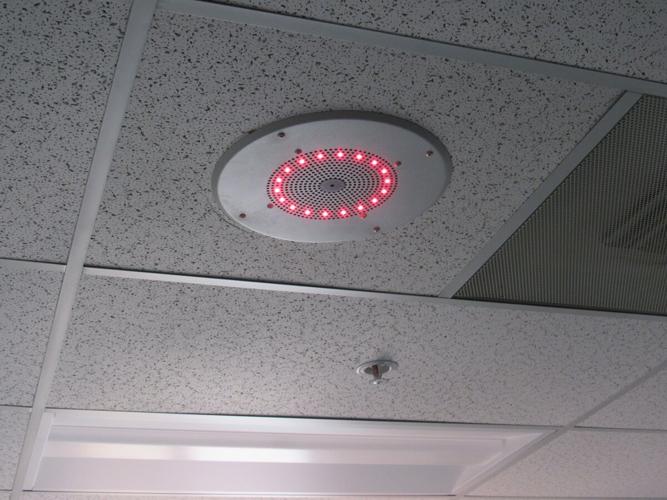
The new dispatch system includes subtle alert systems that reduce the “heart-pounding” effects of being jarred awake by loud alarms and flashing lights.
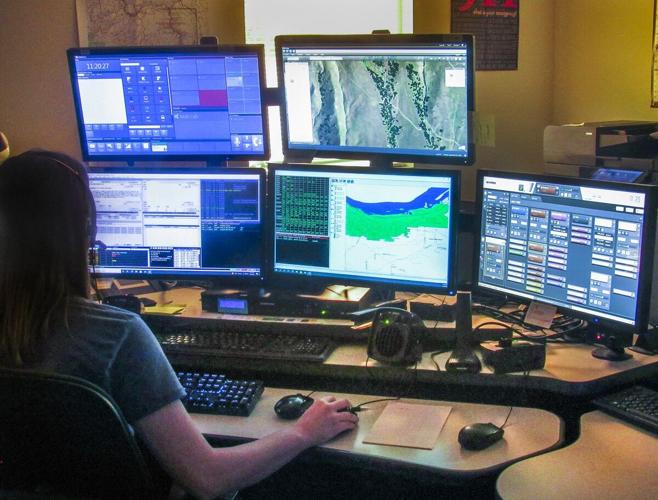
9-1-1 Dispatcher Lauren Brown working at one of the dispatching stations in the Wasco County 9-1-1 Communications Center in The Dalles.
Kelsie Cowart photo
THE DALLES — In early June, Mid-Columbia Fire & Rescue (MCF&R), in collaboration with the Wasco County 911 Communications Center, implemented a new dispatching system produced by the custom engineering firm U.S. Digital Designs (USDD), called the Phoenix G2.
According to the USDD website, the Phoenix G2 is a state-of-the-art automated station alerting system that can almost instantaneously alert fire station personnel of the location, type and level of emergency that is taking place.
When a citizen calls 911 with an emergency, a dispatch operator’s job is to obtain the necessary information, such as the location and nature of the emergency, in order to alert the proper resources to assist the situation. With the traditional method of dispatching, dispatchers would log the call into a computer-aided dispatching (CAD) system, and then, if a fire or medical presence was required, manually set off the tones of the closest responding fire station, according to the Wasco County 911 Director Joe Davitt.
If multiple fire stations are needed, the dispatchers would have to separately alert those stations as well.
With the new system, after logging the call and confirming the location of the emergency, dispatchers can hit a single button and the needed units will immediately be notified of the nature, level and location of the emergency taking place via voice automation and written text that appears on screens located throughout the firehouse, including the apparatus bay, hallways, common/living spaces and dorm rooms.
According to Assistant Fire Chief David Jensen of MCF&R, the total cost for the upgrade was approximately $182,000, with the cost “split between the normal budget tax dollars and excess bond funds,” the excess bond funds being approxiately $53,000.
Jensen believes one of the most important anticipated benefits with the new system is quicker response times.
While it cannot yet be definitively said how much quicker response currently is, due to how recently the system was put in place, both he and Davitt believe that it has achieved doing so by simply cutting down elapsed time between receiving the calls and notifying resources.
The new dispatch system includes subtle alert systems that reduce the “heart-pounding” effects of being jarred awake by loud alarms and flashing lights.
Kelsie Cowart photo
“With MCF&R having two stations, it does make a lot of sense,” said Davitt. “If you have to pull from both stations, you just hit one button and then it automatically does it. It sets off both alarms off so we don’t have to do anything extra, so it is a lot simpler.”
Jensen also believes the additional time the dispatcher is able to spend on the phone with the caller provides major benefits as well. “They (the dispatcher) hit the button, they send it out, and they are still on the phone with the caller getting better information,” he explained. “So by the time they (the responding units) get enroute, the dispatcher has really good information to give them.”
Another benefit is the redundancies the new system offers. According to Jensen, the system utilizes both radio and fiber optic lines to relay the necessary information. “(The alert) simultaneously comes over our radio system, and then it also comes over fiber. If fiber lines that connect to the stations are cut, or severed, the fact that it’s sending information over the radio also can trigger the station independently off of the tone sequence, so it can pick that up.
“That redundancy (is) to ensure that people are waking up or the station actually is getting the call,” he said. “We’re always looking for redundancies in that system to make sure it’s going to work consistently and perfectly.”
In addition to how dispatchers alert each station, the method in which the stations receive the necessary information has also changed. Rather than alerting the entire fire house through “station dispatching,” according to Davitt, dispatchers are now utilizing a method called “unit dispatching.” The system notifies stations of what specific units are recommended for the call. This change is especially significant during the night; instead of waking up the entire station for an emergency, alarms will only go off in dorms of the needed units. They are awoken through a combination of even-toned voice automation and LED lights, both of which “ramp” up gradually, mitigating the heart-pounding effects of being jarred awake by loud alarms and flashing lights.
If needed, responders can view the location and nature of the emergency on consoles installed in their dorm.
The new dispatch system includes dorm room panels that reduce the “heart-pounding” effects of being jarred awake by loud alarms and flashing lights.
Kelsie Cowart photo
Not only does this change allow for responders to get more sleep throughout the night, it also benefits firefighters’ overall health. “Studies have found that when a firefighter wakes up in the middle of the night, if they’re going off to gongs and bells and everything, that instant jerk to (being awake) is not good for your heart,” said Jensen.
“This really maximizes the balance of heart health (and) getting firefighters on scene as soon as we possibly can. It’s top notch and we’re very excited.”
Both parties consider the upgrade a definite positive change, though there are still some things to get used to.
“What we did have to have was training on it,” said Davitt. “That’s one thing that dispatchers do not like, is change. But that’s one thing that happens almost (a) couple times a year. Everything is constantly being updated.
“It’s a learning curve because we’ve never done anything like that,” he went on, “but it’s been really positive for everybody.”




Commented