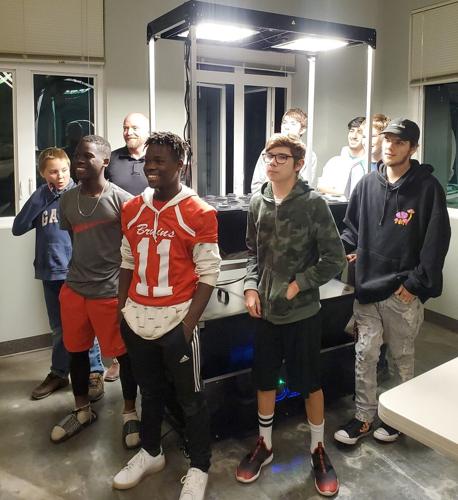
The first Eden Grow Systems tower was sold to Grace Baptist in White Salmon to teach STEM concepts to the church’s young men’s mentorship program, above.
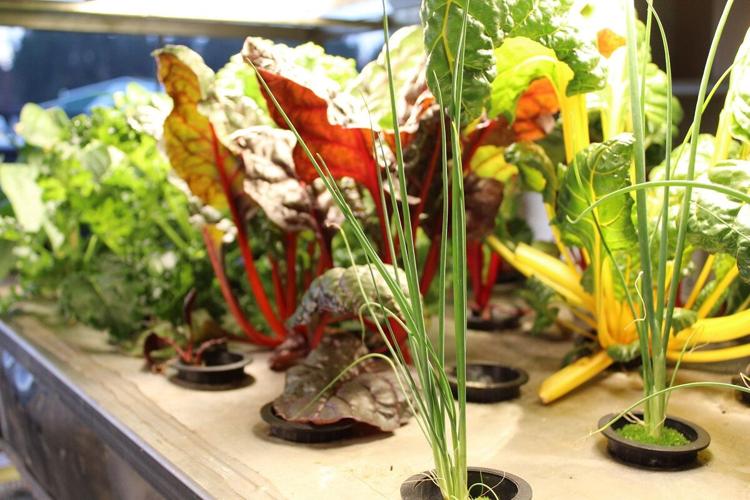
A variety of fruits and vegetables can be grown in the tower, such as green onions and swiss chard, above. The towers utilize technology to allow for year-round growing.
The first Eden Grow Systems tower was sold to Grace Baptist in White Salmon to teach STEM concepts to the church’s young men’s mentorship program, above.
Snowden-based grow-tech startup seeks simplicity in high-tech facility
Jeff Raymond, co-founder of Eden Grow Systems, a grow-tech start up, is looking to make connections in the Gorge.
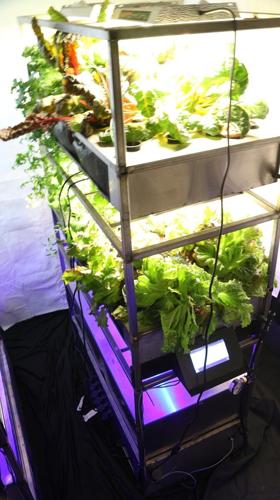
Raymond, who lives in Snowden with his wife, Alicia, has designed a simple, vertical aeroponics tower to grow food indoors and year-round. Seeds are placed in cups; as the plant grows, its roots are suspended in air, sprayed regularly with an optimized nutrient and water solution. The towers additionally utilize lights to simulate sunlight. All of the tower’s mechanics are located at the bottom.
“The system of growing food is complicated, but we’ve removed that complexity, or at least minimized it,” Raymond said.
This is NASA technology. Eden Grow’s director of plant research is Gary Sutte, Ph.D., who spent 25 years at NASA’s flight and ground-based plant research department at Kennedy Space Center in Florida, and helped Raymond update the tower’s design.
“It’s simple, yet it works,” Raymond said. “Being able to convert space-age technology into something that helps feed people right now on the planet is very awesome.”
One of Eden Grow Systems towers.
Photo courtesy of Alicia Raymond
The towers can grow all manner of fruits and vegetables, such as carrots, onions, beets, corn, cucumbers, grapes, strawberries, tomatoes, fennel, basil and leafy greens, to name a few. It utilizes technologies such as artificial intelligence and robotics to remove challenges associated with growing crops in the ground — such as poor dirt quality or animals helping themselves to the crops — that can lead to poor yields.
Aeroponics is an efficient way to not only feed plants, but save water, as the nutrient solution is sprayed directly onto the roots.
“We’re talking about being able to use close to 98-99% less water than traditional agricultural with the same yield,” Raymond said. “That’s just the technique — we just figured out how to package it nicely.”
The first-ever tower was delivered to Grace Baptist in White Salmon a few months ago for use in a young men’s mentoring program, raising the necessary funds by doing odd jobs like chopping wood and shoveling snow. The group uses the tower to learn about STEM — science, technology, engineering and math — and is working on a way to bring a similar tower into a retirement home to help provide fresh food to residents.
One idea has led to another; the Raymonds are now looking for area teachers interested in using the towers for project-based, real-world learning. Raymond has a partnership with North Dakota State University, and has been in communication with Texas A&M and New Mexico State University, as well the Indigenous People’s Task Force in Minnesota.
A variety of fruits and vegetables can be grown in the tower, such as green onions and swiss chard, above. The towers utilize technology to allow for year-round growing.
Photo courtesy of Alicia Raymond
“We partnered with an organization called Grand Farm out of North Dakota,” he said. “They just won a $10 million grant through their state — they’re all about advancing agriculture technology.” The tower has been placed downtown, in a window where everyone passing by can see it.
They’d like to see such partnerships with local schools and businesses.
“We’d like to start a campaign where we work together with people who understand disadvantaged communities, who come from that urban environment,” he said, noting the towers could be used to bring fresh produce to food deserts.
“(The towers) can go into cities. They can go into apartments. They can go into old warehouses, and they can immediately start making a difference,” he said. “We’re finding it can be used by so many different groups. Not only can we go in and help disadvantaged, under-represented communities, but we can go into restaurants and grocery stores.”
One of Eden Grow Systems’ five Gorge employees is a Columbia High School graduate who had no prior growing experience. “He has grown vegetables through the dead of winter with minimal instruction, so we can literally take someone off the street — they don’t need a degree — and we could give them a job, get decent pay and grow food that’s part of a community. And that’s what we want,” he said.
Raymond points to inflation — at home and abroad — as well as supply chain issues and a growing population and sees the towers as a way to get nutritious food into the hands of everyone. Even in the Gorge, where food is grown in abundance, “we still have food banks, it’s still winter … so maybe some people somewhere have a building that we can get these going and in the middle of winter, we can support the food bank with fresh vegetables.”
Raymond credits his Christian faith and trust in God with the growth of the startup. Three years ago, he left his job at Insitu to pursue working on the towers fulltime, but the story didn’t start there.
Fifteen years ago, he joined the Air Force, with plans to become an astronaut. But a physical showed medical problems that ended his dream. He readjusted, he said, and decided to stay. He was serving in Baghdad when he heard the Lord tell him to leave the service and return home.
“And I’m like, ‘Well, I don’t want to, that’s not the plan here,” Raymond said. “But I listened and I took a leap of faith and I left … I didn’t know what I was going to do.”
Soon afterwards, his father was diagnosed with cancer, and six months later, he died. The two were close, and it was from his father that Raymond learned to love the outdoors.
“He was an outdoor cowboy and he loved technology. And then I’m an aerospace engineer, but I love the mountains, so I’ve always felt this pull,” he said. The two of them began to research sustainable living, which led Raymond to build a self-sustaining aquaponics habitat — he called it Hab 1 — on their Snowden property. That journey was documented on his YouTube channel (TheRealMartian), which led to an award of Human of the Year by Motherboard Magazine, speaking at Tedx Mt. Hood, and a speaking engagement at the International Space Development (ISD) Conference in Los Angeles.
It was through that ISD conference they met Bart Womack, who is now the CEO of Eden Grow Systems. “He had been building a farm in a box, in a Conex container,” said Raymond. “So what we did is combine the best of both worlds and we now have Eden Grow Systems. And we’re on the threshold of being able to get these towers out to people.”
The start-up began with two employees at the beginning of 2021, and by year’s end, had grown to 11. Raymond is looking to hire more Gorge residents.
“It’s neat to see the different ways we can apply the technology for every demographic of our society, whether they are wealthy or impoverished, (the tower) helps everybody,” Raymond said. “I couldn’t be more proud of the team we’ve put together, and I’m grateful to God for getting us this far.”



Commented
Sorry, there are no recent results for popular commented articles.