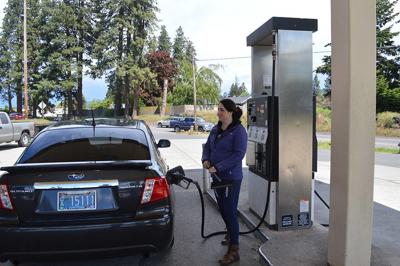
Drivers in rural stretches of Oregon—including Hood River County—could be pumping their own gas if a new bill makes it through Salem.
The Oregon House unanimously passed a bill last Friday that would allow gas stations in counties with fewer than 40,000 residents to keep self-service pumps turned on when no owner, operator or attendant is present to dispense gasoline.
The bill, sponsored by Rep. Cliff Bentz (R-Ontario), and co-sponsored by Senator Ted Ferrioli (R-John Day) breezed through the House with a bi-partisan 60-0 vote. The next step is a Senate decision.
Oregon is one of two states that have historically banned self-service gas, along with New Jersey. The new legislation would strike down Oregon’s 64-year-old law barring Oregonians from pumping their own fuel, but only in rural areas. The original 1951 statute intended to defend the public from handling “Class 1 flammable fuels,” and also to protect the elderly and disabled from getting out of their car to pump gas “because Oregon’s weather is uniquely adverse, causing wet pavement and reduced visibility.”
The new bill attempts to ease traveling through isolated stretches of Oregon, particularly in southeastern Oregon, where drivers can become stranded if no gas stations are open. Bentz argued parts of Oregon are so remote that people unfamiliar with the landscape don’t realize hundreds of miles separate each station.
According to a record of the House’s first reading, HB 3011 strives to address the following issues:
Due to the bill’s population classification of 40,000 and under, it would apply to more than half of Oregon’s counties, including communities along the Columbia River Gorge. According to a 2014 U.S. Census estimate, Hood River County’s population was 22,885 and Wasco County’s was 25,515.
Owners of local gas stations expressed concern regarding the economic impact of bringing self-service gas stations to Hood River County. They voiced an issue that self-service automation could eliminate existing jobs.
Florence Akiyama, who owns Nobi’s gas station on Tucker Road in Hood River with her husband, Nobi, said the legislation could hurt local employment.
“I don’t see the advantage really … the worst disadvantage will be (losing) jobs,” said Akiyama.
Nobi’s employs 11 employees, four of whom are full-time, said Akiyama. She said the station is typically open from 6 a.m. to 10 p.m., with employees working two shifts. The station is closed at night.
Butch Gehrig, owner of Gehrig’s Chevron station in Odell, said his station would “keep full service” even if the option of self-service was introduced around the state.
“I suppose in a way it would save in my labor cost a bit, but I would rather have people working,” said Gehrig.
Gehrig predicted legislation would affect employment statewide but would not change gas prices considerably. He said gas prices are similar in Oregon and Washington, even though Washington uses self-service stations. According to GasBuddy.com, a nationwide gas tracker, Oregon’s average price per gallon as of Friday was $2.99 and Washington’s was $2.97.
Paco Salazar, assistant manager at Gehrig’s Chevron, said a law allowing self-service stations in Oregon could “cut jobs.”
However, Salazar said there wouldn’t be much of an impact on Gehrig’s due to its small staff. Including management, Gehrig’s Chevron runs on the elbow grease of four locals. Salazar said all four workers share duties, including vehicle maintenance and lube, in addition to working as gas attendants.



Commented