
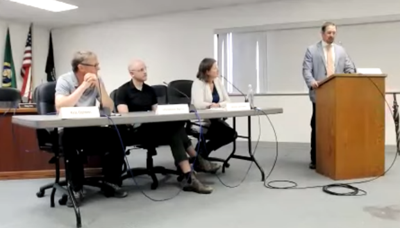
WHITE SALMON —Candidates vying for White Salmon Valley School District board positions gathered at the White Salmon Fire Station Oct. 5 for a forum sponsored by the nonpartisan Klickitat-Skamania League of Women Voters and Columbia Gorge News ahead of the Nov. 7 general election. Questions included those written by the sponsors of the forum as well as those submitted by the public prior to the event.
Klickitat County Commissioner Jacob Anderson served as moderator. In attendance were Kris Ostness, running for position 1, Matthew Bryne, position 2, and Laurie Stanton, incumbent, position 4.
Mike Hughes, also running for position 2, was unable to attend due to a prior commitment. Andrew Chapman, running for position 1, and Todd Andrews, position 4, did not respond to multiple invitations issued by the League of Women Voters.
One of the first questions candidates tackled regarded the steps needed to prevent a repeat of the budget shortfalls seen earlier this year. Stanton said hiring Superintendent Rich Polkinghorn was a good start, as is the board’s plan to put together a financial committee.
“We need to provide more oversight,” she said. “We need to pay better attention, we need to ask those questions as they come up and not be pushed aside when we ask the tough questions. We have to continue to listen to our stakeholders, the parents, the teachers, and be available to hear their questions and concerns and bring those voices and concerns forth.”
Ostness said he also feels the right superintendent is now on the job, which is the first step. For Byrne, it will include having updates from the newly formed financial committee, tying the superintendent to metrics and diversifying funding streams.
“And it’s not as sustainable as we’d probably like, but there is also a lot of opportunities for block grants out there from Washington State as well as the Feds ... and leverage some additional dollars to supplement and get us to that reserve, that point we’re hoping of, 8% by the end of the year,” he said.
Several questions related to student safety issues such as bullying, mental health and gun violence. Concerning the latter, Byrne said, “If we have students who are really struggling or have complexities outside of the home, who may be more likely to be either victims of violence or solicit violence upon their fellow students, we need to be having good systems in place, policies in place to be able to recognize those kids who are needing additional support, ensuring that we have safe spaces within the school environment, and that both administrators and teachers know what those resources are … A lot of that work is done up front and in policy and ensuring that we’re having those conversations ongoing.”
Stanton said it starts with paying attention to student health and wellbeing — “For starters, our partnerships in the community for proper referrals and screenings to get mental health support and identifying students in crisis,” she said. “We’ve unfortunately had a couple of opportunities to practice what would happen if there was an active shooter in our district and that was terrifying. But I feel like our district did a really good job partnering with our law enforcement … And the final thing we need to touch on is the safety of our buildings.”
Ostness said ensuring student safety means identifying children who fall through the cracks. “We need to address their school attendance, their social-emotional issues, the issues they might be having at home and make sure that they do not fall through the cracks,” he said. “Because when they fall through the cracks, that’s when things really start to fall apart.”
Each candidate had one minute at the end of the forum to clarify or add to earlier statements. “My profession is a videographer, so I spend a lot of time behind the camera,” Ostness said. “I’m looking forward to working in the community and becoming a better public speaker.”
Byrne pointed to his background in academia as a strength he will bring to the board. “I worked as the institutional researcher at Columbia Gorge Community College doing student success work. And it was incredibly rewarding and something that I’m hoping to come back to now, having moved into more of a public health field, professionally. But education is near and dear to me,” he said. “I, in grad school, worked as an ESL teacher. Also, I think, one of the best jobs I’ve ever had, and incredibly rewarding, and very much feel for our wonderful teachers and the wonderful work that they’re doing. So I bring some of that background to this position, hoping to kind of leverage some of those skills. And lastly I care a lot about this community and look forward to potentially serving in this role and getting to volunteer my time.”
Stanton used her minute to speak to equitable access to education. “I think the next time we do this, we need to find a way to have these conversations translated into Spanish. I would like to find out if there’s a way to have these discussions maybe this time with our Latino, Latina families and communities,” she said. “That’s a huge segment of our kids, that community that we don’t have a good reach into. I think that’s a missing piece at our board meetings and this event. How do the parents even know who they want to vote for? How do they know which one of us is going to really embrace their kids and their family’s needs?” she asked. “We need to do so, so much better in that respect.”
The forum is available for viewing on Facebook at facebook.com/lwvklickska.
•••
Una versión en español de esta historia está en línea en www.columbiagorgenews.com/enespanol.


Commented