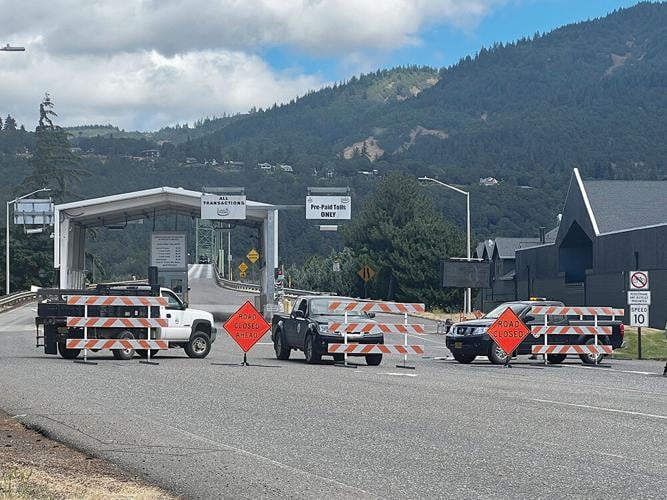
On June 27 at approximately 10:15 a.m., the arm of the excavator struck at least six locations on the north and south support tower and lift span. Right away, the Port of Hood River closed the bridge and engineers completed a constructability review.
On June 27 at approximately 10:15 a.m., the arm of the excavator struck at least six locations on the north and south support tower and lift span. Right away, the Port of Hood River closed the bridge and engineers completed a constructability review.
HOOD RIVER — Port of Hood River Executive Director Kevin Greenwood released an After Action Report (AAR) summarizing the June 27 incident where a truck collided with truss spans on the Hood River-White Salmon Bridge and caused an estimated $1.1 million in damages. The port reported a loss of approximately $135,000 in toll revenue as a result of the three-day bridge closure.
As of July 15, the port has learned that the company and the truck was insured. It was previously believed the truck — which was leased out to a third party — was not insured. According to the police report, the driver said they checked their load before leaving Underwood, Wash., and reported the load height was 13 feet and 11 inches. The bridge clearance is 14 feet and seven inches. The driver believes something must have changed with the “air leveler adjustment.”
According to the AAR, at 10:19 a.m. port personnel “heard an impact with the southbound sign” and contacted Facilities Manager Ryan Klapprich, who investigated the damage. At 10:54 a.m., Klapprich called engineers at Henningson, Durham & Richardson, Inc. (HDR) and at 11:30 a.m. engineers advised the bridge be closed and vehicles still on the bridge were slowly let off. At 11:51 a.m. the last vehicle came through the toll booth.
Port management including Facilities Manager Ryan Klapprich, Executive Director Kevin Greenwood and Executive Assistant Patty Rosas developed a plan to share information on the closure on their website, social media and post notices on Trip Check, Facebook and X (Twitter). Emails were sent out to BreezeBy customers, chamber representatives and other media outlets.
Port staff received commendations from Greenwood for their work removing vehicles from the bridge, shutting down the bridge and disseminating information in a timely manner. This incident served as an opportunity for the port take a closer look at their incident response guidelines and where they may be able to improve.
Based on his findings, Greenwood recommended that port management take National Incident Management System courses and revise their Emergency Action Plan — which focuses on fire, natural disaster and work-place violence — to include bridge emergencies.
The port’s current insurance policy has a $1 million deductible — which increased from $500,000 earlier this year to save $65,000 in annual premium payments. The port board of commissioners will discussed lowering the deductible back to $500,000 at the July 16 meeting (a decision came after print deadline).
Many residents and businesses around the Gorge responded to the port’s decision to close the bridge daily for 12-hour increments so the engineers and construction crews can repair the truss spans.
The report stated: “The decision was not made without concern for those businesses, but businesses that open early in the morning were also considered .... Twelve-hour schedules were the most efficient for completing work as quickly as possible for the highest number of users.”
Greenwood said the AAR is going to be a “living document,” and it will be updated if new information becomes available. A full version of the 10-page document is available in the July 16 Port of Hood River commission meeting packet.




Commented