Welcome to April! If you were not able to view the March 3 Lunar eclipse, check it out on the Goldendale Observatory website, at www.goldendaleobservatory.com. Look under “special events” and you can watch a video of the entire eclipse, or a two-minute timelapse.
April begins with a full Moon on the 1st, no fooling. New Moon follows on the 17th. On the 18th, sharp eyes may be able to detect the young Moon just to the right of Venus, low in the west right after sunset. On the 22nd, the Moon will lie just above Jupiter in the southwestern sky.
Two planets dominate our April evening skies this year, Venus and Jupiter. They are the brightest planets we see, Jupiter due to its immense size, and Venus because of its proximity to Earth, as our closest neighbor. Let’s focus on them a bit this month.
We’ll start with our neighbor, Venus. I think that a lot of people think Mars is our closest neighbor, due to all the interest in the red planet. But Venus comes closer. Venus approaches as near as 24 million miles from us, whereas Mars gets no closer than 33.9 million miles. Venus is also our “twin” — almost exactly the same diameter (7,521 miles) as Earth (7,926). Venus is shrouded in thick clouds, and for years we knew little about the planet. Some thought the clouds may be water vapor, and given that Venus is about the same size as Earth, speculation was that possibly it could hold life. But once we sent probes to Venus, including landers by the Soviet Union, we found that the planet was anything but hospitable! Those clouds were mostly (over 96%) carbon dioxide, and the surface temperature was over 800 degrees F, hot enough to melt lead! That thick atmosphere allows solar radiation to be trapped, heating the planet, a runaway greenhouse effect. Surface pressure is also enormous. Landers on Venus have only lasted a few hours. Not a fun place to be! Venus orbits the Sun in about 244 days, a shorter year-length than Earth. Venus rotates quite slowly though, with a Venetian day equivalent to about 117 Earth-days.
Those thick Venetian clouds give the planet a high reflectance, making the planet quite bright in our sky. If you train a telescope at Venus, you can detect that the planet has phases, like our Moon. Galileo noticed this with the newly invented telescope in 1610, and observed that the planet showed phases. It proved to Galileo that Venus was orbiting the Sun, a first proof that the Sun was the center of our solar system, not the Earth.
Jupiter, our other bright April planet, is the largest planet in the solar system. Unlike the inner planets (Mercury, Venus, Earth and Mars), which have solid surfaces and gaseous atmosphere, Jupiter and the other outer planets are mostly gaseous and liquid, lacking solid surfaces. Jupiter is largely made up of hydrogen and helium, just like our Sun.
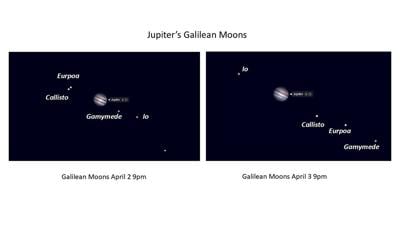
Jupiter also played a part in Galileo’s proof that the Sun is the center of the solar system. In that same year, 1610, he trained his telescope on Jupiter, and observed the planets’ 4 large moons, Io, Europa, Ganymede and Callisto. At first, he thought they were stars, but noticed that they moved from night to night. He correctly deduced that they were moons orbiting Jupiter. They were another proof that the Earth was not the center of the solar system. Those 4 moons are now called the Galilean moons, in honor of Galileo. They are bright enough to see with a small telescope, or even a pair of binoculars.



Commented