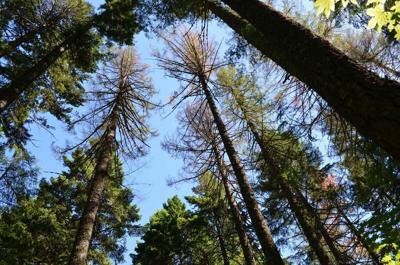
Dying or declining trees stand out in contrast to the lush green of a new growing season in the forest. Bark beetles are the most common cause for dying trees in scattered locations across the Mid-Columbia region. Landowners and others in charge of tree care are advised to take special precautions to prevent bark beetle outbreaks and avoid attracting bark beetles to their trees. The first flight of bark beetles emerge from infested trees and tree debris beginning in April, with periodic emergence through the summer.
You may have heard Oregon Department of Forestry (ODF) Forest Entomologist Christine Buhl on the radio talking about threats from bark beetles. She notes that while not every infestation will spread, the likelihood is greater when trees are struggling due to drought or root disease. OSU Extension is working with Christine and other forest entomologists in Oregon and Washington to provide some basic guidance for reducing risks due to bark beetles.
Though bark beetles are native to Oregon forests, recent episodes of drought, fire, and storm damage have increased bark beetle hazards. Major tree species affected are Ponderosa pine and Douglas-fir. The recommendations for dealing with bark beetles are different for each tree species.
With pine species, tree debris produced during the spring and summer is highly attractive to breeding bark beetles. When possible, schedule tree work such as thinning, pruning, and tree removal for fall and winter (October through December).
Tree debris and slash may be left on the ground during fall and winter time (best if it is scattered). When work on pine trees is done during spring and summer (hazard trees or other urgent needs), tree debris three to eight inches in diameter should be disposed of within two months via chipping, burning, or hauling away. For more details, see slash management for bark beetle protection at www.oregon.gov/odf/Documents/forestbenefits/Slashmanagement.pdf.
The Douglas-fir beetle prefers larger trees or logs, at least 10 inches in diameter. Local outbreaks of Douglas-fir beetle can be caused when groups of fallen trees or logs are left in the woods. The beetles breed in the down wood and their population may grow large enough to infest nearby green trees after a year or two. Fire damaged trees may also become infested to hazardous levels. Recommendations to reduce beetle hazards are to remove fallen trees, logs, or infested trees larger than 10-inches diameter before April of the first or second year after the tree falls. When removal is delayed (or not done), the repellent pheromone MCH can be effective in protecting green trees in the area. For more information, visit www.oregon.gov/odf/Documents/forestbenefits/Douglas-fir-beetle.pdf and MCH for Douglas-fir beetle management at www.oregon.gov/odf/Documents/forestbenefits/MCH_2016.pdf.
If a tree is completely dead and brown in color (dead for one year or more), bark beetle hazards are minimal. In this case, if trees are not considered hazardous, an acceptable alternative is to leave dead trees standing for wildlife use.
Note that any screen trees removed within the Columbia River Gorge National Scenic Area must be replaced with new trees. Contact the CRG Commission for more information at www.gorgecommission.org/default.cfm.
‘Fire Aware, Fire Prepared’
Reducing the amount of tree debris to mitigate bark beetle hazards also helps reduce fire hazards. But there are other important steps that everyone can take to prepare for wildfire. To help prepare for another wildfire season, the OSU Extension Fire Program is providing Wildfire Wednesday educational sessions online. Episodes in the webinar series cover key aspects of preparing for and surviving wildfire. Look for the online webinar guide for upcoming sessions as well as video recordings of past sessions at extension.oregonstate.edu/fire-program/online-webinar-guide.
For questions about tree health or wildfire hazards, contact your OSU Extension Forester (Glenn Ahrens at 503-655-8631 glenn.ahrens@oregonstate.edu) or the Oregon Department of Forestry (The Dalles office, 541-296-4626).
About OSU Extension
The Oregon State University Extension Service shares research-based knowledge with people and communities in Oregon’s 36 counties. OSU Extension’s partnerships and programs contribute to a healthy, prosperous and sustainable future for Oregon.



Commented
Sorry, there are no recent results for popular commented articles.