THE DALLES — With the recent restoration of a 115-year-old piano, and the biggest pipe organ east of the Cascades, Zion Lutheran Church is working to build an inclusive, welcoming music community — a space for all artists and listeners, regardless of their religion, said Pastor Tyler Beane Kelly.
The piano, a 1909 Chickering grand, was disassembled and restored by one of only two piano restoration companies in the U.S., and was re-dedicated this May. The pipe organ was restored in 2019, at the instigation of church organist Garry Estep, who discovered it was worth about $1.3 million — after it started “speaking on its own” and important pieces came off in his hand during songs.
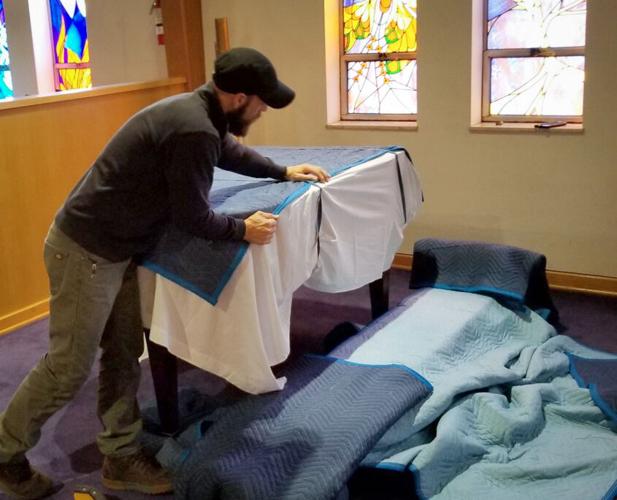
The 115-year-old Chickering is wrapped for transport. A piano restoration company in New Jersey completed all the work.
Photo courtesy Gary Estep
“This church really cares about music,” said Beane Kelly. “And they’ve had a number of excellent musicians over the years, that make beautiful music here, and value that and value having the best pipe organ possible.”
Like many churches, Zion Lutheran has a praise band. They also host the full breadth of church music and secular music. “Some churches, there’s sacred music, that is for church; and there’s secular music that you’re not supposed to have in church. We’re the sort of church that, it’s all good. It’s all sacred. We play Mannheim Steamroller, play rock music,” he added.
Jazz is also fine. “A lot of times I just sit down and start making things up,” said Estep. “Just because I can.”
Estep said he’s motivated by the expense and inaccessibility of traveling to Portland to attend concerts. Between travel expense and tickets, Portland shows are out of reach for many. The concert series at Zion make great music more accessible, he said.
Estep and Beane Kelly emphasized that anyone is welcome to music programs, and the music played during services, regardless of any listener’s religious beliefs, or lack thereof. “I don’t pray. Out of respect, I stand up,” said Estep, noting people of other faiths are welcome to drop in for the music without participating in prayer.
The piano belonged to area resident Dagmar Wilhelm in the early 1900s, before television, stereos or internet, when piano music was an important form of entertainment for many families. “That’s why there’s so many of them out there now that people are trying to give them away,” said Estep. “And nobody wants them now, because we got other forms of entertainment.”
Upon Wilhelm’s death she donated the piano to Zion, where it was the only piano.
More than a century of wear took its toll. After a 20-year career as a concert pianist, Estep said he’s used to fine instruments, and Zion’s didn’t sound so great anymore. “The action itself was clunky. It was very biting,” he said. “There were things that would stick. If you looked inside, the piano was filthy ... Things were just falling apart. And it had to be tuned constantly.”
The low notes sounded thin, because a wooden bridge, which transfers vibrations from the longest strings to the soundboard, cracked. The pedals were unpredictable; sometimes, they “did things” on their own.
The piano’s wooden cabinet contains the harp, a gold-painted metal frame holding the strings. “Almost everything” inside needed restoration, with many handmade parts required. But Lindeblad Piano Restoration’s experts didn’t refinish the cabinet or the ivory keys, so it still looks like the century-old instrument it is. Ivory keys can’t be obtained anymore, since ivory requires the killing of endangered animals like elephants and almost all sales are banned in the U.S.
The piano's harp and keys and other components, once filthy, now shine.
Flora Gibson photo
The restoration could 115 years, Estep said. The project cost almost $30,000, but the church received a memorial donation to cover the cost.
The lower notes sound rich and strong again and the tinny sounds are gone. And the pedals work. “It’s hard to describe if you’re not a pianist, but it’s kind of like the difference between wearing combat boots and moccasins,” Estep said.
The other vital element of Zion’s musical community, the pipe organ, was restored in 2019.
Garry Estep performs on the restored pipe organ.
Flora Gibson photo
When Zion stood three or four blocks downhill from its present location at 10th and Union, this was a theater organ. When the church moved in the early 1950s, the organ pipes were ferried up Union Street by a parade of Sunday School children.
In 1967, the old organ started “doing things on its own.” Parts stopped working. Others started playing unexpectedly. The church “literally split” over the issue of whether to repair or replace the ailing organ.
“I read the notes and everything from the organ committee and the meetings and it was war,” said Estep.
When the church decided on replacement, a third of the congregation picked up and left.
The new organ, built by the Phelps-D’Autremont company for about $400,000, shipped from Erie, Penn. The process started 1973 and took three years. At one point, work paused when a certain wood from Germany became unavailable. Then the console was temporarily misplaced on its way to The Dalles. Then the keyboard didn’t fit, and another needed to be made and shipped.
Finally, the pipes were connected to the organ console by the best of 1970s solid-state wiring. For a few decades, the organ was good.
Then it started “speaking on its own” again. Stops, the small knobs an organist pulls to activates a set of pipes, came loose in Estep’s hand while he played.
The congregation hadn’t realized the organ’s $1.3 million worth. Fortunately, repairs cost just $17,000.
Later, they added another two ranks of pipes, enhancing the sound and — not incidentally — making this the biggest pipe organ east of the Cascades.
Estep entered Zion’s music community when the promise of a particular Mozart song attracted him to a Lloyd Walworth concert six years ago. To his disappointment, the Mozart wasn’t played after all — because Walworth couldn’t find an organist. “You’re looking at one!” Estep told him.
Estep volunteered as organist for the church, not knowing that Zion’s previous organist of 70 years, Phyllis Ronfeld, had retired that very morning. “This church has come a long way, to be open to a gay Buddhist man to be your organist. Maybe 25, 30 years ago that wouldn’t have been the case,” said Beane Kelly.
“We want to promote this community as a place where people hear beautiful music and learn how to make beautiful music,” the pastor added. “And we promote that for the life of the whole community,” especially as music programs are not always valued in schools. “Music is something that speaks to our souls.”
The church hosts several arts and music programs, including a bell choir possessing more than three octaves in bells, the Cascade Singers, Serious Theater, hymn marathons and concert series. They’re also looking for other arts organizations to use the space for poetry slams or concerts on the pianos or other creative things.
Questions about music at Zion can be directed to: office.manager@gmail.com, or phone 541-296-9146.





Commented
Sorry, there are no recent results for popular commented articles.