More than half of Americans (56%) admitted they regularly purchase shoes they later regret because of how uncomfortable they are.
That’s no small problem when you consider the average person takes almost three million steps and walks nearly 1,200 miles per year, according to a new survey of 2,000 Americans evenly split by generation. That equates to walking a little over three miles each day. People also said they stand for roughly five hours each day, on average.
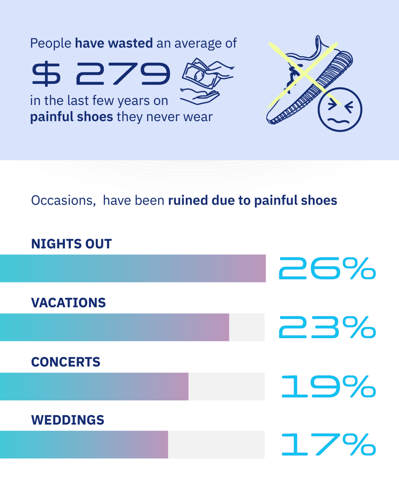
And yet, the survey, commissioned by Skechers and conducted by Talker Research, found people wasted an average of $279 in the last few years on painful shoes they never wear.
When wearing shoes that hurt their feet, respondents said the lingering pain lasts for a full two days, on average, and they feel it everywhere from their feet (67%) to their backs (43%), knees (31%), ankles (29%) and hips (21%).
Many said that traditionally fun occasions, from nights out (26%) to vacations (23%), concerts (19%) and weddings (17%) have all been ruined due to painful, uncomfortable shoes.
In light of this, people said they evolved to become a bit more practical and prioritized buying shoes that are truly supportive at age 34, on average.
However, three-quarters of people (74%) still admitted they wish they had started to prioritize wearing supportive shoes earlier in life.
Looking closer at the shoes people buy today, comfort is key in the buying decision. Respondents said that price is the No. 1 thing that influences their shoe selections in 2026, closely followed by supportiveness (61%), durability (55%) and style (43%).
That’s why Skechers commissioned the study: to highlight the importance of shoes that hold up to the pace of everyday life. They also emphasized that the right shoes are essential for runners to meet their goals. They said, “Every runner chases that exhilarating feeling of pushing past a personal best, finding a stride that feels like flying.”
(Talker Research)
By Talker
In the study, more than half of runners (65%) confessed that in the past, they’ve purchased running shoes simply based on how they look, rather than how they feel, only to regret it later because they were not supportive or comfortable.
To avoid this in the future, runners said the top things they look for in a good running shoe are overall comfort (54%), durability (49%), good ankle support (44%) and a lightweight feel (41%).
Running has become increasingly popular in recent years, with most of Gen Z (67%) saying they run or jog for exercise, followed by 56% of millennials, 29% of Gen X and even 13% of baby boomers.
Motivations for running are varied and blended between mental and physical incentives. The No.1 reason runners said they do it is to clear their minds (35%).
Thirty-four percent run to reduce stress and anxiety, 31% for weight management and another 31% said they run to improve their cardiovascular health.
With so many people running for physical and mental fitness, it’s important that they’re well-equipped. Nearly all runners (87%) agreed: Having the right running shoe is the difference between an amazing run and a horrible run.
Having commissioned the study for their new AERO shoes, Skechers said, "We're dedicated to helping you achieve those moments, and we're thrilled to unveil the next evolution in our performance commitment."
Top indicators of unsupportive shoes
My feet ache all over (39%)
My toes hurt (35%)
My feet feel overly compressed or cramped (32%)
I notice lower back pain (30%)
My heels hurt (29%)
Top 10 reasons people run in 2026
To clear my mind (35%)
To reduce stress or anxiety (34%)
To improve my mental health (33%)
To lose or manage weight (31%)
To improve cardiovascular health (31%)
To improve mobility (30%)
To build endurance / stamina (29%)
To strengthen muscles and joints (29%)
To spend time outdoors (28%)
To have “me time” (28%)
Research methodology:
Talker Research surveyed 2,000 Americans evenly split by generation who have access to the internet; the survey was commissioned by Skechers and administered and conducted online by Talker Research between May 4 and May 8, 2026. A link to the questionnaire can be found here.
To view the complete methodology as part of AAPOR’s Transparency Initiative, please visit the Talker Research Process and Methodology page.



Commented