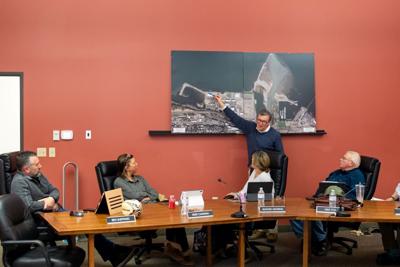
Port Executive Director Kevin Greenwood discusses options for bringing in new businesses at The Hook and Hood River waterfront at the April 9 planning meeting. Also pictured are Commissioners Ben Sheppard, Kristi Chapman, Heather Gehring and Mike Fox; also at the meeting but not pictured is Commissioner Tor Bieker.
Port Executive Director Kevin Greenwood discusses options for bringing in new businesses at The Hook and Hood River waterfront at the April 9 planning meeting. Also pictured are Commissioners Ben Sheppard, Kristi Chapman, Heather Gehring and Mike Fox; also at the meeting but not pictured is Commissioner Tor Bieker.
HOOD RIVER — On April 9, the Port of Hood River Board of Commissioners, staff and the budget committee met for their spring planning work session. Construction of the new bridge looms and the port must cut back and find new ways to generate funds in order to continue offering recreation and business opportunities for residents and visitors to Hood River.
The countdown continues until the port can no longer rely on bridge tolls to cover financial losses in other departments, such as the airport and waterfront parks, which reported losses of $127,636 and $211,133 in Fiscal Year 2022-23, respectively. The waterfront financial losses were in part to capital outlay such as rebuilding the boat launch. A resolution passed last April sets June 30, 2026, as the last day the port can use tolls from the Hood River-White Salmon Bridge to fund non-bridge related activities.
Tolls will continue to be collected and revenue will go towards operation, maintenance and repair of the old bridge and building up reserves for the new bridge — expected to be completed in 2029.
Port properties
For now, the port is weighing the decision to sell their real estate holdings or further develop the land in hopes of attracting businesses.
One property that the port has put up for sale is the Big 7 building in downtown Hood River. They have hired Anne Medenbach from Copper West Realty to sell the industrial and office spaces. The listing will be posted in the week of April 15 and Medenbach estimates it will take three to six months for the property to sell.
Port Executive Director Kevin Greenwood said he has been visiting the Ken Jernstedt Airfield more often to find a resolution to placement of two new hangars. The port signed a Memo of Understanding with Aircraft Storage LLC (ASLCC) in January for the development of a hangar on the North Apron. The agreement proposes that two box hangars will be built on the east-west alignment of the North Apron, but that decision has generated comments from community members including WAAAM (Western Antique Aeroplane and Automobile Museum), a neighbor and the chair of the port’s Airport Advisory Committee (AAC), suggesting the project does not follow the Airport Master Plan — adopted in March 2018.
The Airport Layout Plan (ALP) and application from ASLCC identified sites in the application that the hangars would be “more in line” with the proposal if the hangars were positioned in the north-south alignment. The port maintained flexibility from the county and the Federal Aviation Administration (FAA), for hangar positioning as long as it is aviation related. When the port proposed the two hangars be moved to the north-south alignment, the developer pushed back, citing westerly winds. WAAAM submitted a letter to the port citing their issue with the submitted proposal and stated they are prepared to take legal action.
Greenwood ended the conversation by suggesting the involved parties meet again to discuss points of contention and amicably come to a resolution.
Growth at waterfront
The commission is considering all options — including floating concessions — for marina and waterfront expansion. Commissioner Mike Fox suggested leaving the marina untouched until the new bridge is built but offered up Nichols Basin, waterfront and The Hook as “fair game” for business development. Waterfront Manager Daryl Stafford said they have been receiving numerous inquiries for commercial space on the waterfront. Currently, the port has no guidelines for what type of business is allowed where in a defined area in the waterfront and marina. Commissioners decided to divide the waterfront into four areas: The Hook, waterfront, basin and marina. They added that rules will be put in place for each area in regard to what kind of concessions will be allowed where. Stafford added that until infrastructure projects such as Lot 1 and the proposed roundabout, at the intersection of Riverside Drive and North Second Street, are completed their options for additional development are limited.
Due to the rise in popularity, the port has been forced to divert more time, energy and money towards upkeep at the waterfront recreation area and event site. Stafford said sustainability at the recreation area must be addressed. According to Stafford and the Waterfront Report, the Waterfront Recreation department ran a deficit of approximately $179,000, not including capital projects or overhead.
Last spring the port implemented paid parking at select locations around the waterfront, including the popular water recreation area of The Hook. Commissioners identified two other areas of property that could be developed into additional paid parking lots. Impending construction of a roundabout removed Lot 1 and 900 from consideration, leaving Lot 5, the East Maritime lot and a section directly west of the sewer plant as potential locations.
Looking ahead to construction of the new bridge, the port is considering development of a workforce trailer park at the Lower Hanel Mill east of Odell. Greenwood said staff has been in contact with the county, Odell Sanitation District and Jeff Owen, Kiewit Development manager. There is currently no contract with developers and no sense of the number of workers needed.
“He [Owen] indicated they won’t have a sense of their workforce numbers for 12-plus months,” Greenwood said.



Commented