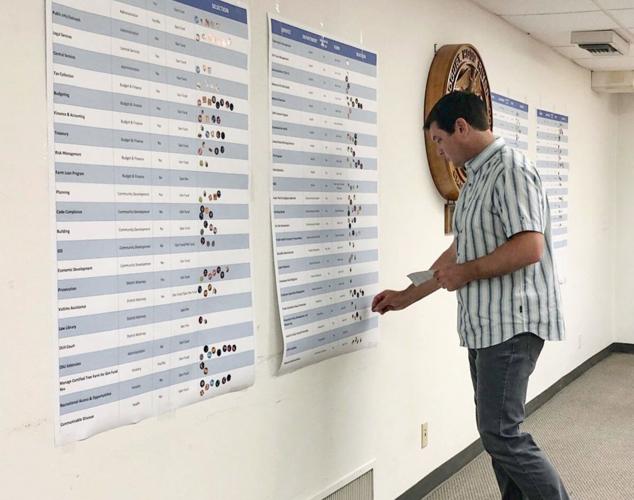
Commissioner Les Perkins participates in a county service prioritization exercise in 2019. Perkins was confirmed as state public utility commissioner on Feb. 8.
Commissioner Les Perkins participates in a county service prioritization exercise in 2019. Perkins was confirmed as state public utility commissioner on Feb. 8.
HOOD RIVER — District 4 representative Les Perkins has opted not to rerun for his position on the Hood River County board of commissioners in the May primary election, though the reason — and his timeline — has changed.
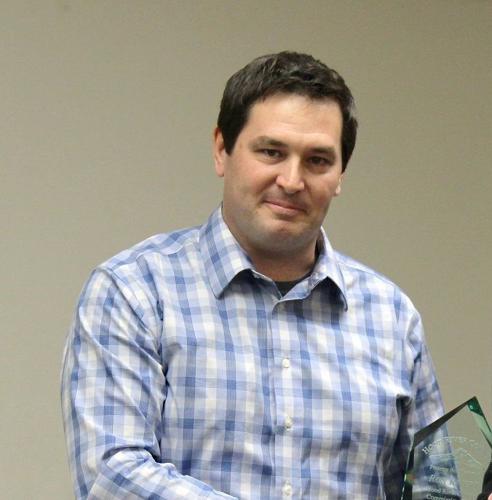
Gov. Tina Kotek named Perkins as her nominee as public utility commissioner Jan. 16, and was confirmed by the full Senate on Feb. 8. Perkins said that he will be required to leave all public and private boards as he prepares to begin the position with the state.
That not only includes his board of commissioners’ position, which he’s held since January 2001, but his job as general manager at Farmers Irrigation District, which serves just under 6,000 acres in the lower west side of Hood River County.
His term on the county board of commissioners was slated to run through 2024, but because of his new position, the board will need to appoint his replacement prior to the general election.
“Other people in the industry encouraged me to [apply for the public utility commissioner position], and honestly, I didn’t know how much of a shot I had,” Perkins said. He applied at the end of November after talking with several people about what the job entails, including outgoing commissioner Mark Thompson.
Next came a panel interview, and then a one-on-one with Kotek.
“We had a great conversation — it was a very direct, very blunt conversation. And then I got a phone call that I was the governor’s choice for nominee,” he said. “I am so honored to have been chosen for this position and I’m excited to take on a new challenge.”
Perkins is one of three serving on the public utility commission, which regulates investor-owned utilities — mainly power, but includes natural gas, water and landline telecommunications, as well as other small components.
Perkins was born and raised in the Hood River Valley, and he and wife Stephanie — a teacher at Mid Valley Elementary and fellow local — raised their children, Katie and Jackson, in the valley. When he was elected to the board of commissioners, he was 27, and the youngest person at that time to hold such a position.
Now, he’s looking forward to the change — with both positions, though he knows stepping back will be hard.
“Twenty-four years is long enough,” he said of his time on the county board of commissioners. “I’ve been through so many cycles of so many issues — you accumulate knowledge, but it stops you from seeing what’s possible at a certain point. I think I’ve lost some of that mental flexibility that I had when I was younger and didn’t know what wasn’t possible.”
Hood River County government covers a multitude of areas, including public health and road maintenance, and includes county forest land that supplies revenue for the general fund. Regardless of the decision before him, he knows that the outcome will directly affect residents of the county.
“It’s hard to make decisions in front of friends and neighbors that you know are going to impact them,” he said. “Especially a county of our size — you make decisions, and you see the impacts immediately, you hear from people immediately. You have to recognize you’re never going to make everyone happy, and maybe the best solution is when nobody is entirely happy.”
Position 4 is geographically the largest in the county, and includes Parkdale, Cascade Locks and part of Odell; those wishing to run for his position can do so by either paying a filing fee at the county office on State Street, or collecting a certain number of signatures.
Being on the board has been a constant learning process, one he knows will continue in his new role as state public utility commissioner.
“You have to learn a whole lot in the first few years, and you continue learning the whole time,” he said. “But once you do come up to speed, you have the background in the various topics. It takes a term to get proficient, but it gets easier from there.”
During his tenure on the board, he is most proud of the work he done around water development and planning. He worked with former Hood River County Development Director Mike Benedict, who retired in November 2014, to create a plan around water for the next 50-100 years — developing a basin study looking at historic, current and future use and creating a groundwater modeling process.
“Benedict came to me saying, ‘Hey, we have a plan for most things, but we don’t have a plan for water — can we do planning around water?’” Perkins said. “I’ve been working in water for a while. I started doing research, and started pulling people together who work in the water space. We put together a pretty basic planning process, then refined it and ran it out of county planning.”
He wrote two grants and worked with a diverse group including Confederated Tribes of the Warm Springs, ODFW, Hood River Soil and Water Conservation District, irrigation and domestic water suppliers and many others, and in the end, the county has what he calls a road map for other basins in the state.
“I’ve talked to a lot of others around the state, and the clear direction and cohesiveness of what we want to do in the future wouldn’t have existed if we hadn’t done that study,” he said.
Similarly, he’s proud of the work the commission has done creating its energy plan, which is similar to its work around water — future needs, resiliency maintaining critical infrastructure and the potential for disaster, be it an ice storm or Cascadia earthquake event. It’s a heavy lift, he said.
He expects to start in his new position early to mid-March.
“It’s going to be a huge learning curve — exciting, but terrifying. But the best opportunities are the ones that scare you,” he said. “Both kids say, ‘You’ve said this to us for a long time, so it seems like something you should do.'”



Commented
Sorry, there are no recent results for popular commented articles.