
By Trisha Walker
Columbia Gorge News
HOOD RIVER — Hood River is now a sanctuary city.
Councilors unanimously voted to approve Resolution 2026-02, which declares that Hood River is safe “for all persons, regardless of race, national origin, immigration or refugee status,” at the Jan. 12 meeting.
“Just as a reminder, a sanctuary city resolution is an administrative action; it’s not an ordinance or a law,” City Manager Abigail Elder told council prior to the vote. “It’s a formal statement, and it does not have an enforcement component to it.”
Oregon has been a sanctuary state since 1987, with the original policy updated with the 2021 Sanctuary Promise Act (HB 3265). Likewise, the council has already passed its own proclamations of inclusivity: Resolution 2017-02 was adopted on Jan. 23, 2017 (“Inclusive City”) and Resolution 2025-06 on Feb. 24, 2025 (“Affirming the City of Hood River as an Inclusive and Welcoming City”), which was again maintained on June 9, 2025.
The day after the motion passed, President Donald Trump announced that federal funds would be withheld from sanctuary states and cities beginning Feb. 1. In a follow up email, Elder clarified that the city doesn’t receive federal funds for day-to-day operations or staff positions.
Crowd in favor
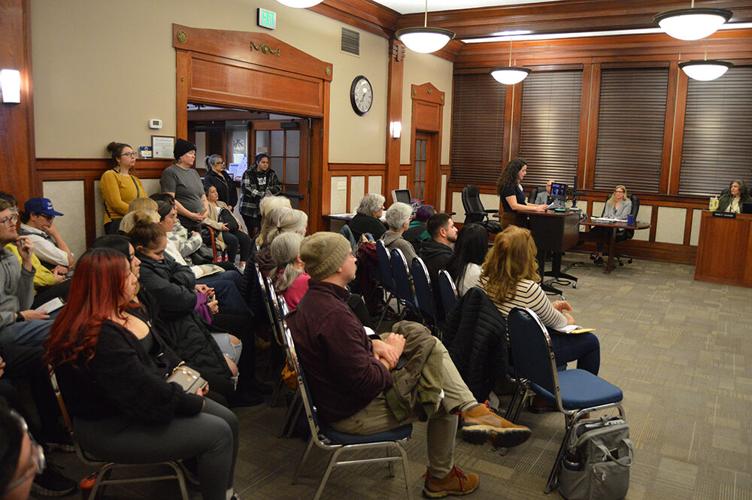
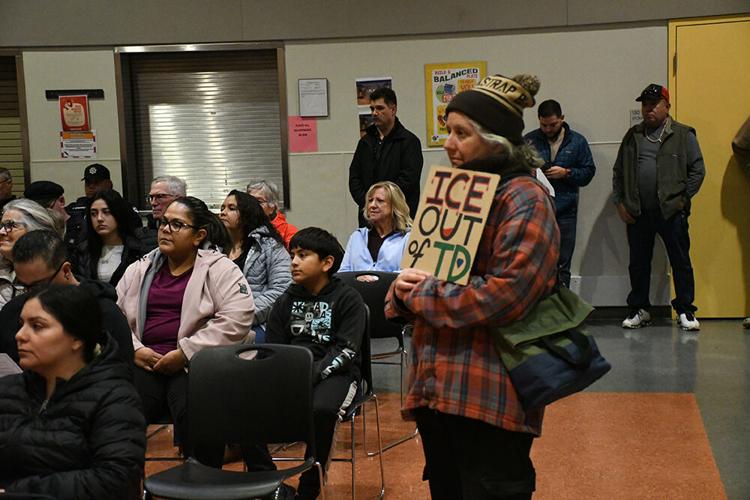
An overflow crowd filled city hall Jan. 12, spilling into the front office. Fourteen people provided public testimony prior to the vote, and the chamber filled with applause once the motion carried. Comments focused on the local presence of U.S. Immigration and Custom Enforcement (ICE) agents; the resulting stress on children, who worry about what will happen to their parents; how many are living in constant fear; and opposition to Trump administration policies.
Community organizers and concerned residents spoke, as did White Salmon City Councilor Morella Mora, One Community Health Behavioral Health Provider Cindy Hernandez, and the Hood River Latino Network’s Amber Rose and Martha Verduzco-Ortega. The last speaker, identified as Enrique, addressed the council in Spanish, with Verduzco-Ortega providing translation.
“Many of us didn’t come here to do any harm, we didn’t come to take anything away from anyone. We came looking for the opportunity to live with dignity,” he said. “Living without papers isn’t living without values. It’s living with fear of leaving my home, fear for my family, fear of losing everything that I’ve built [in my 30 years here]. Even with that, we continue to wake up every day to go to work, to comply, to support, to give ...
“I’m not here to ask for privileges or point fingers at anyone,” he continued. “I’m here to ask for something simple — that you hear our stories as well. We’ve been here for decades. We’ve contributed, because this place is also our home.”
Council decision
The council debated the pros and cons of becoming a sanctuary city — people feeling supported, the resolution’s mostly-symbolic nature, and the possibility of federal retaliation — but ultimately decided the community had shown strong support.
“The idea that protecting our immigrant community risks our economy ignores the fact that Latinos are our economy,” said Council President Gladys Rivera. “And even if there was no economic input argument, the answer would still be the same … Immigrants, they are people.”
She also said that cities do not receive federal funds in exchange for immigration enforcement, nor has there been any evidence that cities have lost general federal funding by following sanctuary law. “We cannot govern by fear or potential retaliation,” she said.
Councilor Ben Mitchell pointed out that the Trump administration had already put Hood River on a sanctuary city watchlist before the formal declaration. “It doesn’t matter, trying to figure out what this administration is going to do, because they’re going to do whatever they want anyway,” he reasoned. “That’s one of the things that really sticks with me, is that we’re thinking they’re playing the same game [as us], and they’re not.
“I’m also thinking about the last time a group of people in Hood River were persecuted by the federal government, people of Japanese ancestry. And what did this area do? Nothing,” he said. “Worse, we aided and abetted it. And I think we have some sins to atone for.”
“I think right now, given the importance of this issue and the terror in the community, we have to do everything we can; a sign is worth it to make people feel comfortable,” said Councilor Doug Stepina. “But we have to continue the hard work we’ve been doing, and we have to continually understand how to build upon that work.”
Emergency declaration extended
Council also unanimously approved to extend an emergency declaration passed in December “regarding federal immigration enforcement activity in the City of Hood River,” or Resolution 2026-01. Going forward, it will be part of the consent agenda.
The emergency declaration has allowed Elder to “take all necessary and proper steps to help minimize and mitigate the effects of this emergency,” like planning community listening sessions in coordination with The Next Door Inc. and creating a staff policy and training on how to respond to requests from immigration enforcement agencies.


Commented
Sorry, there are no recent results for popular commented articles.