
By Nathan Wilson
Columbia Gorge News
HOOD RIVER — The Gorge Rebuild-It Center (GRC) is sending out a plea for help.
Established in 2003, the nonprofit accepts donated building materials like doors, windows, tiles and lumber, alongside a variety of other home goods, and resells them for affordable prices, generally between 30-50% of market value. Without an influx of volunteers and financial support, ideally around $50,000, Executive Director Julie Tucker warned that GRC won’t be around to watch the seasons change.
“We’re at a pivotal point. We need the community to step up,” she said. “We struggle during the winter months, but we have a strategic plan, and we’re building up to bring more people in.”
Tucker acknowledged that GRC’s stability has fluctuated throughout its existence; however, she believes the nonprofit is cresting its final hump and remains adamant about keeping this resource, where lower-income folks can source home improvements without generating more waste, open.
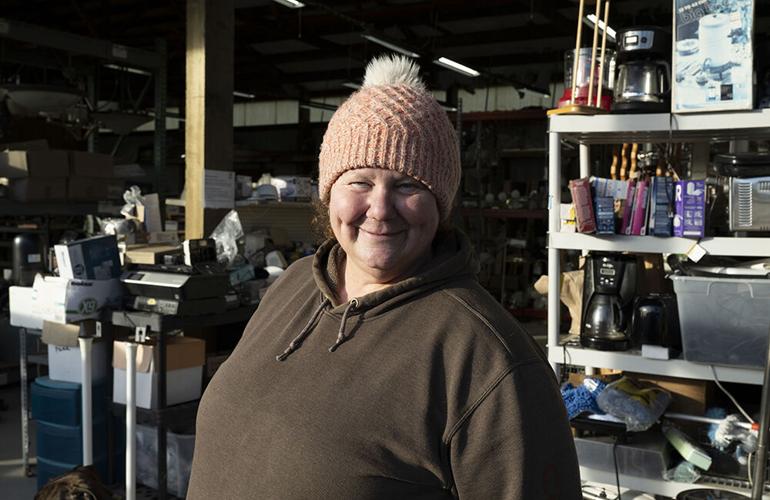
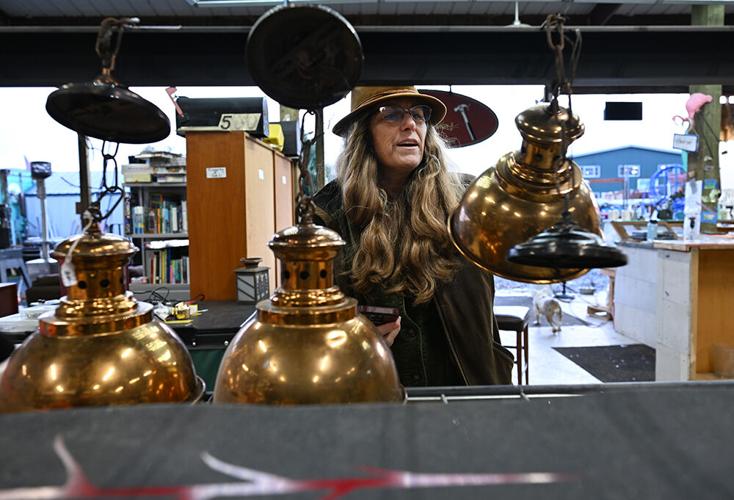
The site itself, located on Tucker Road just past Elliot Drive, is organized chaos. Shipping containers are strewn about, showerheads sit on the same shelf as doorknobs, a 12-foot-tall robot made from scrap metal guards the entrance and not all items have listed prices. Whether it be hand-painted Italian plates or polyiso foam boards for insulation, bartering is the norm, and everything is open air.
A regular since 2007, Kate Bevanda visits GRC on a near-daily basis at 3:30 p.m., thirty minutes before closing, hence why staff nicknamed her “late Kate.” Having remodeled her entire accessory dwelling unit with materials purchased at GRC, she considers it a trove. If the nonprofit closed, there’s no other place in the county where she could find such a wide variety of used items.
“I would be heartbroken,” Bevanda said.
Alongside Tucker, just one other full-time and one part-time employee run GRC, and without an enclosed space, she’s had a hard time retaining workers. Adding burnout to the mix, Tucker said she’s constantly being pulled into the store as a result, rather than expanding intake streams, applying for grants to erect an indoor space or any of the other measures outlined in GRC’s 10-year vision that would bring the nonprofit above water.
GRC ran a net deficit the past two fiscal years.
“I don’t have the time to go do fundraisers. I don’t have the time to put on a silent auction,” Tucker said. “Like many small nonprofits, my executive director role is pulled in many directions with limited staff and board capacity.”
That’s where volunteers come in. More help manning the storefront would both free up Tucker’s time and attract more customers. Contractors working local construction projects often leave behind an abundance of high-quality, desirable materials, but she’s had to leave those opportunities by the wayside since there aren’t enough hands to sort through it all.
After nearly four decades in the recycling sphere, Tucker’s life is intertwined with sustainability, which she defines as “the capacity to endure without causing harm.” Fundamentally, that starts with maintaining a healthy environment, enabling social and economic well-being to then thrive. In a way, Tucker sees GRC as a classroom.
“If we could be better consumers and not purchase new, that sets the stage for not creating stuff, reusing things and keeping it in the circular economy,” Tucker said. “We keep thousands of pounds out of the landfill, but the platform of being here — talking with customers, showing them how to be better consumers — that’s part of it, too.”
And so is helping folks out in a pinch. What makes GRC unique, Tucker said, is the informality, the lack of bureaucracy. It’s a place of relationships.
For instance, a cashier at Rosauers had her water heater fail around this time two years ago while raising her grandchildren. She wasn’t eligible for government assistance, but she also didn’t have enough money to buy a replacement outright. When she came to GRC, Tucker gave her a used one and called a friend who installed it at half the cost. The cashier later returned to GRC with her grandchildren and volunteered for a day.
“That happens all the time here, where people can’t get assistance or help somewhere else for an essential need,” Tucker said. “Where else can you buy a hammer for $2?” And Tucker will dispute anyone who says her prices are the problem.
“That couple of dollars is not why we’re failing. If I had to nickel and dime every customer, we wouldn’t have customers,” she said. “We can’t afford to have people not come back. We try to make everyone leave happy.”
Beyond the ultimate goal of an enclosed space, there are more ways Tucker hopes to see GRC grow before retiring. She’s already hired a bilingual manager and made signage to follow suit. Other key items include fencing around the perimeter, spots for micro-businesses on-site, additional community programming like a tool lending library and more.
Visit www.rebuild.org to learn more and sign up for GRC’s newsletter. If you’d like to donate, go to linkpaypal.com/us/fundraiser/charity/2115041. Volunteers can sign up at www.docs.google.com/forms/d/e/1FAIpQLSf_xc1q2e2dd-YAR9bt8oZDUiV22MpY7bgPuo2K_JDAPzq-4A/viewform?usp=header, and for those who are particularly enthusiastic, GRC is also looking for a new board president.


Commented