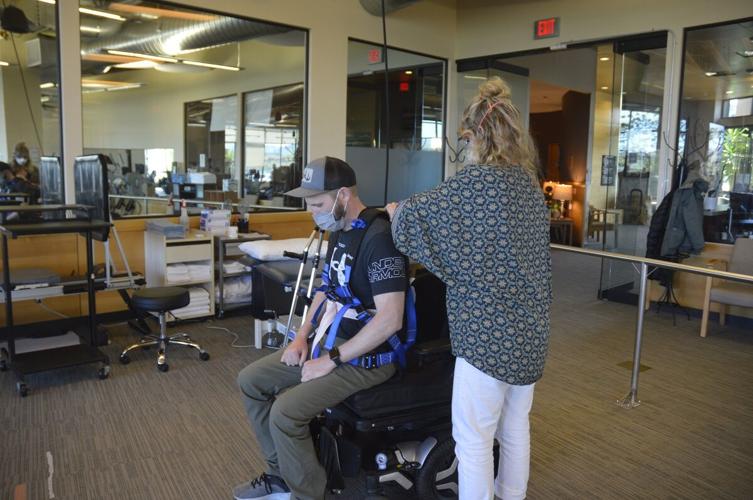
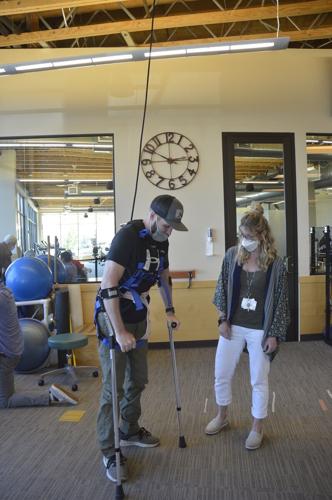
John, a patient with a spinal cord injury, practices walking on his crutches using the Solo-Step, which is attached to the ceiling as physical therapist Dr. Dianne Riggs watches on.
Last July, when Mid-Columbia Medical Center was able to purchase a new piece of equipment for Water’s Edge Physical Therapy, they knew it would make a big difference for many of their patients; however, they had no idea just how many lives it would touch.
According to Lindsay Lederer, MCMC’s assistant director of inpatient therapy, the idea of purchasing this particular device came last summer, when Dr. Anna Saltonstall, the physical therapist who runs the Parkinson’s exercise program, was reached out to by the family of someone in the program.
“They had decided to donate a sum of money towards something that could be beneficial to patients who had Parkinson’s, so Anna was hoping to find something that could have a lasting benefit for patients coming in,” Lederer said.
Saltonstall thought of the “Solo-Step,” an overhead track system that attaches to a harness, allowing patients with balance issues to walk a distance without needing to hold onto something or be held onto by someone else. The idea was that the Solo-Step could not only help those with Parkinson’s, but also other people with balance issues, which it has.
“It’s been very beneficial,” Water’s Edge physical therapist Dr. Dianne Riggs said. “I thought that I was going to be like the primary one using it because I’m the neuro-physical therapist. But everybody’s used it because we all have people who need it for balance.”
Being able to be, quite literally, hands-off with patients completely changes the way a therapist can approach physical therapy, Riggs said.
“I can take a step back, if I’m doing gait training, and say, ‘Okay, I see what’s going on,’” she said. “Instead of me being right up on them so I can’t look from afar. I just think it allows us as therapists to work with greater ease and progress our balance stuff a little bit more.”
Riggs said it’s opened up even more avenues for therapy, like throwing something to a patient while they’re walking without fear of them falling, in order to test their focus and reactions. It can also allow them to set up a little obstacle course and have the patient walk through it without having to have the therapist by their side.
John, a patient with a spinal cord injury, practices walking on his crutches using the Solo-Step, which is attached to the ceiling as physical therapist Dr. Dianne Riggs watches on.
Alana Lackner photo
It makes a huge difference to have the assurance of safety, for both the therapist and patient, Lederer said.
“It gives the therapist the chance to have the patient in a really safe place and also work their therapeutic magic, knowing that the patient is in a safe spot,” she said. “So I would say it’s probably the best tool we’ve ever gotten.”
Debbie, a patient at Water’s Edge who is only being identified by her first name to protect medical privacy, has Parkinson’s disease and also had two hip replacements in the last year, which means she often utilizes the Solo-Step in her sessions.
“I get a lot of security when I have that on and am using it,” Debbie said. “I can kind of get tense and worried that I’m going to fall, and it gives me a sense of security in knowing that something is there and that I can get my balance.”
The first time she used the Solo-Step, Debbie said she was nervous because she didn’t know what to expect.
“I knew Dianne had it all hooked up just the way that it needed to be, but I was like ‘Oh my god, is it tight enough?’” she said. “I was worried about that, but it was perfect. I was trying to do an obstacle course with it that was just stepping over something, just a little step. Not anything big. But it just gave me so much more confidence … I would kind of get going and it would be like ‘Oh yeah, I can do this.’”
The ability to know she’s not going to fall completely changes the way she approaches the session, Debbie said.
“Working with [the Solo-Step] with the obstacles, it really does help,” she said. “I can step over something and feel confident that I’m not going to fall.”



Commented