
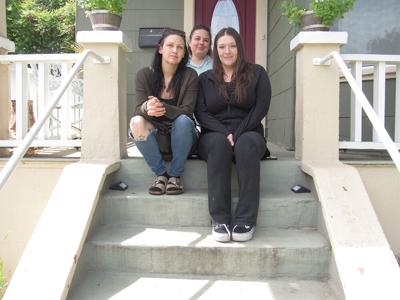
THE DALLES — Give them Wings (WINGS), a safe and sober living program for women and children, is facing closure after 10 years of serving The Dalles, Hood River and surrounding communities.
The program assists participants in areas such as housing and employment, as well as child reunification.
“We do take women without children, but most of them have kids,” said Faith Mulvaney, WINGS director and mentor. “A majority of them have DHS (Department of Health and Human Services) involvement, or come from probation, or just other people that are interested in [the program]. We help them with all of the things to get on their feet.”
Operating out of a five-bedroom house in The Dalles, each participant would have a room for them and their children. “We have housed up to four kids and one mom in one room, which has always worked out well. We put extra beds in there, bunk beds,” Mulvaney said, “They’re always happy to be here, happy to be with their parent.”
WINGS would also help participants with obtaining documents such as their driver’s license, or with transportation, and provided childcare.
Mulvaney herself is a graduate of the program, and through it was able to regain custody of her three children. “When I got here, I honestly can say I wouldn’t have been able to pull myself out of the hole I was in without the love and support from this program … I didn’t have anyone truly sober to guide me,” she said. “I’ve been clean seven years and it’s because of this program.”
Becoming a nonprofit in 2007, the program initially started in Hood River by Founder and Director Allyson Pate as a program for young men between the ages of 18-23. With the relaxation of laws surrounding marijuana, Pate and the program started seeing less and less participants, and found that program graduates were staying out of trouble.
“I think we ended up counting that we had 90 young men who went through our program and I would check many times after it closed, and never saw one of my boys in jail again,” Pate said, “So we felt like that was a huge success.”
The men’s program officially closed in 2017, but while it was still operating, a staff member had suggested to Pate that they look into starting a separate program for women, which launched in 2015.
Operating for the last 10 years, WINGS is now currently facing closure. For the past 36 months, the program had been utilizing funding through Oregon’s Measure 110 to stay afloat. According to Pate, the program received an 18-month Behavior Health Resource Network (BHRN) grant, which she said they were able to renew for a second year.
Oregon.gov defines a BHRN, as “an entity or group of entities working together to provide comprehensive, community-based services and supports to people with substance use disorders or harmful substance use.”
According to Pate, the program received a total of $234,500 through the grant and used those funds to help pay rent, utilities and their employees’ salaries. When it came time to reapply for the grant, though, Pate said they found themselves hitting a brick wall.
“All calls and emails have gone unanswered,” she said.
Finding themselves unable to reapply for the grant, WINGS looked for other funding solutions, but has ultimately decided to close its doors.
“We have made the decision to close the WINGS house as soon as we can find housing for our last moms. We have funding that can keep us going though the end of July, and by then, we hope everyone will be settled,” Pate said, “We are very grateful for everyone’s offer of support, but feel that this is the right decision for us all.”
When asked how many women they helped annually, Mulvaney guessed it was approximately five a year, not counting any assistance they provided to graduates of the program. While that number could seem relatively small compared to larger organizations, Mulvaney emphasized every participant made a difference.
“[The community is] losing a program that is working with moms, and that is most important for the kids,” Mulvaney said, “I know it’s not very many women, but it does really make a difference with the women that have graduated and the ones that are here. It would be a tremendous resource to lose because there isn’t one available. There’s not another one.”
While many have struggled with addition in the past, as a sober living program, residents of WINGS were required to be actively sober to participate. According to Mulvaney, that meant residents had to either be actively living sober or be picked up from a detox facility by a program employee in order to live in the WINGS house or receive assistance.
“When we meet them, [participants] are in a swamp … and we as WINGS won’t pull you out of the swamp, you have to do that yourself,” Pate said. “We’re going to give you a boat and an oar and supplies and food and shelter and a map. And if you want to, you can pull yourself out of the swamp and get in the boat, and then you’re going to have to paddle it to shore to save yourself.”
“They are here to get their life back,” Mulvaney said about the program participants. “They are here to work on the whole circle, all of it, any, you know, schooling, treatment … old behaviors, learning new ones.”
Mulvaney continued, “A lot of the girls that have been here are those women that …. think that it’s never going to work … and they do it, and they come out on the other side with their babies.”


Commented