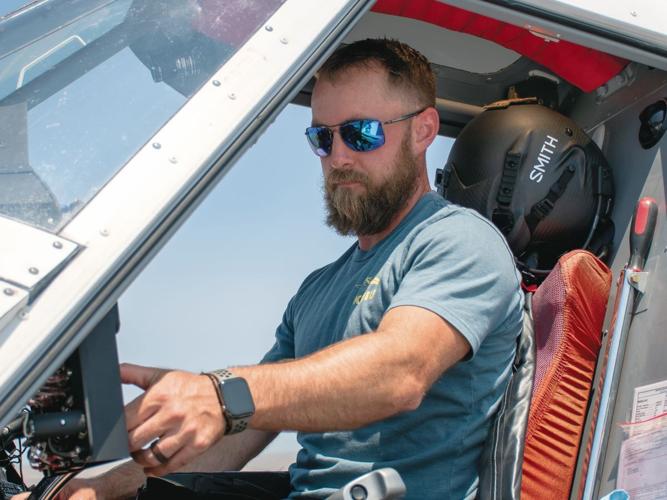
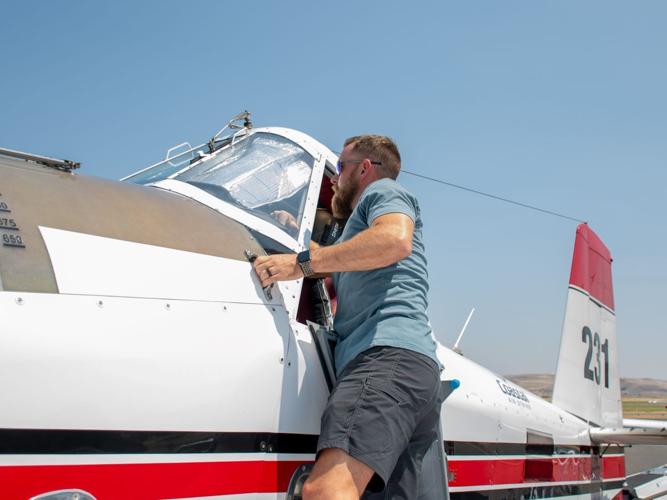
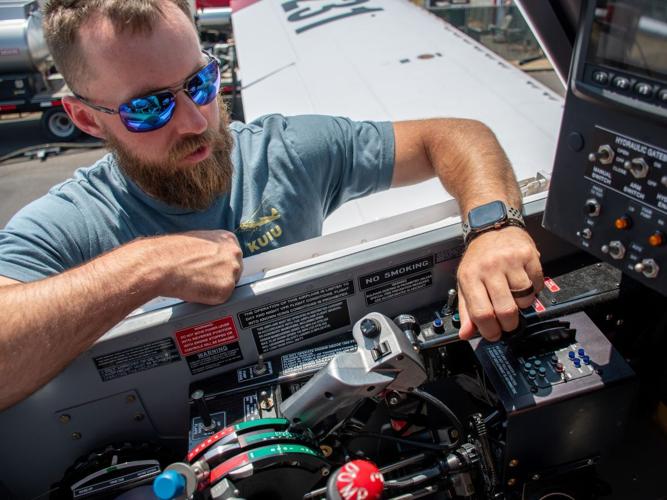
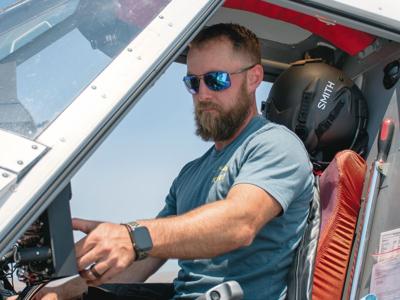
Fire Boss 231 pilot Colby Smith calibrates the planes system during a pre-flight check on July 5 at the Columbia Gorge Regional Airport.Noah Noteboom photo
When disaster strikes and a wildland fire is reported, emergency response on the ground is swift but can be complicated depending on the situation. The Tunnel 5 Fire, for example, ignited on the north side of the Columbia River at the western base of Underwood-White Salmon bluffs. The steep terrain and aggressive fire behavior limited what crews could do on the ground. As the fire quickly advanced up the bluff, emergency responders relied heavily on help from their airborne counterparts. Enter Fire Boss 231 and 232 pilots Colby Smith and Aaron Vince. Both pilots work for Coastal Air Strike and are currently contracted out by the State of Oregon for fire season in the Gorge. This summer marks their third in Oregon. Although their contract with the State of Oregon didn’t start until Monday, July 3 — 12 hours after the Tunnel 5 Fire started — they played an important role in the Tunnel 5 Fire response.
Their single-seater planes are called Air Tractor 802 Fire Bosses, or AT-802F. Currently stationed at the Columbia Gorge Regional Airport in Dallesport, Wash., Vince and Smith will remain on-call for 75 days. The two, along with their partners and mechanics Matt Burges and Chad Long, will respond mainly to fires in the Gorge, but are capable of flying all over the state. Like many other pilots, Vince and Smith started their aviation careers dusting crops. In the same aircrafts, but under much different circumstances. The AT-802F is an amphibious aircraft in that it can quickly and efficiently spread pesticides on crop fields or collect water from rivers and lakes.
“They put the floats on it and it miraculously becomes the Fire Boss,” Vince joked.
The floats are necessary for the plane to pick up water on the move. An elbow-shaped pipe on the bottom of the floats collects water by skimming the surface at 60-70 miles per hour. Utilizing the speed and pressure, the plane can gather up to 800 gallons of water in seconds. Smith explained that they typically need at least a mile stretch of water to safely make a pickup.
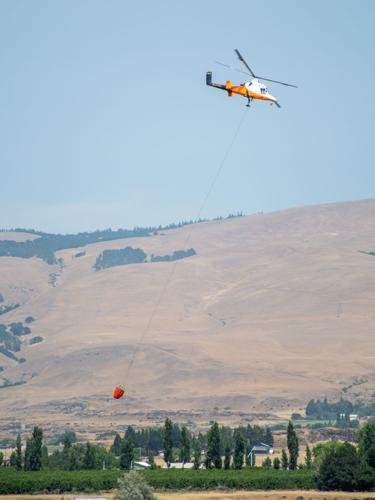
Coastal Air Strike AT-802F plane in the air. The plane was part of the team fighting the Tunnel 5 Fire.
Noah Noteboom photo
“We can actually turn them on the water as we’re going. We’re no speedboat by any means as far as maneuverability, but yeah, we can we can kind of go around the bend of the river if we need to,” said Smith. Other obstacles include sand bars, barges, kayakers and even kite boarders. When a lane is open and weather conditions are clear, they can make almost 70 trips on one tank of fuel. For three to four hours at a time the pilots can strategically and efficiently drop an average of 700 gallons of water per trip on a fire. The Fire Boss also can control how much of the water is dropped at once. They can go for a more direct approach and open the bottom hatch entirely, or spread their load over a longer distance. Vince estimated their drops can range from 250-1,000 feet of coverage.
“Well, if it was just grass out here burnin’ and we were trying to hit the flames on that it would just be open maybe halfway,” Vince said. “And when there is timber, like the Tunnel 5 Fire, it was all the way open. We want to try and penetrate that tall tree canopy.”
Of course, there are limitations to everything that they do.
They can only fly up to eight hours a day, per government rules. Their planes can only hold so much fuel and water at a time. And there are specific bodies of water they have to avoid. All pilots must have a certain amount of flight hours and are required to practice flying in different terrain. Pilots must safely maneuver across fields, along rivers, over lakes, and around mountains and hillsides. The strict requirements set forth by the Federal Aviation Administration prepare pilots for fighting wildland fires in the most unforgiving conditions.
Fire Boss 231 pilot Colby Smith calibrates the planes system during a pre-flight check on July 5 at the Columbia Gorge Regional Airport.Noah Noteboom photo
Noah Noteboom photo
Different crews and different planes will have different jobs depending on the terrain, weather conditions and proximity to homes. When called to the Tunnel 5 Fire, Vince and Smith were tasked to help with containment on the western flank, as helicopters took the eastern bank. For almost seven hours on July 3, they battled to gain the upper hand. Timely and accurate communication between the multiple different agencies is absolutely necessary for any kind of emergency response, and the Tunnel 5 Fire is no exception. Incident management teams utilize the air attack thousands of feet above the fire as their eyes in the skies. This person is playing the role of air traffic controller and running the entire show.
“So as we’re going out to get water, they’re usually talking to the ground crews. Figuring out what to do next and what’s our ultimate goal,” Smith said.
When their contract with the state runs out, there is a chance it could get extended. And if these pilots have learned anything, it is you have to expect the unexpected. When the State of Washington and Incident Management Teams took command of the Tunnel 5 Fire, Vince and Smith returned to the regional airport and awaited their next call. To no surprise, that call came a day later when a fire at a home outside of Mosier was reported. Their impact was immediate, as officials had control over the fire in less than 12 hours.
Fire Boss 231 pilot Colby Smith calibrates the planes system during a pre-flight check on July 5 at the Columbia Gorge Regional Airport.
Noah Noteboom photo
For the next 70 days, they will stand-by until called into action. Most of the crew’s down time is spent cleaning and maintaining their planes. Vince and Smith credit their mechanics Burges and Long for their continued work and dedication to their craft.
“These guys are kind of a jack of all trades as far as anything on the ground,” Smith said. “They do maintenance, loading, pre- and post-flight, food errands. They kind of do the rest and fill in the blanks for us.”
To find out more about Vince, Smith and Coastal Air Strike, visit their Facebook page for updates on the crew.



Commented