
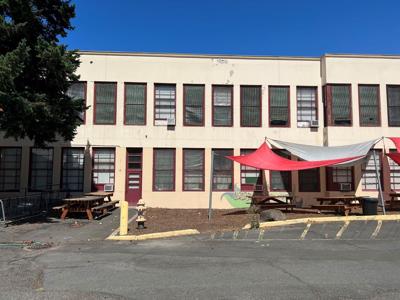
THE DALLES — The Aug. 2 article, “Time takes a toll: A closer look at The Dalles High School disrepair,” garnered several questions from the community regarding the school bond measure slated to appear on the Nov. 7 ballot. Columbia Gorge News reached out to district officials for further information. Below is part 1 of their responses.
Further responses will appear in an upcoming edition.
Columbia Gorge News: Based off comments received online, there seems to be a perception for some of the community that there has been some misuse of funding regarding the prioritization of facilities maintenance in the past. Would the district like to provide a comment addressing this perception?
Stephanie Bowen, district communications director: First, I would like to note that our school district has had a great deal of change over the past several years. We have a new superintendent and new chief financial officer who both started after the last bond was presented to our community. This is in addition to many other changes to both the district’s leadership team and the school board. While I understand that it can be incredibly hard to put previous apprehensions or animosities in the past, they are not reflective of our current team and our current operations. The district has taken a number of added steps over the past two years to create extra layers of sustainability and stability, particularly around our facilities, including:
• Establishing a Capital Projects fund
• Applying for, and receiving, multiple grants to address district facility needs. This includes two seismic rehabilitation grants totaling more than $4.5 million.
• Creating a Director of Facilities Improvement position with a focus on the development of comprehensive and strategic long-term facilities plans.
• Creating a Facilities Advisory Workgroup. The purpose of this group, which includes public, parent and staff participation, is to review current facility condition reports and assist with prioritizing and recommending repairs and renovations.
Built in 1941, the current D21 high school facility is 82 years old, with its last major renovation taking place in the mid 1970s. According to the National Center for Educational Statistics, the average age of public school buildings in the United States is between 40-44 years of age with most schools becoming obsolete after age 60. Overall, the average facility age in our district is about 65 years old. Our high school isn’t even our oldest building — Colonel Wright Elementary will be celebrating its 100th anniversary this school year. The fact that these buildings continue to be operational and utilized for student learning at these extreme ages speaks to the care and maintenance we have, and continue to provide, our school buildings.
CGN: What percentage of the district’s annual budget is typically set aside for capital outlay? Is that percentage a standard practice or does the district itself decide that number? If the district does, why that percentage?
SB: Our district allocates approximately 5% of the total budget to facilities improvement and capital outlay.
School districts can choose how they prioritize non-restricted funds from the state school fund. However, the majority of our budget is allocated to salaries and other associated payroll costs, adding up to roughly 79% of our total budget, followed by purchased services and supplies. This is typical in districts across the nation. The reality is that state schools funds do not cover much beyond our basic daily operations and leave little to address the many needs in all of our school buildings. Funding for new school buildings remains, primarily, the responsibility of the local school district and is usually financed through bond sales, and not through state school funds. That means for the most part, districts in Oregon are at the mercy of voters to finance capital projects, like extensive repairs/renovations and of course, new school buildings.
CGN: How does the district plan on addressing the other district buildings in need of maintenance as outlined in the 2019 long range facilities plan?
SB: Taking a deep dive into the long range facilities planning (LRFP) process is one of the key areas of focus for our director of facilities improvement and the Facilities Advisory Workgroup. We hope to create a more in depth and strategic LRFP in the near future that will help us define and prioritize the needs across the district. The current plan, which was created in 2019, is due for renewal this coming year.
CGN: Can you give more details on how the original building will be repurposed if the bond passes?
SB: Our hope is that the existing TDHS building will essentially become a mixed-use building with a focus on youth services. We plan on consolidating various departments and programs here, such as our district offices and nutrition services. This would allow us to surplus other district buildings that the district could then sell and put towards the Capital Projects Fund or repayment of the bond. We hope to also engage other local community partners to centralize their services here. By breaking up the building and its use, we can better navigate some of the building’s ADA limitations, as well as lighten the strain on our systems. An example of this model would be The Gladstone Center for Children and Families, which is a partnership between public and private agencies to address the needs of families and young children from birth to six years of age. While following this model, we hope to expand the concept and create an all encompassing “services center” for youth 0-18.


Commented