
By Nathan Wilson
Columbia Gorge News
Warning: This story contains descriptions of domestic violence, murder and suicidal thoughts.
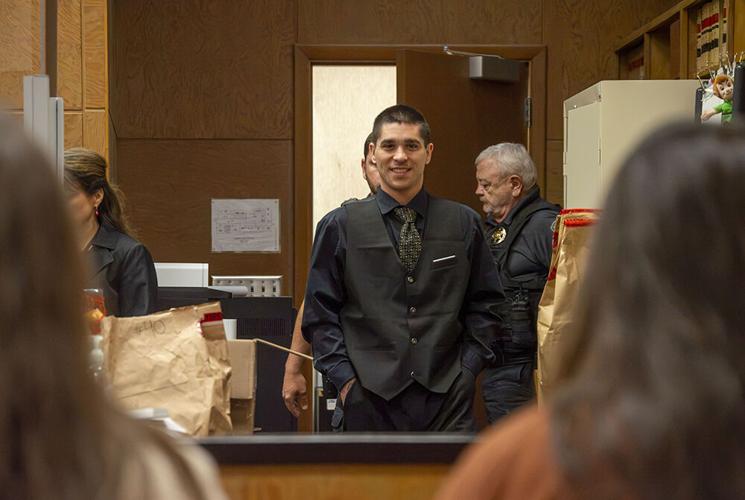
STEVENSON — On Oct. 29, Skamania County Superior Court Judge Randall C. Krog sentenced Levi DeLena to life in prison for killing his ex-wife and mother of three daughters, Candice Malave.
The decision, which DeLena immediately appealed, comes after a weeklong trial in September, where a jury charged him with murder in the first and second degrees, both being aggravated domestic violence offenses. Malave, then 34 years old, was found deceased on May 15 at the White Cap Apartments, adjacent to Stevenson High School, after suffering more than a dozen stab wounds and lacerations to her head, neck and torso.
In the five years prior, Malave and DeLena placed 14 domestic violence complaints against each other to the Skamania County Sheriff’s Office, court documents show. Malave stayed in a shelter twice, sought multiple restraining orders, a domestic violence protection order and divorced DeLena as a result of the abuse she endured, but none of those institutional mechanisms ultimately guaranteed her safety.
As of press deadline on Monday, DeLena’s appeal date had yet to be set.
A tumultuous, abusive history
Malave and DeLena originally met when they were teenagers and married young in October 2010, when they were both 18 years old. Nikki Malone, Malave’s cousin, explained how she had long been affectionate towards DeLena, but that their relationship quickly eroded after the ceremony in Arizona.
“Something had changed. He was so overbearing, and she couldn’t handle it, so they would fight a lot because she just wanted to be her own person,” Malone said. “He had her believe that she couldn’t think, that she was ugly — he tore into her pretty well.”
The two lived together on and off in multiple states since, while DeLena’s criminal history grew. Records show that he was found guilty of resisting arrest, driving under the influence and possessing drug paraphernalia in Mohave County, Arizona. DeLena was also charged with assault in the fourth degree twice in Skamania County, with all of his jail time converted to community service or work crew for the gross misdemeanors.
Still, however, Malave always wanted to have a family and be part of a large extended one, which DeLena provided. After Malave gave birth to their first daughter, who’s now 7 years old, Malone said the abuse worsened as Malave assumed the role of caregiver and became financially dependent on DeLena.
“The root of domestic violence is all of the coercive emotional control and power one person has over another. It’s not always physical, and when any substance use is involved, it just escalates the situation,” said Lisa Alexander, executive director of the Skamania County Council on Domestic Violence and Sexual Assault SCCDVSA.
Malave experienced the gamut. Testimony written by her for court proceedings describes how DeLena intentionally isolated Malave from friends and family, neglected their daughter’s basic needs, called Malave names, got aggressive when intoxicated and pushed her in front of their children, among many other incidents, to the point where Malave had to get evaluated at Skyline Hospital because she expressed recurring suicidal thoughts to police.
“He was doing things to hurt her in specific places so that no one else could tell what was happening,” Malone said, recounting how she often got phone calls from Malave after physical outbursts. “But she couldn’t go after the baby. She knew that he was never going to leave her alone after the baby.”
For the most part, Malave and DeLena raised their daughters in Skamania County. They moved in with Malave’s mother, who was residing at the White Cap Apartments, in October 2020 until March 2021, when they relocated to a separate unit in the same complex. By that point, Malave had already given birth to her second daughter, who’s now 6 years old.
Malave petitioned for her first divorce, which included an immediate restraining order, in January 2023, but court documents show that both parties agreed to dismiss the motion a year later. Malave stopped living with DeLena in April 2024, and SCCDVSA helped place Malave in an emergency shelter in November, then again in March 2025.
After filing for another divorce, and again failing to get a restraining order, that’s when Malave filed for a domestic violence protection order, which is a standalone civil proceeding.
“I don’t know what I’m supposed to do here. The lawyers, the cops, they tell me about a protection plan, I tell them what he’s doing — I’m not getting any protection here,” Malave said during a March 2025 hearing. “I have bits and pieces of proof to try and tell you guys what I’m facing with this man, and then he’s just getting away scot-free.”
Malave ended up accepting a temporary family law order, which prohibited both parties from coming with 1,000 feet of their respective homes, and a later parenting plan that granted her majority custody and decision-making authority over their daughters in place of the protection order. The divorce was formalized in October 2025.
“She was human and she was there, and somebody needed to help her,” Malone said. “Nobody really wanted to, and I think that I could’ve done better.”
The trial
“What could have led to Candice suffering such a horrible fate?” Yarden Weidenfeld, Skamania County’s chief deputy prosecutor, asked the jury during opening arguments on Sept. 14. “This was clearly a crime of hate, a premeditated crime motivated by the growing hatred Levi DeLena had for his former wife as he saw her slipping away from him.”
Over the next four days, Weidenfeld and Prosecuting Attorney Adam Kick reviewed security footage and crime scene photos, unsealed evidence and called three dozen witnesses, including neighbors, a coroner, DNA analysts, local business owners and several members of law enforcement, to the stand.
After a White Cap tenant made the initial report, emergency medical personnel found Malave nearly decapitated and lying on the stairwell beneath her mother’s old apartment, who died of natural causes a few months earlier, with additional stab wounds penetrating her skull, spinal cord, left lung and heart. Malave was clearing out the unit for a new renter when she was killed on May 15; paramedics pronounced her deceased upon arrival at 2:13 p.m.
Given the history between Malave and DeLena, and that the three children were still unaccounted for, police searched the mother’s old unit and then forced entry into DeLena’s apartment, located across the parking lot. His residence was empty, but multiple items of clothing were soaking in DeLena’s bathtub with an obvious bleach-like odor, one detective said.
Law enforcement eventually located DeLena shortly before 9 p.m. inside Malave’s Cascade Village apartment, and none of the daughters were harmed.
Upon further investigation, security tape shows Malave’s vehicle pulling into the White Cap complex at 11:11 a.m. that morning and DeLena’s car leaving at 12:56 p.m. Two tenants overheard screaming and thudding during the same stretch of time, but the prosecutors didn’t present any direct witnesses, nor did police locate the murder weapon.
DeLena’s DNA profile, however, was the most prominent on a knife sheath found outside Malave’s mother’s apartment, and his blood was identified in the kitchen. DeLena’s DNA was also found on Malave’s chest, underneath her fingernails and a medical examiner testified that the incisions found on DeLena’s hand were consistent with a knife slipping, not from a bike crash as he originally claimed.
Moreover, one witness who worked with DeLena in late 2025, and contacted law enforcement after hearing about the murder, recalled a conversation where he made a veiled threat on Malave’s life.
“He felt like his children’s mother was using the kids to punish him, and he was talking about how she had another person in her life,” the witness testified. “He said that she was going to get what was coming to her.”
DeLena’s attorney, Todd Pascoe, called on two witnesses during the trial and pointed out inconsistencies with some of the information presented, but after about two hours of deliberation, the jury came back with guilty verdicts on Sept. 21.
“Candice was a person with her own hopes, dreams and future. She was also the mother of three young children who depended upon her for her love, security, guidance and care,” Judge Krog said during the Oct. 29 sentencing hearing. “You took all of that away from them. No sentence in this case can restore what they lost.”
Alongside life in prison without parole, Krog ordered that DeLena have no contact with the three children and pay for Malave’s funeral costs.
Pushing for more training
The Skamania County Council on Domestic Violence and Sexual Assault (SCCDVSA) provided services to Malave since September 2019. Beyond helping her find shelter twice and with court proceedings, they facilitated safety planning: conversations about how abuse typically manifests in a relationship and strategies for de-escalation.
For instance, SCCDVSA advises domestic violence victims to store important documents, like birth certificates and social security cards, in a secure location; develop safe words that signal to friends when danger is present; keep a spare set of keys hidden from the abuser; and never lock themselves in a bathroom, because the window usually isn’t large enough to crawl out of.
“Even if everybody did everything that they should do — law enforcement, us and the courts — these things can still happen. The lethality risk of domestic violence is one of the highest of any crime,” Alexander of SCCDVSA said. “Why do people stay? They still care about that person, and abusers are very dynamic at being able to say all the right things to get back in after they’ve done terrible things.”
About 15% of people across the state experience domestic violence in their lifetime, based on numbers from a 2018 Washington State Health Assessment. According to SCCDVSA, rural areas see higher rates, and victims face more challenges due to stretched services, poor public transportation, lack of anonymity and higher gun ownership.
In the five years prior to May 2026, Malave and DeLena placed 14 domestic violence complaints against each other to the Skamania County Sheriff’s Office (SCSO), which classified many of the incidents as “verbal only,” and neighbors reported another 10. One heard Malave “making a noise that she was being hurt” in July 2022, so she had police come to her apartment; like other cases, Malave told officers that she and DeLena were just having an argument.
Alexander explained that victims often don’t divulge every detail to law enforcement because domestic violence calls are highly volatile and involve intimate trauma.
“Our officers are doing the best they can, but they need to be supported with more training,” Alexander said. “When there are chronic responses by law enforcement, it can help them take the extra steps to talk to the victim, maybe even after an incident has occurred, to try and connect with them. The more that victim can trust that officer, the more likely they’re going to cooperate the next time they show up.”
In May of this year, Washington State’s Criminal Justice Training Commission rolled out a new 20-hour program designed specifically to handle ongoing, complex abuse scenarios. The courses cover how trauma disrupts memory and behavior, tracking non-physical forms of abuse, proper enforcement of protection orders and more. State law requires that officers who regularly investigate domestic violence must complete the training within one year of being assigned, or by July 2027.
Alexander isn’t certain, however, that SCSO is setting aside the time and money required for completion. And while SCCDVSA still helps law enforcement interview domestic violence victims, it’s seen a sharp drop in calls for crisis assistance since Sheriff Summer Scheyer took over in 2023.
SCSO did not respond to multiple requests for comment placed over two weeks.
Montgomery Buettner spent three decades with SCSO, retiring in 2019 as a detective sergeant. Back then, advocates with the council occasionally provided on-scene assistance, usually when the suspect was already in custody.
“We would speak with them and confer with them regularly on cases,” Buettner added. “Even our patrol officers, if there was a domestic violence case where they thought the victim needed more resources, they would reach out and contact [SCCDVSA] directly and see if they were involved.”
Now, the pager that SCCDVSA keeps on hand should SCSO put in a request doesn’t go off very often. But following Malave’s murder, SCCDVSA has seen an uptick in both new clients and previous ones because the incident caused their past experiences to resurface, Alexander said.
Remembering Malave
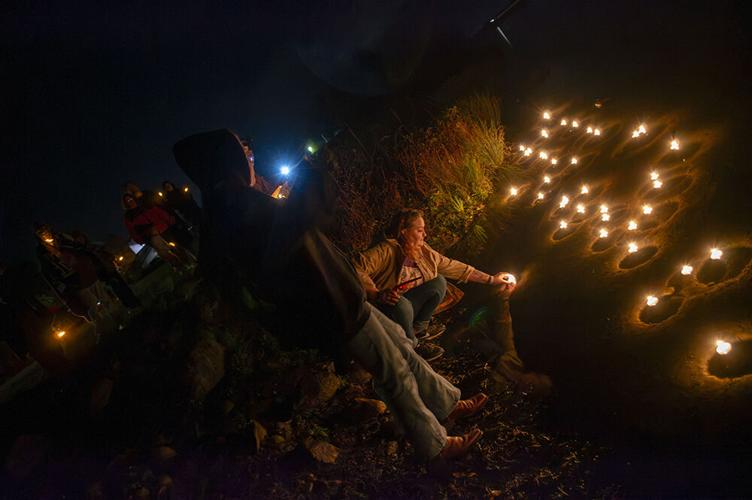
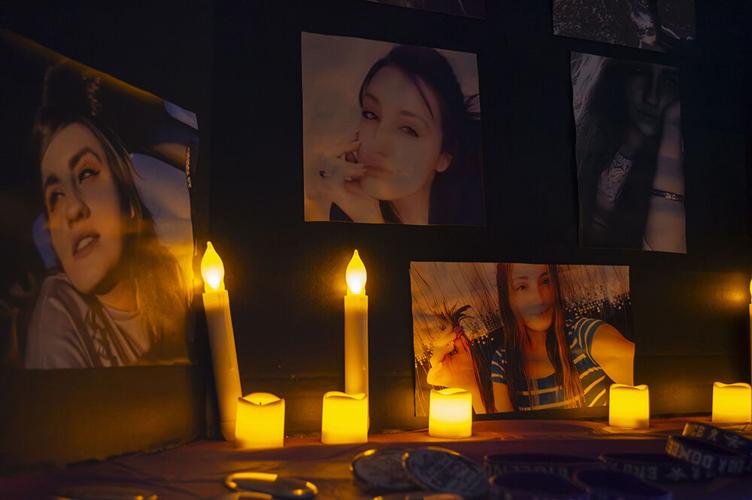
The evening after DeLena’s sentencing, friends and family held a vigil in Rock Creek Park to honor Malave. They prayed, listened to clips of Malave singing and set candles off into Rock Cove under a light drizzle.
“I wish Candice was here,” said Malone, Malave’s cousin. “Walking out of the courtroom doors, there were so many people in the hallway and just this outpouring of laughter and happiness. Candice really wanted that, and I don’t think she realized that she already had it.”
Separately, Malone noted that the three daughters remain in foster care and that Malave’s brother, Chris, is working to get custody, hopefully by Christmas. That could change depending on DeLena’s appeal, however.
“I think we all know that things could’ve been handled a little bit differently with Candice,” said Alyson Castonguay, who serves on SCCDVSA’s board of directors. “I hope you can see around you the people who show up … and who can help carry this grief collectively, because this is not just for the family — this is for the entire community who lost Candice.”
•••
If you’re experiencing domestic violence, call the National Domestic Violence Hotline at 800-799-7233 or the Skamania County Council on Domestic Violence and Sexual Assault at 509-427-4210.


Commented