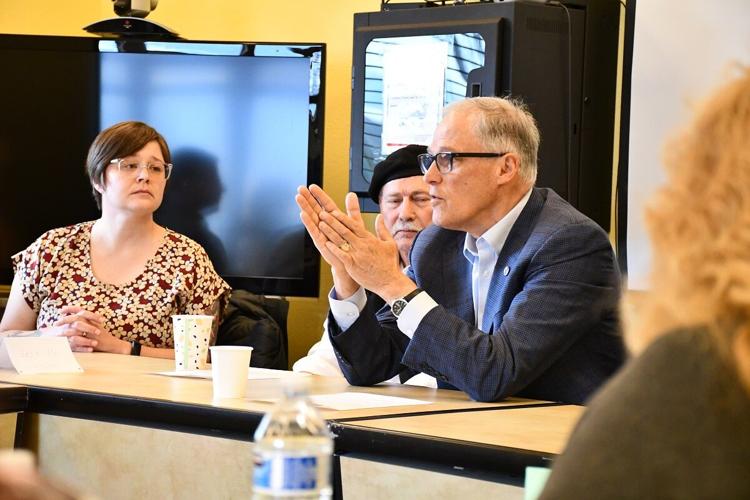
Washington Gorge Action Programs Executive Director Leslie Naramore, left, and Skamania County Housing Program director Curt Gray, middle, listen to Wash. Gov. Jay Inslee address concerns over housing and access to services during a roundtable discussion on community services in Stevenson last Tuesday.
Washington Gorge Action Programs Executive Director Leslie Naramore, left, and Skamania County Housing Program director Curt Gray, middle, listen to Wash. Gov. Jay Inslee address concerns over housing and access to services during a roundtable discussion on community services in Stevenson last Tuesday.
STEVENSON — Washington Gov. Jay Inslee visited Stevenson last week to speak with local representatives about the community services provided by agencies and nonprofit organizations in the area.
As part of the tour of Skamania County, Inslee participated in roundtable sessions with community leaders and experts on the topics of housing and human services.
He visited the Port of Skamania County first before heading over to the Washington Gorge Action Programs (WAGAP) office in Stevenson, where he met with service providers and toured the food bank office. There they discussed the rising needs in the community such as food and housing insecurity in an inflationary economic environment.
Local service providers, including Patti Nichols, the program coordinator for WAGAP’s food bank, spoke with Inslee on the specific needs of the community. Nichols said that 100 additional families in Skamania County have received food from the service provider since SNAP benefits decreased at the start of the year. The decrease in SNAP benefits is due to end of temporary boosts to benefits that supported families during the COVID-19 pandemic.
Nichols said the food bank has also seen significant donations recently, which has helped to keep the service in operation.
“We never send anyone away without food,” Nichols told Inslee.
At a roundtable with service providers, including representatives from WAGAP, People For People, Mid-Columbia Children’s Council, Department of Social and Health Services, as well as local businesses Play Frontier and WR Business Operations, service providers joined Inslee to discuss how the state can help with what they do on a daily basis and to speak on their successes within the community.
“Your efforts are very important,” Inslee told the several community representatives in the room. “I do think some good things are happening in this [legislative] session that I want to talk about, but mostly, I came to ask you: How can we be more efficient and effective? I’m looking forward to your suggestions, and maybe even criticism. Those are welcome as well.”
As representatives went around the room introducing themselves and their work, Inslee spoke on concerns, asked clarifying questions, and ultimately responded to the comments he was hearing.
When Tamara Cissell, the director of Skamania County Community Health, spoke to challenges her department faces, primarily being the recruitment and retention of behavioral health specialists, Inslee told her that he sees issues in the process of licensing individuals to perform the job, and that as the state reviews its licensure process, he said he hopes to see changes come through the legislature next year.
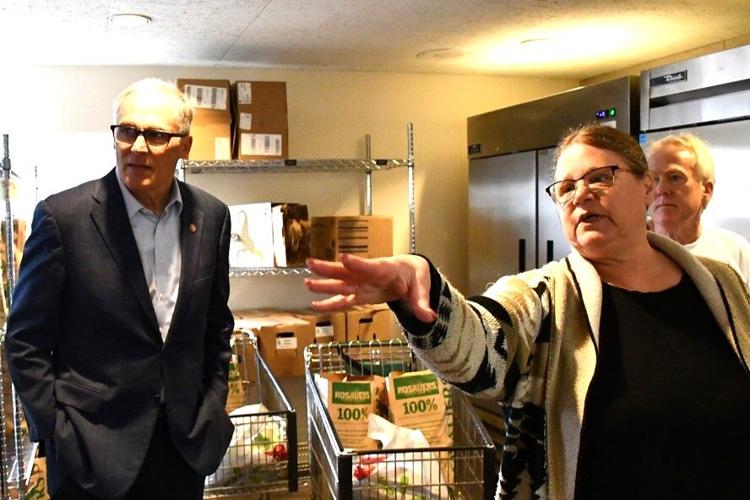
WAGAP’s food bank coordinator for Stevenson, Patti Nichols, shows Inslee around the food bank, located at 683 SW Rock Creek Drive.
Jacob Bertram photo
Community representatives cited housing, transportation, and childcare as the greatest barriers to accessing services.
Marcy Jordan, director of DSHS in Stevenson, said the local office has been closed in White Salmon for more than three years. She said it’s a challenge for people to receive services if they have to drive to either Stevenson or Goldendale when there is no in-person location in between that can handle those requests. Ultimately she said her greatest challenge is finding housing and transitional housing for people.
“It’s really hard to watch somebody who can’t get into housing and can’t get what they need,” Jordan said, adding that many people struggle going through Apple Health, a medicaid program provided through Molina Healthcare. “Agencies only taking one type of insurance when we have three or four different types of medications, but only one is taken, that makes it difficult for individuals out here.”
Inslee responded to community concerns about housing during the discussion, calling it a “crisis across the state of Washington.
“I believe we have to go big this year in the legislature so that people can go home,” he said.
Inslee is seeking a $4 billion voter-approved bond over six years to address the state’s housing situation. These funds would help homeless individuals and would subsidize housing costs for renters across the state, he said.
“That’s a significant number of dollars, but it’s necessary. That’s the scale of the problem. We’ve got about 25,000 people unhoused in the state, and by any stretch of the imagination, you need something at that scale to really, in a meaningful way, move the needle,” Inslee said.
Inslee said a public bond is a “fiscally responsible” way to receive those funds, and that he is open to other ideas of how to finance a project such as the one that is being requested.
He also addressed two bills currently going through the legislature that would free up more places to develop multi-family housing.
He called the housing funding solution “the only way we’re going to get dollars efficiently to move the needle for housing in Skamania County. So cross your fingers, talk to your legislators.”
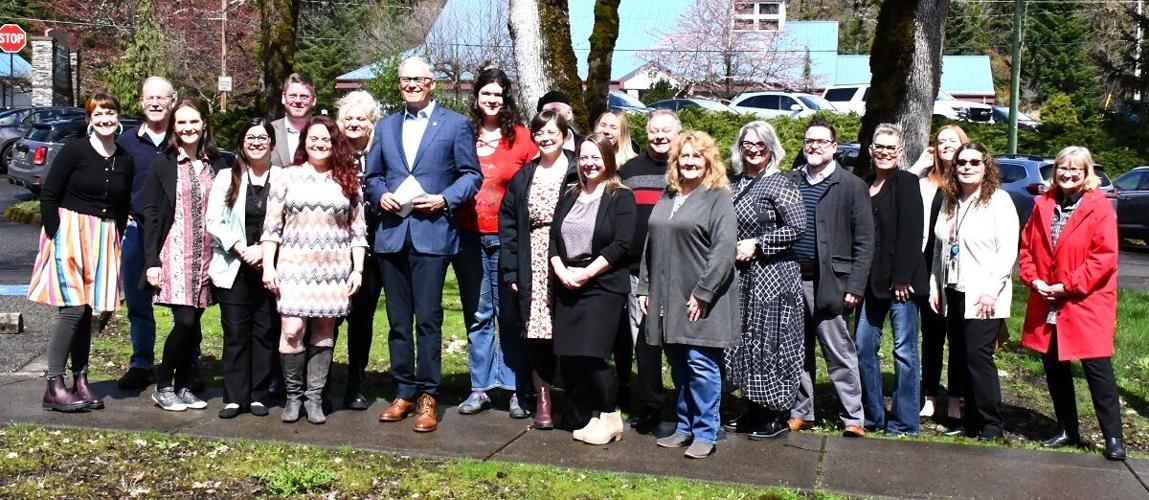
Representatives of community service agencies and organizations in Skamania County pose for a photo with Gov. Jay Inslee.
Jacob Bertram photo
Joel Madsen, director of Columbia Cascade Housing Corporation and the Mid-Columbia Housing Authority, said that the proposed state budget shows “some of the highest investments we’ve seen in the housing trust fund. And those are critical resources for us throughout the region to be able to build more affordable homes.”
Inslee responded that each year the government puts more money into housing, “but it just hasn’t been at scale … You all are doing good things, we just have to do it at scale. So that’s why I’m urging legislators to step up to the plate, do what we know works, but do it at the size that fits.”
WAGAP Executive Director Leslie Naramore told Inslee that alongside housing being a big issue, the decrease in funds received from document recording fees — the money charged by the county auditor for processing documents which is remitting to the state treasurer and in turn used for affordable housing operations and maintenance — can have negative impacts to those services in the area long term.
Naramore added that the Columbia Gorge is “truly one region,” saying that because people cross state lines constantly for work and to live, funding mechanisms make it challenging to get work done as funding is specific to Washington state.
Highlighted during the session was the collaborative environment created by the community agencies. Representatives, such as Curt Gray, the housing coordinator for WAGAP in Skamania County, emphasized that agencies work together to link individuals to resources.
“We refer almost every person that we deal with, given the chance to connect with them,” he said.
He told Inslee that success story of one woman whose house burned down. She was elderly and could not work. Because of relationships built between the agency and property managers, they were able to find housing for the woman who had no active income. Her lease was signed and rolled over into a voucher, and now she is thriving in her community. They also referred her to a recovery program.
“These are the kinds of stories that show how our teamwork is all based on that first step, which is housing first. Get them into housing first then help them adjust,” Gray said.
Towards the end of the meeting, representatives voiced a need for interpreter services to translate into Spanish and American Sign Language.
In departing words, Inslee told the group that stories such as Gray’s are those about changing peoples’ lives.
“I hope you enjoy your success. You’re changing lives. I hope you’re proud of the work you’re doing,” he said. “We want to continue to help you and I believe we will this session. I think we’re going to have some good things that will help you coming out of this session.”



Commented
Sorry, there are no recent results for popular commented articles.