
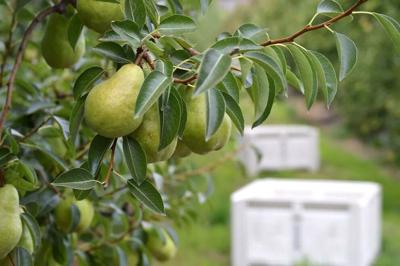
Spring displays a special showcase each year in the Hood River Valley. People have been visiting for generations to witness bright blooms opening across pear, cherry and apple orchards. The celebration comes full circle as many return in the fall for freshly-harvested fruit.
Folks are drawn to Hood River for a variety of reasons: Water recreation, hiking, biking, shopping, eating and drinking have transformed the city into a resort community. The closer you are to town, the more it is obvious that tourism is a major economic drive.
With tree fruit blossoms emerging, many will be venturing out to different corners of the valley to take in the lush orchards. It is hard to miss agriculture’s important role. It is the reason for the season.
Tree fruit farming has been a part of Hood River Valley’s landscape for nearly 150 years. The area’s volcanic soils and climate are an ideal combination for high-quality fruit production. Hood River’s agriculture industry sustains hundreds of family farms and thousands of workers.
Hood River Valley is a farming community, and regular farming activities occur here. There are many points where agricultural activity and tourism intersect. The valley’s east side, for instance, is a prime fruit-growing location. Given excellent county roads and downtown proximity, it’s also a great place to ride a bike. With a bit of understanding, they can share the road.
Did you know that there are more than 12,500 acres of pears in the Hood River Valley, by far the county’s leading commodity? More than 175,000 tons are produced annually, from Anjou and Bartlett to Comice and Forelle. Another 5,000 tons of cherries grow here, while apples — the original crop planted back in the 1880s — add 10,500 tons each year.
All that produce is grown by more than 400 family businesses. Most farm orchards are smaller than 50 acres. Most growers have been working these acres for generations. Farming is a tradition as much as it is an occupation.
Even longtime residents may not recognize the amount of activity needed to keep an orchard vital. Tree fruit crops are labor-intensive, requiring year-round employees for pruning, thinning, irrigating, spraying and picking. Farm owners and their managers complete extensive training to meet state and federal rules designed to protect agricultural workers and pesticide handlers. Workers undergo food safety, farm safety and first aid training.
A strong sense of stewardship is another feature shared by local fruit producers. This can be measured in the success of Pesticide Stewardship Projects (PSP) in Hood River and Wasco counties.
Established nearly a quarter century ago, the PSP approach relies on local expertise combined with water quality sampling to encourage voluntary changes in pesticide use and practices. Working with local stakeholders since the early 2000s, the Oregon Department of Environmental Quality (DEQ) launched two pilot projects in the Hood River and Mill Creek (Wasco County) watersheds. The PSP has encouraged pesticide users to implement best management practices that reduce the risk of drift, runoff and pesticides in area waterways. In the intervening years, substantial improvements have been achieved in water quality associated with changes in pesticide management practices. Today most surface water quality issues arise from the use of residential products like Roundup, not from agricultural practices. Growers in this region have adopted an integrated pest management (IPM) approach to protecting their fruit. By employing many non-chemical pest control tactics such as pheromone mating disruption and protecting beneficial insects as the foundation of their pest management strategy, growers have been able to substantially reduce the use of pesticides.
The public, however, remains concerned about pesticide application. They should know that before anyone drives a tractor or climbs a ladder, orchard workers have been trained with their own and the public’s safety in mind. Pesticide handlers in particular must be certified before safely applying chemicals. For tree fruits like pears, operators are skilled at limiting spray to targeted areas.
That’s good to know if you happen to be pedaling on a country road and spy farm activity ahead.
Growers recognize it’s rare to find windless conditions to safely apply pesticides to their crops. It’s normal to see spray operations before sunrise when winds are at their calmest.
Of course, still air is ideal for cyclists, too. If a farm worker is close to a public road and sees anyone approach — bike rider, walker or motorist — spraying is suspended until the traveler passes. Many farms take an extra step to place warning signs on the road. Others attempt to take care of trees close to roads during normal low-traffic times to reduce these interactions.
The traveler can be proactive, too. When approaching farming activity, be sure to be seen by workers before passing through.
Logic applies to farm equipment on roads. Tractors are common, and trucks are used to haul fruit. Growers train their workers to be aware of traffic in all directions, use turn signals and pull over where possible to let faster traffic by. Travelers should use caution when approaching slow farm equipment, keeping a safe distance to be seen by the farmer. Always look for the tractor operator’s indication of a turn.
Hood River Valley is a great place to visit any time of the year. Recognizing agriculture’s role helps appreciate the beauty a little more.
•••
Christopher Adams is tree-fruit entomologist at Mid-Columbia Agricultural Research and Extension Center in Hood River.
Mike Doke is Executive Director of Columbia Gorge Fruit Growers, which represents 440 growers and 20 packing houses in the Mid-Columbia.


Commented