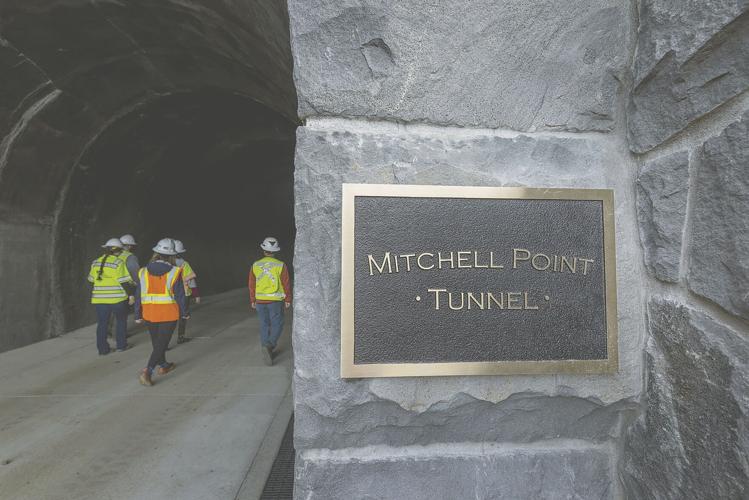
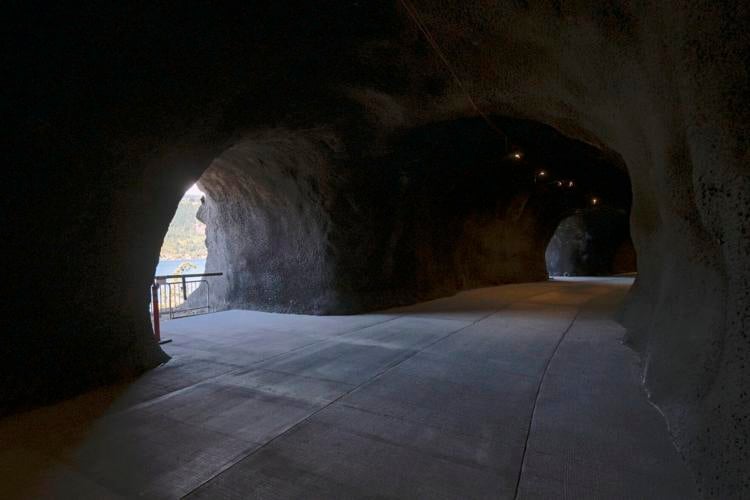
THE GORGE — The Mitchell Point Tunnel project is connecting communities and bringing history back to the Columbia River Gorge. When finished, it will feature arched windows, expansive views of the Gorge, hand-placed stone masonry, a new plaza and expanded amenities at the trailhead. One of the final sections of the Historic Columbia River Highway, Terra Lingley said, it has been one of the most difficult.
“I think the biggest issue is that this is a very challenging project in a very challenging place to construct,” said Lingley, Columbia River Gorge National Scenic Area coordinator for Oregon Department of Transportation (ODOT).
The Historic Columbia River Advisory Committee is comprised by Gorge residents including The Dalles Chamber of Commerce CEO Lisa Farquharson and Hood River County Commissioners Arthur Babitz and Leti Valle Moretti.
Planning officially began in 2018, when the advisory committee recommended a 570-foot tunnel be built for the Mitchell Point Crossing. One month later, the Oregon Parks and Recreation District endorsed the blueprints and design continued for nearly two years through 2020. In the spring of 2021, construction began which closed exit 58 on Interstate 84. Since then construction has had minor impact on traffic despite the close proximity to the interstate.
In 1966, the original Mitchell Point tunnel was deconstructed to make room for I-84. Today, engineers, geologists, designers and construction crews have had to carefully plan out their order of operations to avoid falling rocks or other disastrous impacts. Crews retrieved samples from the hillside to get a better understanding of what types of rock they would be dealing with. Lingely said that multiple volcanic eruptions aided in the formation of Mitchell Point.
Outlook inside the Mitchell Point tunnel.
ODOT Contributed photo
“So [we were] trying to figure out where those seams are and trying to figure out what’s happening internally,” Lingely said.
She added that there were some unforeseen points of concern with the rock wall, including the western bench approaching the tunnel. According to ODOT, a bench is a narrow strip of relatively level or gently inclined land that is bounded by distinctly steeper slopes above and below.
“There’s an existing bench that the historic highway was originally on but it’s been kind of eroded away and the cliff is fairly unstable, we see rock fall there pretty often,” Lingley said.
Plans include building a concrete wall to reduce rock fall and adding a moment slab to further protect trail users. Lingely described a moment slab as a “half-bridge” which will span the gap where rocks have been worn away.
“Rockfall was always a concern. We did a lot of modeling in the design phase and we have a lot of rock protection for all users; both the pedestrians and bicyclists as well as the traffic down below,” she said.
Lingley and Don Hamilton, public information officer for the Portland Metro Region, said they don’t have a concrete date for a grand opening, but anticipate a late spring or early summer launch. An April 15 Federal Highway Administration (FHWA) newsletter lists June 4 as an approximate completion date.
Upon fulfillment of the Mitchell Point Crossing, restoration of the Columbia Gorge Historic Highway will be one step nearer. In September, ODOT opened two miles of road east of the newly renovated Viento State Park. Lingley is happy to report that another project on the east side of Mitchell Point had been awarded funds for construction.
“We have construction funding for we call Perham-Mitchell,” she said. Perham-Mitchell is a 0.7 mile segment that is still in need of pedestrian bridges across Perham and Mitchell creeks.
The new Mitchell Point trailhead will provide 19 parking spaces, ADA accessible space, a couple picnic tables and a turnaround for buses or other large vehicles. In anticipation of large crowds at the grand opening event, Lingley said they will not allow private vehicles in the parking lot, so ODOT has partnered with Columbia Area Transit to offer a free shuttle service.



Commented